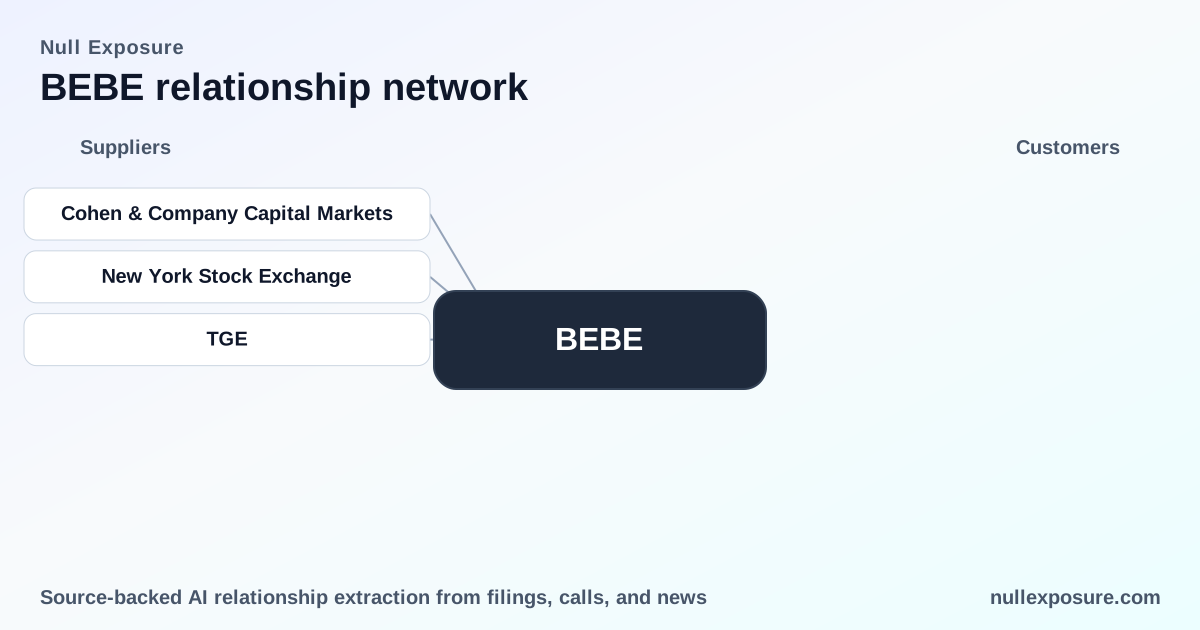
Bebe (BEBE) — Where the balance sheet meets the boutique floor
Bebe operates a specialty women’s apparel and accessories business through a dual-channel retail model that combines physical stores with a direct-to-consumer e-commerce platform; the company monetizes primarily through merchandise sales, promotions and periodic inventory dispositions. For investors, BEBE is a small-cap retail story with an iconic brand, material operating losses, and an active reliance on external capital and secured financing to bridge working capital needs. Explore our platform for deeper counterparty detail: https://nullexposure.com/
A short investment thesis for owners and operators
Bebe’s value proposition rests on brand recognition and channel reach; its ability to produce free cash flow depends on restoring gross margins and replacing episodic financing with routine operating liquidity. Near-term upside for shareholders is conditional on capital stability, inventory efficiency and margin recovery, while downside is governed by current negative profitability metrics and apparent reliance on secured loans and equity placements.
How a recent financing reshaped the capital stack
A March 2026 report in SourcingJournal documented a specific funding event that materially altered Bebe’s capital structure: the company funded a transaction using cash on hand, a $22 million secured loan from Milfam, and the sale of 1.5 million common shares to B. Riley at $5.00 per share. This transaction reduced immediate liquidity pressure but increased secured indebtedness and produced equity dilution at the $5 price point (SourcingJournal, March 10, 2026; https://sourcingjournal.com/topics/financial/bebe-stores-18-5-million-manny-mashouf-b-riley-stake-womens-fashion-457406/).
Financial constraints that define operating choices
The company’s reported metrics highlight a constrained operating profile that drives strategic and tactical decisions:
- Negative profitability and book value: Recent figures show negative EBITDA (-$7.9M), negative gross profit (-$35.0M), and a book value of -$0.279, reflecting sustained operating losses that limit internal capital generation and force reliance on external financing.
- Revenue and scale signals: The reported RevenueTTM is listed as -$101.9M, a number that signals accounting or operational irregularities that investors must reconcile in filings; market capitalization sits near $198.5M, with shares outstanding of 15M and a float of ~8.9M.
- Capital-market reception: Price-to-sales and EV multiples are modest (P/S ~1.82; EV/Revenue ~0.626; EV/EBITDA ~2.90), indicating the market prices a low-growth, capital-constrained retail recovery story rather than a growth premium.
- Shareholder composition and liquidity: Institutional ownership (~15.7%) is moderate; shares outstanding and recent equity placements create dilution risk if management repeats share sales to support operations.
These constraints translate into a contracting posture that is financing-driven, where short-term secured loans, equity placements and cash-on-hand decisions determine inventory budgets, store investments and marketing spend. The business is operationally immature relative to stable retail peers, with financial maturity delayed by repeated capital raises.
Operational model characteristics investors should internalize
Bebe’s operating model is typical of specialty retailers but operates under stressed conditions:
- Contracting posture: Predominantly transactional relationships with vendors and landlords, with shorter procurement cycles and inventory-sensitive contracts that create cash-flow lags.
- Concentration and criticality: Product and channel concentration create exposure to fashion cycles and seasonal inventory risk; brand is the critical asset and operational leverage is limited until margins normalize.
- Maturity: The company is in a restructuring/re-capitalization phase, not in steady-state expansion; capital allocation decisions prioritize liquidity preservation and brand maintenance over aggressive store rollouts.
These company-level signals explain why management paused on long-horizon investments and relied on secured lending and equity issuance to stabilize operations.
Complete list of customer/related-party interactions uncovered
This section covers every relationship returned by the vendor search.
- B. Riley (reported symbol RILYK): Bebe sold 1.5 million common shares at $5.00 per share to B. Riley as part of financing for a transaction, providing equity capital while diluting existing holders; the company also used $22 million in secured financing from Milfam and cash on hand to complete the deal (SourcingJournal, March 10, 2026; https://sourcingjournal.com/topics/financial/bebe-stores-18-5-million-manny-mashouf-b-riley-stake-womens-fashion-457406/).
What this relationship implies for credit and equity investors
The B. Riley share placement and the Milfam secured loan are equity-and-debt interventions rather than operating partnerships. Investors should treat these events as telling of management’s immediate priorities: preserve liquidity via secured borrowing and dilutive equity, rather than deleveraging or restructuring through operational improvements alone. The presence of secured debt increases counterparty risk to inventory and other pledged assets, while the equity placement resets the capital base at a sub-$6 per-share reference point (analyst target price is $6.00 in available metadata).
Risks and the signal events to monitor
Key investment risks and the near-term triggers that will resolve them:
- Refinancing and dilution risk: Continued reliance on secured loans or follow-on equity sales will depress shareholder returns and increase creditor priority.
- Margin recovery: Gross-profit restoration is essential; monitor successive quarters for margin improvement and inventory turns.
- Brand traction and channel mix: Recovery in comparable-store sales and e-commerce conversion rates will be the clearest operational signals of recovery.
- Liquidity and covenant pressure: Watch covenant terms on the Milfam loan and timing of maturities; any covenant breach would accelerate downside outcomes.
Investors should track quarterly filings for covenant disclosures, subsequent financing activity and the company’s working-capital cadence.
Final read: position sizing and monitoring checklist
For strategic investors and operators evaluating BEBE customer and counterparty exposure, treat current ownership as a high-conviction, high-volatility small-cap retail play. Position sizing should reflect the company’s negative earnings profile, secured financing, and dilution history. Use the following monitoring framework:
- Verify next covenant dates and maturity schedule in SEC filings.
- Watch gross-margin and inventory-turn trends each quarter.
- Track any further equity placements or secured financings.
For a deeper view of counterparties and financing relationships that shape recoveries in stressed retail brands, visit our site for an expanded counterparty map and historical funding chronology: https://nullexposure.com/
Bold decisions are required when balance sheets and brands intersect; Bebe’s path to stability runs through margin recovery and the replacement of episodic financing with sustainable cash flow.