Mobile Infrastructure (BEEP): Customer Relationships That Drive Near‑Term Revenue and Risk
Mobile Infrastructure Corporation operates, owns and optimizes off‑street parking assets across the United States and monetizes through a blend of parking fees, leased space and managed‑property revenue, supplemented by selective software licensing. The company reports roughly $35.1M in trailing twelve‑month revenue and $11.2M of EBITDA, but its revenue base is highly concentrated: a small number of operator/tenant partners account for the majority of property‑level income, making partner stability the primary lever for investors evaluating cash‑flow durability. For more background on how we track these relationships, visit https://nullexposure.com/.
Two partners dominate the customer ledger — here’s the breakdown
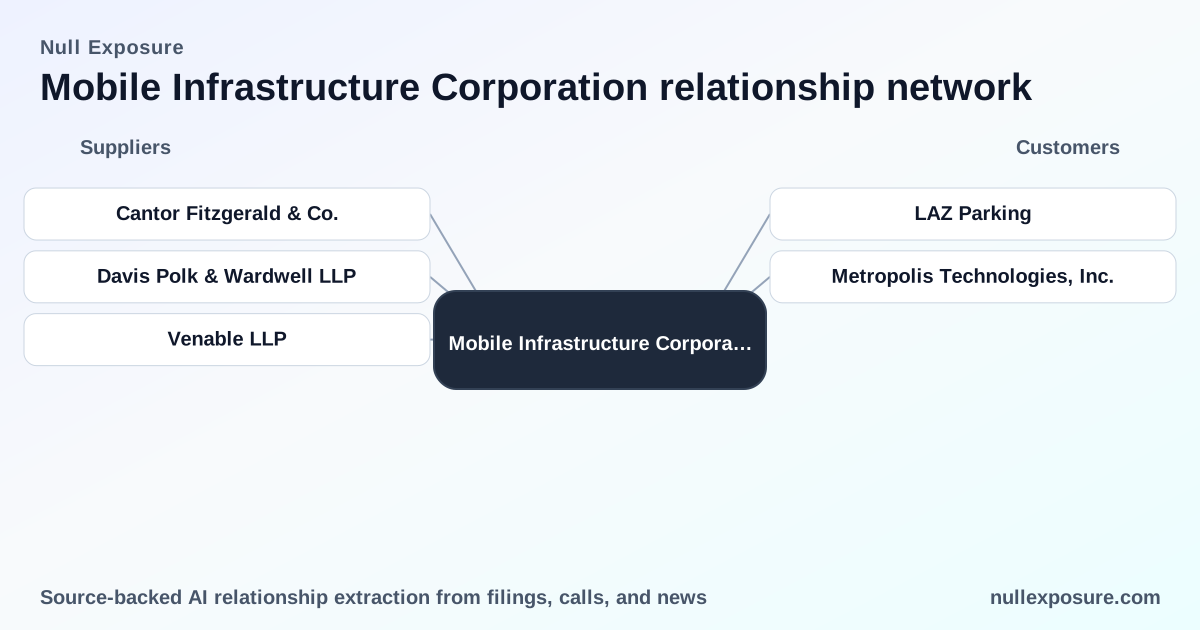
BEEP’s publicly filed disclosures show a classic landlord/operator model where third‑party operators or tenants either lease space or act as agent operators; these arrangements produce materially concentrated cash flow. Metropolis Technologies, Inc. and LAZ Parking are the only customer relationships called out in the company’s 2024 Form 10‑K, and together they explain a large portion of property revenue.
Metropolis Technologies, Inc.
Metropolis accounted for 55.7% of revenue from locations where it acts as a lease tenant or operator agent in FY2024 (61.3% in FY2023), signaling that a single operator relationship drives the majority of parking segment receipts. According to the company’s 2024 Form 10‑K, this concentration makes Metropolis a critical counterparty for near‑term cash flow.
LAZ Parking
LAZ Parking represented 15.3% of revenue from locations where it acts as a lease tenant or operator agent in FY2024, up from 3.2% in FY2023 — a notable shift that increased its contribution materially in the latest year. The change is disclosed in the same 2024 Form 10‑K and highlights how operator mix can quickly reweight revenue sources.
What the company filings signal about contracts, counterparties and geography
BEEP’s public filing language gives investors a clear read into how customers transact and the company’s operating posture:
- The business captures revenue across subscription‑style monthly contract parkers and spot/ transient parkers, with subscription receipts recognized over the month and transient fees recognized on the day of access. This means the revenue stream blends recurring monthly cash with high‑frequency, demand‑sensitive spot income.
- A software license and development agreement exists (dated August 25, 2021) with an affiliate of Bombe Asset Management — an affiliate of the CEO — granting that affiliate a limited, non‑exclusive license for a fee of $5,000 per month, illustrating a modest ancillary licensing revenue and a related‑party commercial relationship disclosed in the 10‑K.
- The company identifies individual transient parkers as primary counterparty types for spot revenue, and it also disclosed a not‑for‑profit lease (ProKids), where ProKids pays only for parking and common area utilities under a long‑term lease arrangement; the ProKids relationship includes a family‑board connection disclosed in the filing.
- All operations and revenue are domestically located in the United States, with 40 facilities in 20 markets and roughly 15,100 parking spaces as of December 31, 2024, emphasizing geographic concentration to North American (U.S.) demand dynamics.
- BEEP positions itself as a seller of access and parking services and reports the parking segment under a services orientation — the core obligation is to provide vehicle access, with fees varying by usage.
These elements together describe a company with mixed contract tenors (monthly subscriptions and day‑rate spot), moderate related‑party licensing activity, and domestic operational concentration—a profile that makes partner stability and local traffic patterns important drivers of revenue volatility.
Why this customer mix matters for valuation and risk
BEEP’s financial and relationship metrics translate into concrete valuation considerations for investors:
- Concentration risk is elevated. With Metropolis generating the majority of operator revenue, any operational change, contract renegotiation or footprint reduction by that partner would have an outsized impact on revenue and EBITDA.
- Revenue quality is mixed. Subscription (monthly) revenue provides predictability, but the material exposure to transient parkers ties near‑term results to traffic patterns and local demand cycles.
- Related‑party and non‑economic leases are notable governance and cash‑flow signals. The Bombe affiliate license (small monthly fee) and the ProKids rent‑free arrangement (parking‑only charges) are disclosure items investors must monitor for governance, conflict‑of‑interest and cash‑collection implications.
- On valuation, the company shows Price/Book ~0.54 and EV/Revenue ~7.9 with EV/EBITDA ~46.8, indicating the market is pricing expected future growth or operational improvement into a relatively thin current earnings base; investors should weigh that premium against concentration and demand risk.
- Analyst coverage is limited but constructive: the consensus target price is $6.17 with two Strong Buy and one Buy rating noted in the filings, implying upside expectations relative to the company’s current market cap and a small but interested analyst base.
Practical implications for operators and investors
For portfolio managers and operating partners evaluating BEEP, the actionable implications are straightforward:
- Monitor Metropolis closely. Given its revenue share, any signaling from Metropolis about portfolio rationalization, pricing renegotiation or credit stress is a direct risk to BEEP’s cash flow.
- Stress‑test spot revenue. Build scenarios where transient parker volumes decline and measure the impact on liquidity and covenant metrics, because large swings in day‑rate traffic will propagate quickly to top‑line and working capital.
- Watch governance and related‑party transactions. The Bombe affiliate license and the ProKids arrangement are small today but represent governance touchpoints that influence investor perception and potential future disclosure obligations.
- Geographic concentration limits diversification benefits. With all assets in the U.S., macro factors that depress urban mobility or downtown office occupancy will affect most of BEEP’s portfolio simultaneously.
For a consolidated view of BEEP’s counterparty risks and to track future disclosure updates, visit https://nullexposure.com/.
Concluding read for investors
BEEP is a small‑cap, U.S.‑focused parking owner/operator with clear recurring and spot revenue streams but meaningful counterparty concentration. Metropolis’s dominant share of operator revenue is the single largest operational risk, while contract mix (monthly vs. transient) dictates cash flow volatility. Investors should treat BEEP as a company where partner contract durability and local demand trends will determine whether the currently priced valuation reflects sustainable cash flow or a short‑term premium awaiting derisking through diversification or contract repricing.