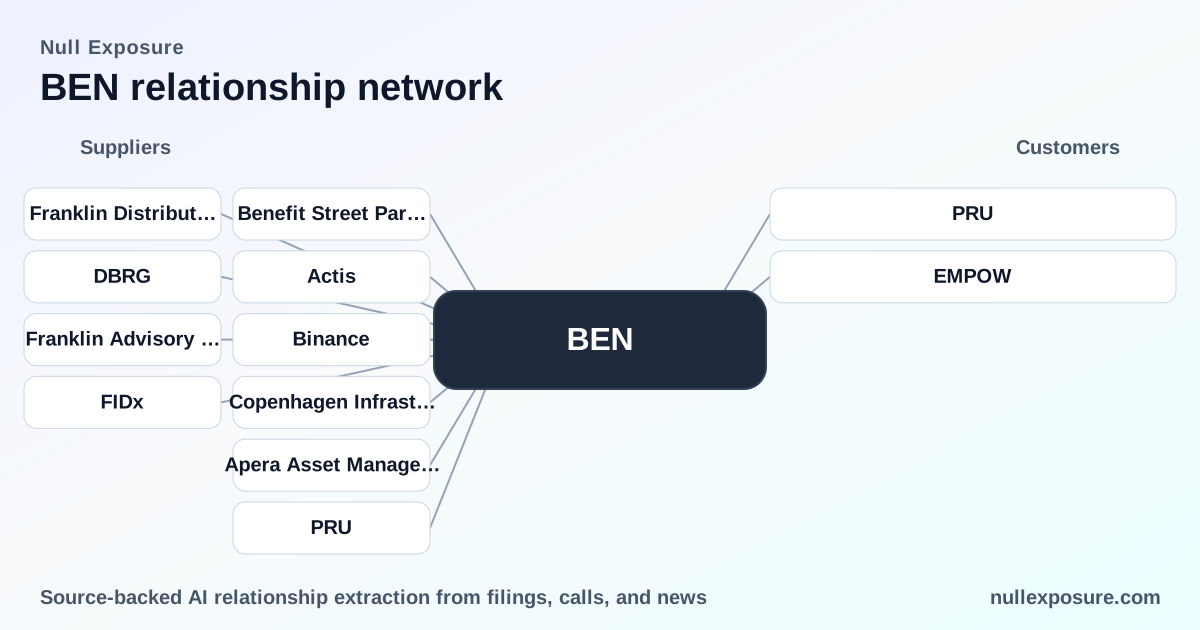
Franklin Templeton (BEN): Customer Relationships, Revenue Mechanisms, and Operational Constraints
Franklin Resources (Franklin Templeton) is a global investment manager that earns management fees and related services revenue by running mutual funds, ETFs, and separately managed accounts for retail, institutional, and high‑net‑worth clients worldwide. Its commercial model is fee‑based, concentrated in investment management and distribution partnerships, and relies on recurring but contractually renewable relationships with fund boards, platforms, insurers, and distribution partners.
Explore the full relationship map and source references at https://nullexposure.com/ for a searchable, investor‑grade view of counterparties and evidence.
Why relationships matter for BEN investors
Franklin’s economics flow from assets under management and the distribution of those assets across product types and channels. Customer relationships determine scale, product velocity (new ETF launches, tokenized ETFs), and distribution reach via platforms and retirement providers. For investors, the critical questions are: how durable are the contracts that underpin fee streams, how concentrated are distribution partners, and which partnerships expand or commoditize Franklin’s product shelf.
Snapshot: the relationships you need on your watchlist
Below I catalogue every counterparty referenced in our records, summarizing the nature of the connection, its commercial significance, and the original reporting.
Franklin Small Cap Enhanced ETF (FSML)
Franklin launched the New York‑listed Franklin Small Cap Enhanced ETF (FSML) as part of an active ETF growth push, positioning it to capture retail and institutional small‑cap flows. (FamilyWealthReport, FY2025; TradingView listings, FY2025 — https://www.familywealthreport.com/ and https://www.tradingview.com/)
eToro (ETOR)
eToro expanded its Smart Portfolios to include Franklin Templeton products and partnered with Franklin on target‑date and other managed portfolios, broadening Franklin’s retail digital distribution. (GlobeNewswire eToro results, Feb 17, 2026; eToro Q2 2025 release — https://www.globenewswire.com/)
EZBC (Digital Holdings Trust / Bitcoin ETF)
Franklin issues digital‑asset ETFs and trusts (including EZBC) that provide crypto exposure under regulated fund wrappers, reflecting a strategic push into digital asset ETFs and tokenized product distribution. (CoinDesk coverage Nov 24, 2025; TradingView listings, FY2024–FY2026 — https://www.coindesk.com/ and https://www.tradingview.com/)
Prudential Financial (PRU)
Prudential launched an ActiveIncome insurance overlay on Franklin Templeton’s Canvas platform, integrating Prudential insurance solutions into Franklin’s managed‑account technology for wealth managers. This is an important distribution and product‑stack integration with a major insurer. (MarketScreener / PR release, March 2026; related coverage on Finviz, FY2026 — https://www.marketscreener.com/)
Franklin Municipal ETF Suite (including FTPA)
Franklin introduced a group of state municipal income ETFs (for Massachusetts, Minnesota, New Jersey, Ohio, Pennsylvania) with portfolio management led by Franklin Advisers and sub‑advisory support from Putnam and Franklin Templeton Investment Management Limited. These funds expand tax‑efficient fixed‑income offerings for retail investors. (Sahm Capital coverage, Nov 13, 2025 — https://www.sahmcapital.com/)
Primerica (PRI)
Primerica partners with major asset managers such as Franklin Templeton to distribute mutual funds across its sales force, underscoring a distribution channel that accounted for a high share of U.S. mutual fund sales in 2025. This is a classic wholesale distribution relationship. (TradingView news summarizing Primerica’s SEC filing, FY2026 — https://www.tradingview.com/)
Templeton Emerging Markets Debt ETF (TEMD)
Franklin launched the Templeton Emerging Markets Debt ETF (TEMD) to capture demand for EM debt exposure across USD and local‑currency strategies, widening Franklin’s fixed‑income ETF footprint. (The Daily Upside, May 2026; ad‑hoc news summary, FY2026 — https://thedailyupside.com/ and ad‑hoc-news.de)
Western Asset Diversified Income Fund (WDI)
Franklin Templeton Fund Adviser, LLC serves as the investment manager for the Western Asset Diversified Income Fund, reflecting Franklin’s role as manager for third‑party or affiliated mutual fund vehicles. (MarketScreener / press release; FinancialContent reporting, FY2024–FY2026 — https://www.marketscreener.com/)
DBRG (DigitalBridge) partnership reference
An earnings call transcript notes a partnership announced with Franklin Templeton in Q3, indicating Franklin’s participation in distribution or joint product initiatives with other asset managers or platforms. (DBRG earnings call transcript, 2025 Q3 — dbrg‑2025q3‑earnings‑call)
Ondo (tokenized fund listings)
Franklin has launched tokenized ETFs on Ondo, reflecting a strategic move to list tokenized fund wrappers on crypto‑native exchanges to reach new liquidity pools. (Earnings call coverage and InsiderMonkey transcript, FY2026 — https://www.insidermonkey.com/)
Kraken (tokenized ETF listings)
Franklin listed tokenized ETFs on Kraken as part of its digital asset distribution strategy, using crypto exchanges to expand access to regulated fund products. (Earnings call coverage and InsiderMonkey transcript, FY2026; MEXC reporting on asset additions — https://www.insidermonkey.com/ and https://www.mexc.com/)
Empower / EMPOW (retirement platform)
Franklin announced a partnership with Empower — one of the largest U.S. retirement service providers — to support retirement solutions, which anchors a stable institutional distribution channel for long‑term AUM. (BEN earnings call, FY2025 Q4; company transcript reporting, 2025Q4 — ben‑2025q4‑earnings‑call)
EMO‑R‑W (ClearBridge / affiliated fund context)
A ClearBridge Investments note references that ClearBridge, an indirect Franklin subsidiary, is responsible for active management of specific funds, highlighting Franklin’s multi‑brand and subsidiary distribution architecture. (FinancialContent / BizWire, Oct 2025 — https://markets.financialcontent.com/)
Explore evidence and the broader relationship network at https://nullexposure.com/ to review source links and timestamps.
Company‑level operating constraints investors must price in
Franklin’s relationship fabric is shaped by several structural constraints that affect revenue durability and contract bargaining power:
- Short‑term contracting posture for U.S. mutual funds. Investment management agreements for many U.S. mutual funds require annual renewal and board approval and are terminable without penalty on prior notice, making a material portion of fund fee revenue contractually renewable on a one‑year cadence (company filings).
- Broad counterparty mix (government, individual, non‑profit). Franklin serves sovereign, institutional, non‑profit and individual investors globally, which diversifies demand but creates exposure to policy and fiduciary shifts across client types (company disclosures).
- Global footprint and operating geography. Revenues and assets are sourced worldwide; this gives scale but increases sensitivity to regional flows, FX, and regulatory regimes.
- Service‑provider posture and single operating segment orientation. The firm operates as an investment manager and related services company; revenue depends on asset scale and product competitiveness rather than manufacturing or long‑term supply contracts.
These signals together imply revenue that is recurring but contractually reviewable, distribution risk concentrated in major platform partners, and product risk driven by asset flows and innovation adoption (tokenized ETFs, digital asset offerings).
Investment implications and final takeaways
- Positive: Franklin’s active expansion into ETFs, tokenized funds, and platform integrations (eToro, Kraken, Ondo, Canvas) supports fee diversification and potential AUM capture across new investor segments. Partnerships with large retirement and insurance players (Empower, Prudential) anchor stable, institutional flows.
- Negative: The annual renewability of many fund management agreements and reliance on platform partners create concentration and duration risk for fee revenue; digital asset product expansion increases reputational and regulatory exposure.
- Tactical: Monitor renewal outcomes for large institutional mandates, AUM trends in Franklin’s new ETF launches (FSML, TEMD), and adoption metrics for tokenized listings on crypto exchanges.
For a structured, sourced view of every counterparty and the underlying evidence trail, visit our relationship explorer at https://nullexposure.com/.