Brookfield Renewable (BEP): The corporate-offtake relationships powering a utility-scale growth narrative
Brookfield Renewable monetizes by owning and operating large-scale renewable generation and selling long-term contracted output to corporate and institutional buyers. The company's moat is execution of utility-scale hydro and renewables and converting that capacity into predictable cash flows via multi-year framework agreements and PPAs with large technology customers. Recent framework deals with Microsoft and Google transform BEP from a diversified independent power producer into a preferred vendor for hyperscale AI data-center buildouts, materially increasing contracted forward volume and revenue visibility. For more customer-level intelligence on BEP visit https://nullexposure.com/.
Why the customer list matters for valuation
Investors value BEP not on merchant commodity cycles but on the quality, tenor and scale of contracts that convert generation into distributable cash. Multi-gigawatt framework agreements signed with global cloud providers change both the scale and counterparty profile of BEP's revenue book: long tenors, high credit quality counterparties, and direct links to secular AI-related demand. That combination reduces merchant volatility while increasing execution and construction risk exposure.
The relationships — what the public record shows
Below I cover every customer relationship surfaced in the recent public record for BEP. Each entry is a plain-English summary followed by the source context.
Microsoft (MSFT)
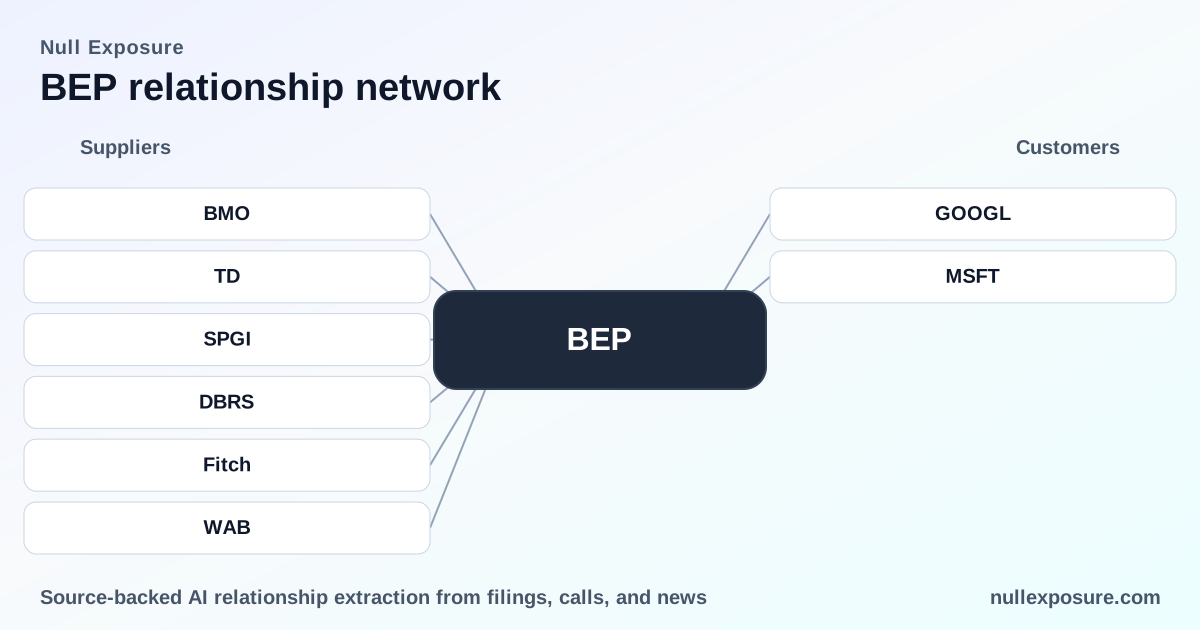
Brookfield Renewable has a large, multi-gigawatt framework agreement with Microsoft that includes a 10.5 GW commitment to supply new renewable capacity through 2030, and BEP has begun contracting specific projects under that framework, including a 20‑year PPA at a PJM hydro asset. According to BEP's Q3 and Q4 2025 earnings commentary and supporting news coverage in March 2026, the partnership is the largest corporate PPA in history and is being executed through staged project deliveries and long-term contracts. (Sources: BEP Q3/Q4 2025 earnings call transcripts; Finviz coverage and related March 2026 reporting.)
Google / Alphabet (GOOGL)
Brookfield signed a hydro framework agreement with Google for up to 3 GW of hydropower in the United States, and BEP has already contracted at least two facilities under that framework. The company disclosed the Google framework in mid‑2025 and reiterated contracting activity during subsequent earnings calls; multiple March–May 2026 news articles summarized the framework as up to 3,000 MW of U.S. hydro capacity. (Sources: BEP Q3 and Q4 2025 earnings calls; Finviz and TS2 Tech reporting, March–May 2026.)
What these relationships imply for BEP’s operating and business model
There are no discrete constraint excerpts provided in the public relationship payload; company-level signals derived from the contract language and public commentary are as follows.
- Contracting posture — institutional framework agreements. BEP is executing long-dated framework agreements rather than one-off short PPAs, which signals a posture of committed, staged delivery tied to development pipelines rather than merchant spot exposure. (Company commentary across Q3 and Q4 2025 earnings calls, March 2026.)
- Concentration — large counterparties dominate incremental bookings. Securing multi-gigawatt positions with Microsoft and Google increases BEP's customer concentration for incremental growth, although these counterparties bring top-tier credit quality. That concentration improves revenue predictability but increases single-counterparty execution risk.
- Criticality — essential to customers’ AI buildouts. Coverage and management commentary explicitly connect these deals to cloud and AI data-center expansions, making BEP a strategic supplier for hyperscale compute customers rather than a commodity generator. (Industry coverage March–May 2026.)
- Maturity and tenor — long-term, multi-decade contracts. BEP cited a 20‑year contract at a PJM hydro asset and framework timelines that extend to 2030 for Microsoft commitments, indicating multi-decade cash-flow visibility for sizeable portions of new capacity.
- Execution and development risk — front-loaded construction exposure. Converting framework GW into operational assets requires capex, permitting and construction execution; the contracts shift offtake risk to BEP while securing revenue once plants are online. Investors must price project development and interconnection risk into prospective returns.
- Revenue predictability vs. growth capital intensity. These contracts materially improve forward demand visibility, but they also imply capital deployment needs and potential balance-sheet sensitivity during the build phase.
Risks and valuation implications
- Execution risk is now the core incremental risk. The largest near-term valuation lever shifts from commodity cycles to BEP’s ability to deliver contracted GW on schedule and on budget.
- Counterparty concentration creates asymmetric exposure. Large, creditworthy customers reduce counterparty credit risk but amplify the impact of any delivery shortfalls or contractual disputes.
- Long tenors compress volatility but lengthen exposure to policy and interconnection changes. Multi-decade PPAs provide cash flow stability but lock BEP into project economics that can be affected by evolving grid rules, permitting timelines and transmission constraints.
Investor takeaways and next steps
- Strategic takeaway: BEP has successfully positioned itself as a preferred large-scale supplier for hyperscale cloud vendors, converting headline GW figures into contracted projects and long-duration PPAs that strengthen revenue visibility.
- Operational focus: Monitor the pace of project-level contracting, construction milestones, and capital deployment plans—these determine whether the promised GW translate to distributable cash sooner rather than later.
- Valuation focus: Re-rate optionality for growth when contract-to-asset conversion accelerates; stress-test the balance sheet for development funding needs during the build cycle.
For investors and operators who need a concise, customer-centric view of these relationships and their implications on cash flows, BEP’s public commentary and the March–May 2026 media coverage are the primary sources to monitor. If you want a packaged intelligence brief on BEP customer contracts and delivery schedules, visit https://nullexposure.com/ for more.