Brookfield Renewable (BEPC): Customer relationships that underpin long-duration cash flows
Brookfield Renewable builds and owns large-scale hydro, wind and solar generation and monetizes primarily through long-term offtake contracts and strategic asset sales; its commercial model is driven by multi-gigawatt framework agreements with major corporate offtakers and by packaging assets into investor platforms that recycle capital into new development. For investors evaluating BEPC’s customer relationships, the recent slate of framework deals and platform divestments signal a deliberate shift toward secured, long-dated revenue and capital recycling that supports distribution growth and balance-sheet flexibility. For a deeper view into the commercial partnerships discussed here, visit https://nullexposure.com/.
Why these relationships matter to investors
Brookfield Renewable’s value proposition is not just generation — it is contract duration and counterparty credit. Large technology and retail counterparties lock in offtake for decades, lowering merchant exposure, while platform sales free capital and reduce development risk. That combination supports recurring cash available for distributions but also concentrates commercial exposure into a handful of strategic partners, making counterparties and contract structure central to any investment thesis.
What the record of partner announcements shows
Brookfield’s disclosures across FY2025–FY2026 emphasize two categories of customer relationships: very large framework offtake agreements with global technology companies (multi-gigawatt, long-term hydro and renewable frameworks) and asset monetizations into investor-led platforms where third-party investors take operating portfolios off Brookfield’s consolidated balance sheet.
The core corporate counterparties: what they are and why they matter
Microsoft — long-duration capacity via a broad renewable framework
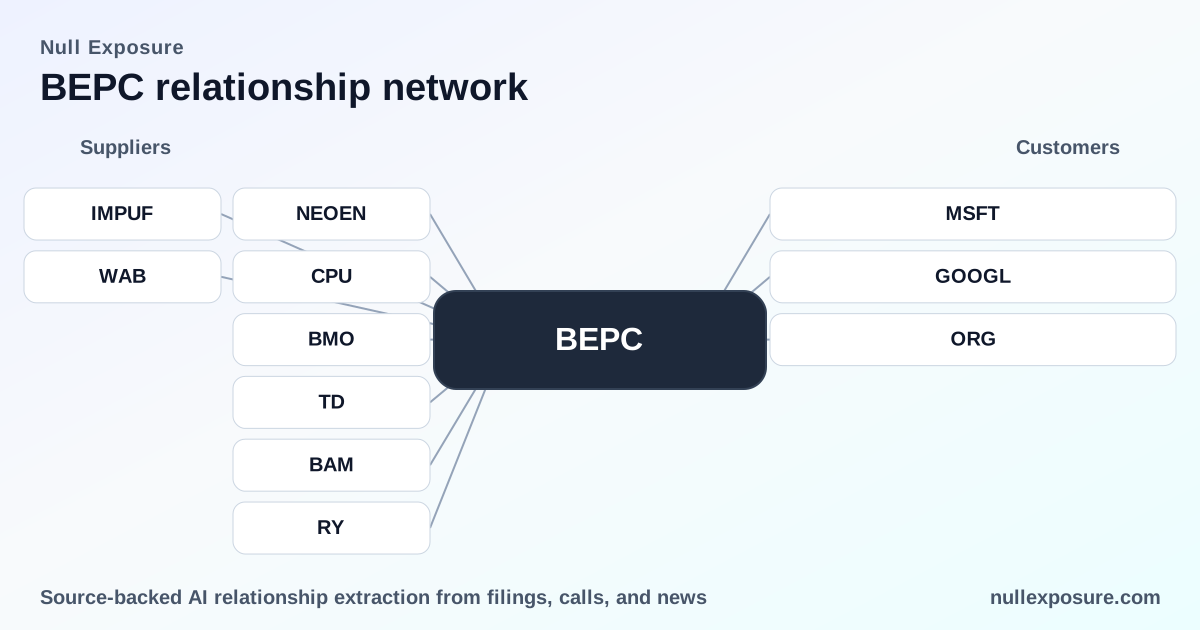
Brookfield referenced a Renewable Energy Framework Agreement signed in May 2024 to deliver over 10,500 MW of renewable capacity across the U.S. and Europe, and management also cited a new 20‑year contract at a PJM hydro asset executed under that framework. Microsoft provides scale and credit quality to Brookfield’s contracted book, and the framework structure converts development and operating assets into long-dated cashflow. (Source: Brookfield press remarks reported by GlobeNewswire / The Manila Times on FY2025 results; BEPC 2025 Q3 and Q4 earnings comments.)
Google — a first-of-its-kind hydro framework for 3,000 MW
Brookfield signed a Hydro Framework Agreement with Google to deliver up to 3,000 MW of hydroelectric capacity, described by management as the largest hydro purchase framework ever and followed by immediate contracting of two facilities. Google’s deal is strategic: it focuses on dispatchable hydro supply and reduces Brookfield’s merchant exposure while anchoring large-cap growth projects. (Source: BEPC 2025 Q3 and Q4 earnings call transcripts; GlobeNewswire coverage re-published by The Manila Times in FY2025–FY2026.)
Origin Energy — retail footprint as offtake optionality
Brookfield’s acquisition of Origin Energy was characterized by analysts as providing Brookfield access to Origin’s large retail energy operations, which can be leveraged for offtake for new renewable assets — effectively converting retail customer access into internal demand for generation. Origin’s retail platform is an industrial strategy to internalize demand and de-risk merchant exposure for Australian projects. (Source: Morningstar coverage of BEP’s acquisition of Origin Energy, FY2025.)
Platform and investor partners that change capital intensity
Northview Energy — a packaged U.S. wind + solar portfolio sale
Brookfield signed an agreement to sell roughly 2,300 MW of operating U.S. wind and solar assets into the Northview Energy platform, a vehicle launched with external partners. This transaction recycles capital, reduces operating exposure and shifts assets into a sponsored-but-third‑party ownership model that supports further development activity at BEPC. (Source: Brookfield press release re-published by The Manila Times, FY2026.)
BCI (Brookfield Corporation / Brookfield entities) — sponsor role in platform formation
BCI participated as a founding partner in the Northview Energy platform alongside Brookfield vehicles and other investors, illustrating intra-group and affiliate-led capital formation that accelerates monetization while maintaining sponsor control and fees. These partnerships demonstrate Brookfield’s preference for launching third‑party funded platforms to capture upside while de-risking balance-sheet capital. (Source: Brookfield press release reported in FY2026.)
Norges Bank Investment Management — institutional LP on the buy-side
Norges Bank Investment Management joined BCI and Brookfield funds in the Northview platform, bringing sovereign-sized capital and long-term horizons that validate the investment thesis for operating renewable portfolios. Norges Bank’s participation increases the likelihood of successful capital recycling at attractive valuations and signals external investor demand for contracted operating renewables. (Source: Manila Times coverage of the Northview Energy launch, FY2026.)
Constraints and operating-model characteristics investors should weigh
The dataset supplied contains no explicit contractual constraints captured as discrete excerpts; as a company-level signal, that absence coincides with Brookfield’s public communications emphasizing framework agreements and long-term bilateral contracts rather than short-form merchant exposure. From the relationship evidence, infer these operating-model characteristics:
- Contracting posture: heavily tilted toward long-dated frameworks and PPAs — Brookfield pursues multi‑gigawatt, multi‑decade agreements (e.g., Google hydro framework, Microsoft renewable framework, 20‑year PJM hydro contract) that convert project-level output into predictable cashflows.
- Concentration and counterparty quality: materially concentrated among a few global tech and large retail players, concentrating commercial risk but materially improving cash-flow predictability given counterparty credit.
- Criticality: high — these relationships underpin project financing, valuation and cash yield; a canceled or renegotiated framework could materially affect near-term contracted revenue growth and development economics.
- **Maturity: mixed — many agreements are frameworks (commercial commitment to buy capacity over time) and some are already operationally contracted (immediate contracting of facilities under frameworks), indicating both near-term revenue capture and an ongoing pipeline for future monetization.
These characteristics influence valuation sensitivity: the business trades more like a long-duration yield asset once frameworks are converted to executed PPAs and platform monetizations reduce development risk.
Key investment takeaways
- Large global tech counterparties (Microsoft, Google) anchor Brookfield’s long-duration revenue profile and materially reduce merchant volatility when frameworks convert into executed contracts.
- Platform monetizations (Northview Energy with BCI and Norges Bank IM) are central to Brookfield’s capital recycling strategy, supporting distribution growth while de-risking operating portfolios.
- Concentration risk is non-trivial: a small set of counterparties accounts for much of the announced contracted capacity, so underwriting should focus on contract terms, counterparty credit, and the pace at which frameworks translate to executed PPAs.
For further corporate relationship tracking and to monitor how these frameworks convert into contracted cashflows, visit https://nullexposure.com/.
Hassle-free monitoring of counterparties and platform outcomes is essential for underwriting BEPC’s cashflow durability; the combination of framework agreements with high-credit counterparties and repeatable platform monetizations is a defining commercial advantage for Brookfield Renewable.