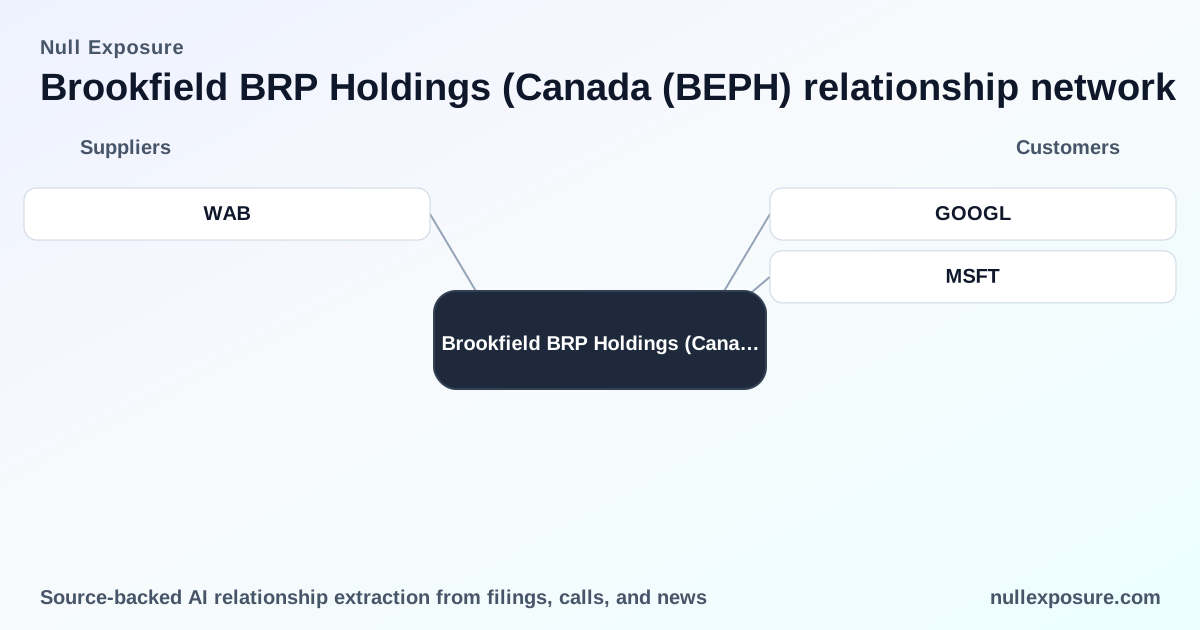
BEPH Customer Relationships: How Brookfield BRP Positions Its Renewable Power Offtake Strategy
Brookfield BRP Holdings (BEPH) operates and monetizes by developing and operating large-scale renewable generation—notably hydro—and selling capacity and energy under long-term commercial arrangements with corporate buyers and wholesale counterparties. The company converts project development into predictable cash flows through framework agreements and wholesale contracts with highly creditworthy customers, creating revenue visibility as assets are built and commissioned. For primary sources and deeper relationship mapping, visit https://nullexposure.com/.
The investor thesis in one paragraph
BEPH is executing a classic asset-backed contracting play: build utility-scale renewable generation, then lock in long-duration offtakes or framework commitments with blue-chip corporates and wholesale buyers. This model emphasizes upfront capital deployment and contract-backed cash flow, concentrates counterparty risk among a few large buyers, and creates high earnings leverage to successful project delivery and commissioning. The 2025 Q4 investor call confirmed both the strategy and concrete offtake momentum with major tech customers.
Key operating signals that matter to valuation
BEPH’s customer disclosures on the 2025 Q4 call reveal several actionable business-model characteristics investors should price into scenarios:
- Contracting posture: BEPH uses framework and wholesale agreements rather than spot-only sales, which implies multi-year revenue visibility and negotiated delivery cadences tied to project commissioning.
- Counterparty concentration: Publicly disclosed relationships center on a small number of very large corporate buyers; that reduces marketing friction but increases single-counterparty exposure.
- Criticality and scale: Commitments like a multi-gigawatt hydro framework are strategically significant to both BEPH (volume to amortize capex) and the buyer (large-scale renewable supply for corporate decarbonization).
- Maturity and delivery risk: Hydro projects span multiple years; the cadence of capacity into contracts through 2030 is a primary operational risk and value driver for near-term cash flow forecasts.
These signals should be treated as core inputs when modeling BEPH’s future revenue ramp and balance-sheet funding needs.
What BEPH told investors about its customers (2025 Q4 earnings call)
Below are the relationships extracted from the company’s 2025 Q4 earnings call. Each entry reflects a direct mention in the transcript and is followed by a concise, plain-English take and a source note.
GOOGL
BEPH cited a framework agreement with Google to deliver up to three gigawatts of hydro generation in the United States, positioning Google as a large-scale offtake counterparty that underpins multi-GW project economics. According to BEPH’s 2025 Q4 earnings call (transcript, March 8, 2026), this is a formal framework commitment tied to U.S. hydro projects.
The company reiterated the Google framework in the same call, emphasizing the scale and geographic focus—three gigawatts in the U.S.—which signals substantial firm demand that can materially accelerate BEPH’s project-build plan. This point was made on BEPH’s 2025 Q4 earnings call (March 8, 2026).
Microsoft
Executives referenced a strong relationship with Microsoft and discussed the cadence of capacity deliveries into that contract through 2030, indicating an ongoing multi-year supply schedule with one of the highest-credit corporate buyers. Investors should note this as a meaningful source of long-dated offtake volume, as stated on BEPH’s 2025 Q4 earnings call (transcript, March 8, 2026).
MSFT
The transcript duplicates the Microsoft mention using the MSFT ticker, again raising the cadence question—how rapidly contracted capacity will come online through 2030—which is the key operational metric for revenue recognition and financing milestones. This duplicate mention appears in BEPH’s 2025 Q4 earnings call (March 8, 2026).
How these relationships affect valuation and risk
These customer relationships convert into three direct valuation inputs:
- Revenue visibility: Frameworks and long-term wholesale contracts with Google and Microsoft materially increase forward revenue predictability as projects reach commercial operation.
- Execution risk: The market should discount for the pace of commissioning—project delivery cadence through 2030 is the single largest driver of near-term cash flow and leverage outcomes.
- Concentration risk: Heavy reliance on a handful of large tech buyers reduces commercialization friction but amplifies counterparty concentration; contract terms and credit protections (e.g., take-or-pay, payment security) determine the real risk premium investors should apply.
Financial modeling should stress-test scenarios where commissioning slips by one to two years and where contract volumes are phased more slowly than current frameworks imply.
A mid-read action for analysts
For a systematic view of how BEPH’s customer commitments convert into projected cash flows and financing needs, see our platform coverage at https://nullexposure.com/. Use the call transcripts to map contractual cadence to expected COD (commercial operation dates) and model capital calls against projected equity and debt capacity.
Disclosure and data limitations investors should price in
The customer relationship records extracted from the 2025 Q4 call are explicit about counterparties and headline volumes, but the public excerpts do not include contractual granularity: pricing, firm vs. conditional volumes, credit support, or precise delivery schedules. No formal constraints were listed in the customer-relationship dataset provided, which is itself a company-level signal about disclosure granularity in third-party data feeds. Investors must therefore rely on call statements and any subsequent filings to confirm contract economics.
Final read: what to watch next
- Monitor BEPH disclosures for binding offtake confirmations, project-level COD announcements, and contract terms (price floors, volume guarantees, and termination rights).
- Watch capital markets activity for indications of financing secured against these projects; access to low-cost financing materially improves the return profile on multi-gigawatt hydro assets.
- Track any incremental counterparties beyond the large tech names to assess whether commercial concentration is diversifying.
Bottom line: BEPH has anchored large-scale demand with two of the world’s largest tech firms, converting development optionality into clear ramp narratives—execution on the delivery cadence through 2030 determines whether that narrative translates into cash flow and value creation.