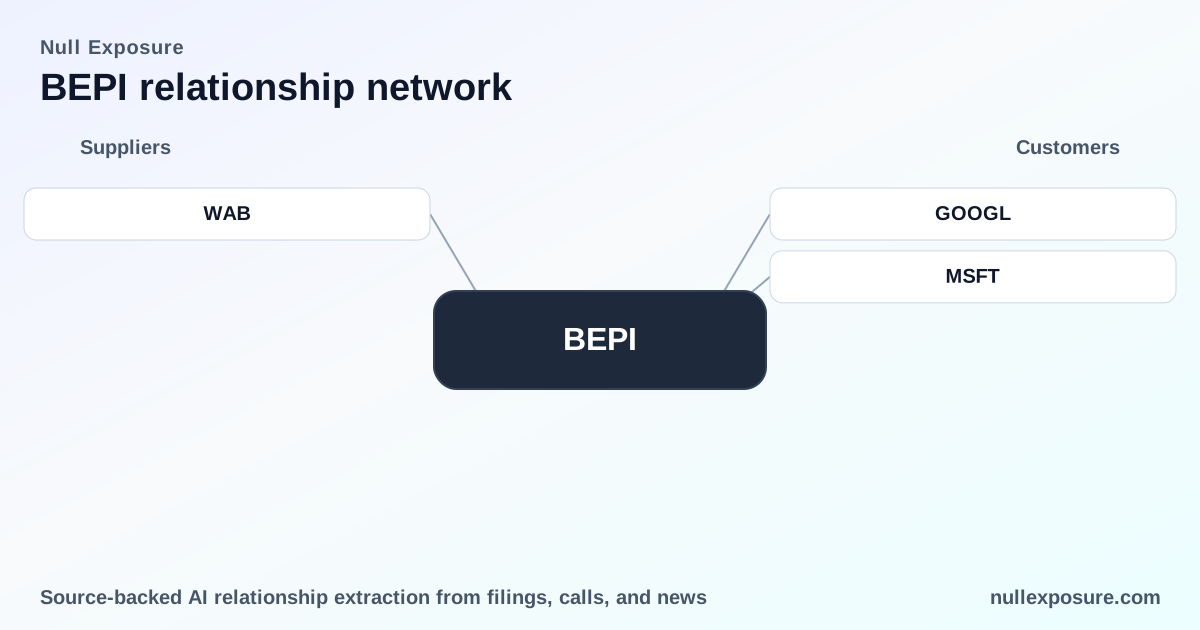
BEPI and the hyperscalers: how Brookfield BRP captures power demand from Google and Microsoft
Brookfield BRP Holdings (BEPI) monetizes its infrastructure expertise by developing and delivering large-scale renewable generation and selling capacity and energy under long-term commercial arrangements to corporate offtakers. BEPI’s business model is anchored in asset-backed project development and negotiated framework agreements with large corporates, which convert development capability into predictable revenue streams when projects reach commercial operation. For investors, the most consequential signal from the latest reporting cycle is BEPI’s explicit alignment with hyperscalers — Google and Microsoft — as strategic customers for its hydro generation capacity. Learn more at https://nullexposure.com/
Thesis in one line
BEPI is executing an institutional-scale renewables play: develop hydro capacity, lock in corporate offtakes through framework agreements, and realize cash flows as projects are delivered — a model that delivers scale and margin if execution stays on schedule and counterparties remain concentrated.
Why the hyperscalers matter to the bottom line
BEPI’s comments in its 2025Q4 earnings call place hyperscalers at the center of near-term demand, signaling concentration of revenue opportunity but also a higher level of commercial certainty compared with merchant exposures. Framework agreements with large technology companies translate development pipeline into contracted offtake potential, improving visibility for capital allocation and financing. At the same time, concentration toward a small number of large customers increases counterparty credit importance and execution risk tied to delivering multi-gigawatt projects on schedule.
What the company explicitly disclosed to investors
The following items are extracted from BEPI’s 2025Q4 earnings call and represent every customer relationship mention captured in the source results.
-
GOOGL — framework for up to 3 GW of hydro in the U.S.
BEPI said it has signed a framework agreement with Google to deliver up to three gigawatts of hydro generation in the United States, reflecting a large-scale commercial pipeline tied to a single hyperscaler. According to BEPI’s 2025Q4 earnings call (first reported March 8, 2026), this is a formal framework commitment to supply capacity and/or energy. (Source: BEPI 2025Q4 earnings call, March 2026) -
Google — same confirmation captured under the company name ‘Google’.
The company reiterated the framework agreement with Google for up to three gigawatts of hydro generation in the U.S., underlining that this arrangement is a central element of BEPI’s project disposition strategy. BEPI disclosed this in its Q4 2025 earnings call (reported March 8, 2026). (Source: BEPI 2025Q4 earnings call, March 2026) -
Microsoft — a long-standing, strategic hyperscaler relationship.
BEPI referenced a “strong relationship with Microsoft” and noted that demand from corporates — particularly large hyperscalers — is at an all-time high, positioning Microsoft as a material repeat counterparty for renewable supply. This was stated during the company’s 2025Q4 earnings call (first seen March 8, 2026). (Source: BEPI 2025Q4 earnings call, March 2026) -
MSFT — duplicate mention of Microsoft under its ticker identifier.
The call also referenced Microsoft by its ticker, underscoring the same point: BEPI’s pipeline is heavily influenced by hyperscaler demand, with Microsoft explicitly called out as a core buyer. This is recorded in the Q4 2025 earnings call (first seen March 8, 2026). (Source: BEPI 2025Q4 earnings call, March 2026)
Operating-model constraints and what they imply for investors
The disclosed results do not include contract-level constraints or granular commercial terms. As a company-level signal, the absence of detailed contractual constraints in the earnings call indicates BEPI is disclosing strategic partners and framework scope rather than finalized PPA terms, pricing, or delivery schedules. Investors should therefore treat these public statements as indicators of pipeline and counterparty quality, not as confirmation of revenue recognition or cash receipts.
From the disclosures and the nature of framework agreements, several operating-model characteristics are clear:
- Contracting posture: BEPI uses framework agreements with major corporates to secure offtake intent before finalizing project-specific PPAs or construction contracts. Frameworks move projects from optional pipeline to advanced commercial stage.
- Concentration: The business is oriented toward a small number of large buyers (hyperscalers), increasing the impact of each counterparty on revenue and credit exposure.
- Criticality: The product — large-scale renewable hydro generation — is strategically important to hyperscalers’ decarbonization goals, increasing the likelihood of long-term commercial relationships once delivery commitments are firm.
- Maturity: Framework agreements and repeated customer mentions signal a maturing business development pattern: repeatable counterparties, standard commercial structures, and improved project finance leverage.
For investors, these characteristics mean upside from improved project financing and lower merchant risk, balanced against execution and concentration risk until specific PPAs and commercial operation dates are disclosed.
Investment implications and risks to monitor
- Execution risk: Delivering up to 3 GW of hydro capacity requires permitting, capital, and construction milestones; missed timelines or cost overruns would materially affect cash flow realization.
- Counterparty concentration: Heavy reliance on a few hyperscalers amplifies the importance of each buyer’s credit and procurement timelines.
- Contract transparency: Framework agreements improve visibility but do not substitute for signed PPAs with pricing and tenor; investors need tranche-level contract announcements.
- Regulatory and permitting risk: Hydro projects face environmental and permitting scrutiny that can delay or change project economics.
Key investor actions: track BEPI announcements for signed PPAs, project finance closings, commercial operation dates, and any customer-specific disclosure that converts framework agreements into revenue-recognizable contracts. Explore more background and monitoring tools at https://nullexposure.com/
Bottom line: what to watch next
BEPI’s public statements position it as a preferred supplier to the hyperscalers for renewable hydro capacity, which is strategically positive for long-term contracted cash flow if projects are executed on plan. The next inflection points for investors are concrete contract level disclosures (signed PPAs), project financing closings, and operational milestones that move framework commitments toward revenue. Monitor earnings updates and company announcements closely — the difference between a pipeline headline and a signed contract is the difference between expectation and cash flow.
For analysts and operators underwriting BEPI exposure, focus on counterparty credit, project delivery schedules, and any shift in hyperscaler procurement patterns; these will determine whether the company’s framework agreements convert into lasting, material revenue streams.