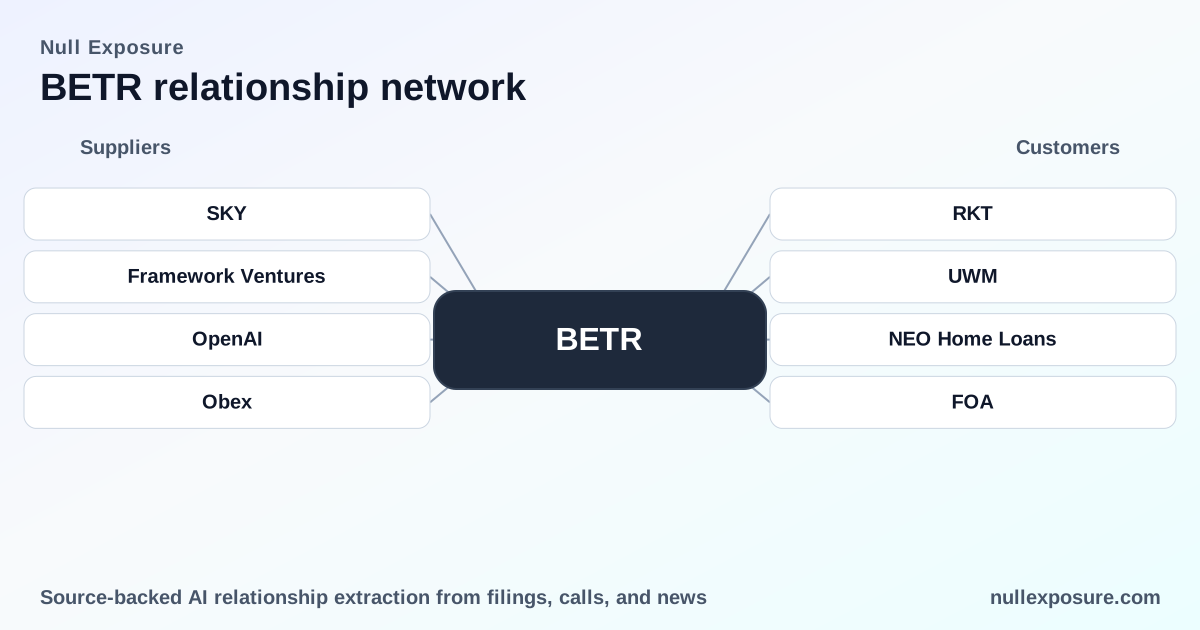
Better Home & Finance (BETR): Customer relationships that power mortgage distribution and scale
Better Home & Finance (BETR) operates an AI-native mortgage origination and home-finance platform that originates loans, sells those loans to institutional purchasers, and earns revenue on origination and sale margins. The company monetizes through loan production income, fees on related homeownership services, and recurring deposit/financing products tied to its Home Finance business, while extending distribution via partnerships and embedded channels. For investors, the critical lens is how BETR’s customer and institutional relationships translate into distribution scale, capital recycling, and credit risk transfer. For an expanded view of BETR’s customer network, visit https://nullexposure.com/.
Strategic summary: BETR’s model is transaction-driven and highly dependent on a network of institutional purchasers and distribution partners; securing GSE eligibility and bank integrations materially improves funding economics and lowers blended costs of capital.
Why customer relationships matter for BETR’s unit economics
BETR’s profitability hinges on two linked dynamics: (1) the speed and volume of mortgage origination and (2) the ability to sell originated loans to institutional buyers without recourse. A broad purchaser network (GSEs, banks, asset managers) reduces funding friction and interest-rate sensitivity, while distribution partnerships (embedded fintechs, advisor networks, white‑label originators) expand access to borrowers and improve acquisition efficiency. Governance and regulatory approvals—especially GSE acceptance—directly affect pricing and investor appetite for BETR-originated paper.
Explore deeper coverage and signals on BETR customer relationships at https://nullexposure.com/.
Customer relationships at a glance — one-sentence takeaways and sources
-
Fannie Mae — Better is operating as a Fannie Mae–approved mortgage seller and has structured crypto‑backed mortgages “in accordance with Fannie Mae guidelines,” enabling those loans to be guaranteed and priced more competitively. Source: CoinDesk (Mar 2026) and Newsday (May 2026) reporting on the Coinbase/BETR/Fannie Mae developments; Investing.com coverage (Mar 2026) also references Fannie Mae acceptance in the warehouse facility context.
-
NEO Home Loans — BETR’s distributed retail channel, “NEO powered by Better,” completed a one‑year partnership that BETR says produced measurable gains in production efficiency and lower cost to originate; marketing leadership hires aim to deepen integration of advisors and the digital platform. Source: StockTitan announcement (Mar 2026) and SimplyWall.st commentary (Mar 2026).
-
RKT (Rocket Companies) — BETR launched a ChatGPT‑integrated mortgage approval tool positioned to target competitors such as Rocket Mortgage by enabling rival lenders to approve loans faster and cut origination costs. Source: CNBC feature on BETR’s new ChatGPT app (Mar 5, 2026).
-
Rocket Mortgage — BETR’s product explicitly targets industry leaders like Rocket Mortgage to win share through faster approvals and lower operating cost per loan. Source: CNBC coverage of the March 2026 product launch.
-
United Wholesale Mortgage (UWM) — BETR’s platform cites United Wholesale Mortgage among the industry incumbents it is targeting for competitive displacement through faster underwriting and lower costs. Source: CNBC (Mar 2026).
-
Finance of America Companies, Inc. (FOA) — BETR will act as an origination partner for Finance of America’s reverse mortgage products, including HECM and the HomeSafe™ suite, which expands BETR’s product set into reverse mortgages and non‑traditional home equity products. Source: Investing.com (FY2025 coverage) and Benzinga commentary (Nov 2025 referenced in FY2025 context).
-
U.S. Bank (USB) — BETR’s underwriting platform provides capabilities for over 45 institutional mortgage investors and explicitly names banks such as U.S. Bank among supported investors, indicating integration with major bank purchasers. Source: Investing.com report on BETR’s AI mortgage approval launch (Mar 2026).
-
Intuit Credit Karma — BETR expanded distribution through an integration with Intuit Credit Karma to offer embedded mortgage experiences, increasing borrower acquisition channels via consumer finance platforms. Source: National Mortgage Professional coverage of BETR’s board expansions and distribution integrations (May 2026).
What these relationships reveal about operating constraints and risk posture
-
Counterparty mix and role: BETR’s purchaser network is multi‑tiered — government‑sponsored enterprises (GSEs), banks, and large investors are core counterparties, while individual borrowers are the revenue-generating end customers. This fosters a sell‑through model where BETR acts as both originator and seller of loan assets, relying on external purchasers to recycle capital.
-
Contracting posture and maturity: The company operates under shorter-term transactional contracts with loan purchasers (loans sold without recourse), and strategic multi‑year partnerships with distribution and channel partners (e.g., NEO, Credit Karma) that are more durable and support repeat origination.
-
Concentration and geography: Revenue is heavily U.S.‑centric and materially concentrated in several states; Home Finance licenses cover all 50 states and D.C., but state concentration (California, Texas, Florida) is a company-level exposure signal that affects loss severity and regional market cycles.
-
Criticality of relationships: GSE acceptance and bank integrations are critical to funding economics; these relationships materially reduce cost of funds and expand secondary market demand, making them central to BETR’s business continuity.
-
Customer types and data sensitivity: BETR manages consumer PII at scale and serves primarily middle‑to‑upper income borrowers; this underlies regulatory and operational controls requirements and elevates remediation and compliance spend as a persistent cost line.
-
Spend and remediation exposure: The firm has reserved material remediation dollars (several million) for historical tolerance and compliance issues, indicating ongoing operational remediation and third‑party review commitments.
Investment implications and risk checklist
-
Positive catalysts: GSE acceptance for new products (e.g., crypto‑backed mortgages), expanded distributor partnerships (NEO, Intuit Credit Karma), and broader bank integrations accelerate loan sale throughput and lower funding costs.
-
Key risks: Concentration in a handful of states, dependence on the secondary market to recycle capital, regulatory/compliance remediation costs, and competition from large incumbents (Rocket, UWM) deploying similar automation.
-
Operational watch items: Monitor quarterly disclosures on loan sale volumes to GSEs and banks, margins on loan production vs. sale prices, and updates on embedded distribution adoption metrics.
Final thought and next step
BETR’s business is scalable only if its institutional distribution channels (GSEs and bank purchasers) and embedded partners continue to absorb originations at attractive spreads. For a tactical investor review and deeper signals on counterparty exposure, underwriting partners, and distribution velocity, see additional coverage at https://nullexposure.com/.