BETRW: How Better Home & Finance Monetizes an advisor-led, short-cycle mortgage model
Better Home & Finance Holding Company (BETRW) originates and digitally services mortgage loans for individual homeowners, monetizing primarily through origination fees and the sale of mortgage loans into the secondary market. The firm funds loans, uses short-term commitments and forward sales to hedge rate exposure, and earns trailing fee revenue from bundled home-related services; distribution partnerships such as the advisor-led “NEO powered by Better” channel are a mechanism to scale production and lower cost-to-originate.
If you want a concise data package and relationship mapping for BETRW, see a deeper overview at https://nullexposure.com/.
What the business actually does and why it matters to investors
BETRW is a retail-focused mortgage originator that combines a digital front end with adviser-distributed channels and a loan-sale funding model. Revenue is almost entirely driven by Home Finance (mortgage production) and related services such as real estate agent and insurance referrals. The company funds loans, then sells them to loan purchasers—including GSEs—using short-term instruments (IRLCs, forward sales, mandatory/best-efforts commitments) to hedge interest-rate risk and limit balance-sheet duration. For investors, the critical variables are origination volume, cost-to-originate, the effectiveness of hedging, and the size of repurchase exposure.
Explore company-level relationship signals and customer mappings at https://nullexposure.com/.
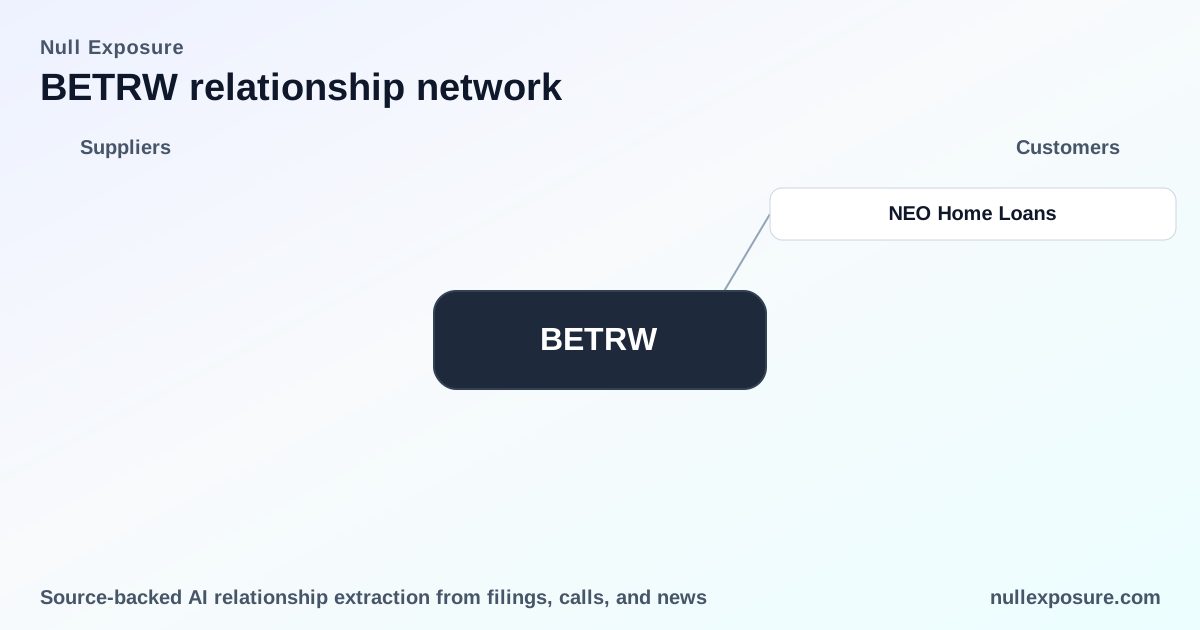
Active customer relationships: NEO Home Loans
NEO Home Loans — BETRW’s advisor-led retail partner, branded “NEO powered by Better,” completed its first anniversary and reported material gains in production efficiency and lower cost to originate through the distributed channel. According to a BETR press release in March 2026, the partnership has demonstrably improved production metrics under an advisor-led model (FY2026 press release via Financial Times market announcements/BizWire). This relationship functions as an acquisition and origination channel that feeds BETRW’s core Home Finance engine.
Why this matters: NEO represents a scalable distribution node that converts advisor networks into funded loans, directly supporting BETRW’s path to higher volume and lower per-loan cost. (Source: BETR press release, March 2026 — markets.ft.com / BizWire announcement.)
Operating model characteristics and what the constraints reveal
BETRW’s corporate filings and disclosures to date outline a consistent, short-cycle origination model with several structural characteristics that drive both upside and risk.
- Contracting posture — short-term and transactional. BETRW uses IRLCs and forward sales to lock rates and simultaneously execute loan sales; the average holding period from funding to sale was approximately 21 days in 2024, indicating a near-zero duration balance sheet posture and heavy reliance on efficient sale execution (company filings, year ended December 31, 2024).
- Customer profile — retail borrowers. The company’s revenue base is overwhelmingly individual consumers: the average funded loan in 2024 was roughly $305–306k, borrowers tended to be mid-40s with high FICO scores, and revenue is primarily denominated in U.S. dollars (company disclosures, 2024).
- Geographic footprint — U.S.-centric with state concentration. BETRW is licensed across all 50 states and DC, but ~30% of funded volume in 2024 was concentrated in California (12%), Texas (9%) and Florida (9%), creating state-level concentration risk within an otherwise national footprint (company filing, 2024).
- Role dynamics — seller and service provider. The company sells loans to loan purchasers (loans are often sold without recourse), and operates digital service platforms (e.g., Tinman) to enable borrower self-service and ancillary revenue capture (company disclosures).
- Segment and maturity — core mortgage product with adjacent services. Home Finance is the core product; Better Plus and other non-mortgage services (real estate, title, insurance) are complementary revenue lines as the firm scales.
- Repurchase exposure and spend bands. The company disclosed repurchases of unpaid principal balance of $9.9 million in 2024 and $22.1 million in 2023, which is an operational cost tied to loan repurchase obligations and a metric investors should monitor for underwriting quality (company filings, years ended December 31, 2024 and 2023).
These characteristics together define a company that is modeled for high-throughput loan origination, low-duration balance sheet risk, and service-led cross-sell, but that remains sensitive to execution in loan sale markets, interest-rate volatility, and repurchase liabilities.
What the NEO relationship implies for the company’s economics
The NEO partnership is explicitly designed to increase production efficiency through an advisor-distributed retail channel. The operational implication for investors is twofold: first, improved cost-to-originate should lift underlying unit economics; second, if NEO scales materially, originations will become less dependent on direct digital acquisition, diversifying distribution mix. The press release emphasizes production efficiency gains after one year of partnership (press release, March 2026).
Key risks investors should watch
- Funding and sale execution risk. With an average funding-to-sale window of about three weeks, the company depends on frictionless access to loan purchasers and functioning forward markets to avoid liquidity stress (company filings, 2024).
- Interest-rate and hedging execution. Short-term IRLCs and forward commitments reduce duration risk but require accurate hedging and counterparty reliability; execution failures amplify margin volatility.
- Repurchase and underwriting exposure. Repurchases totaling tens of millions across recent years show an existing operational cost tied to post-sale underwriting disputes; persistent repurchase levels would compress margins.
- Geographic concentration. Heavy exposure to a few states concentrates market risk from regional home-price or regulatory shocks.
A concise list of near-term monitoring items:
- Quarterly funded loan volume by channel (NEO vs. direct).
- Cost-to-originate trends and loan sale timing.
- Repurchase dollar trends and root causes.
- Hedging instrument usage and counterparties.
Bottom line for investors
Better Home & Finance is a distribution- and execution-dependent mortgage originator: its economics scale when originations rise and the loan-sale engine operates smoothly; conversely, funding disruptions, hedging missteps, or elevated repurchases materially compress earnings. The NEO relationship is an important strategic lever that improves production efficiency and diversifies distribution, but investors must continue to monitor sale execution, repurchase levels, and state concentration.
For a complete map of BETRW customer relationships and constraints, visit Null Exposure for our relationship intelligence and tracking: https://nullexposure.com/.