Brown‑Forman (BF‑A): Customer Relationships and What Investors Need to Know
Brown‑Forman manufactures and markets premium branded spirits and wines worldwide and monetizes through global wholesale and retail channels—selling to distributors, wholesalers, retailers and, where applicable, state government alcohol boards. The company captures value through brand equity (Jack Daniel’s, Woodford Reserve, Finlandia, Herradura, Korbel) and a deliberate portfolio strategy that includes selective divestitures to optimize margins and growth. For a concise institutional view of customer exposures and counterparty structure, visit https://nullexposure.com/.
Investor thesis in one line
Brown‑Forman is a cash‑generative, brand‑driven beverage company with diversified global reach but tangible customer concentration, selling through intermediated channels that create durable margins but expose revenue to distributor and state purchasing behaviors.
One notable counterparty change: Sazerac divestiture explained
Brown‑Forman completed a sale of several lower‑tier whiskey brands and related production assets to Sazerac. The transaction transferred the Early Times, Canadian Mist, and Collingwood brands plus Canadian Mist production to Sazerac as part of a broader portfolio rationalization (transaction referenced to FY2019 and summarized by the company on its website). According to Brown‑Forman’s corporate announcement, the sale reduced Brown‑Forman’s exposure to lower‑growth, lower‑margin brands and reallocated capital towards core global growth brands (brown‑forman.com).
How Brown‑Forman sells: channels and counterparty signals that matter
Brown‑Forman’s operating model is shaped by how it contracts with buyers and where it sells product. The company’s public disclosures make several points clear:
- Indirect distribution is the norm. In the U.S., Brown‑Forman sells primarily to distributors or state governments that then sell to retailers and consumers. This channel structure imposes multi‑layer contractual dynamics and extends the company’s receivables and pricing negotiations one step removed from the retail consumer.
- Global scale with U.S. concentration. Brown‑Forman sells in over 170 countries but the United States remains the single largest market, accounting for roughly 44% of net sales in fiscal 2025, with the remainder outside North America.
- Meaningful customer concentration. The company discloses that its two largest customers accounted for 14% and 12% of consolidated net sales in 2023 and similar proportions in 2024–2025, which creates measurable counterparty risk if distributor relationships shift.
- Customer roles skew to distributors/resellers and governments. Public filings indicate most customers are distributors, wholesalers or retailers, with state government purchasing in control states also an explicit route to market.
These are company‑level signals drawn from Brown‑Forman’s disclosures and inform revenue predictability, working capital needs, and bargaining dynamics with major channels.
What this means for contracting posture, concentration, criticality and maturity
- Contracting posture: Brown‑Forman operates with an intermediary contracting posture — it negotiates with distributors and occasionally directly with large retail or government channels in controlled markets. That structure reduces direct retail pricing control but protects the company from certain distribution execution risks.
- Concentration: Double‑digit reliance on a small number of large customers introduces counterparty risk. Distribution agreements in the U.S. and select international markets can materially influence quarterly sales and collections.
- Criticality: The company’s products are not critical infrastructure, but they are highly brand‑sensitive commodities; availability and channel placement materially affect pricing power and premiumization strategies.
- Maturity: Brown‑Forman’s global footprint, deep brand portfolio and steady margins (Operating margin ~31.9%; Profit margin ~20.6%) indicate a mature, cash‑oriented enterprise where portfolio management and channel optimization drive incremental returns.
Collectively, these characteristics explain why Brown‑Forman pursues selective divestitures like the transaction with Sazerac: to sharpen brand focus, redeploy capital and improve margin profiles.
Relationship register — full coverage of listed counterparties
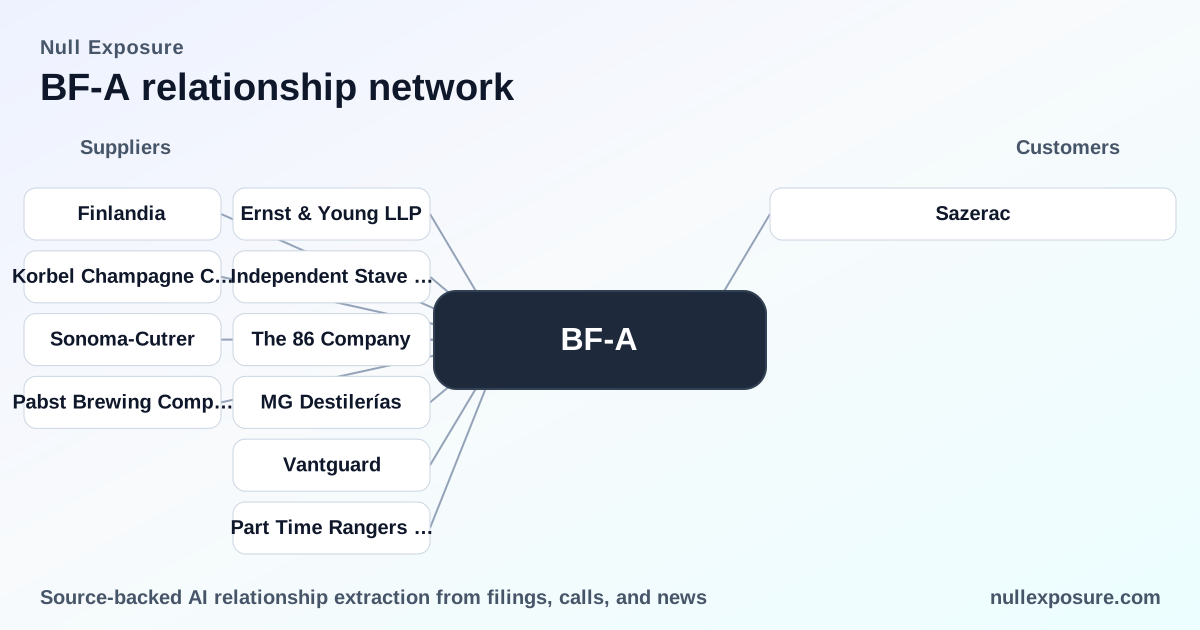
Below is the complete set of customer relationships identified in public records for the BF‑A customer scope.
- Sazerac: Brown‑Forman completed the sale of the Early Times, Canadian Mist, and Collingwood brands and transferred Canadian Mist production to Sazerac, a move disclosed in the company’s transaction announcement and connected with FY2019 portfolio activity; see the Brown‑Forman press release on the company site (brown‑forman.com).
Financial context that amplifies customer signals
Brown‑Forman reports steady revenue and strong margins that contextualize its customer relationships. Reported trailing revenue is about $3.91 billion, with operating margin near 32% and profit margin near 20.6%, reflecting premiumization and cost leverage across channels. The company’s market capitalization ($11.5 billion) and EBITDA ($1.209 billion) support ongoing investment in core brand growth and selective M&A or divestiture activity to optimize the portfolio.
Risk and opportunity map for investors
- Risk — distribution concentration: Double‑digit sales exposure to a small number of large accounts creates downside if a distributor changes stocking priorities or if state governments adjust purchasing policies.
- Risk — channel friction: Indirect channels reduce price transparency and lengthen cash conversion cycles; working capital outcomes depend on wholesale partner performance.
- Opportunity — portfolio optimization: Disposal of non‑core brands (e.g., transaction with Sazerac) frees capital for premium brand investment and can lift aggregate margins as the company focuses on higher‑return SKUs.
- Opportunity — global diversification: Sales in 170+ countries provide multiple growth vectors; accelerating premiumization in key international markets supports margin expansion.
Bottom line and next step
Brown‑Forman operates as a mature, brand‑centric global spirits company that manages revenue through intermediary channels and periodically reshapes its brand mix through divestitures and acquisitions. Customer concentration and the intermediary nature of its sales are the primary operational risks, while premiumization and targeted portfolio moves are the levers for growth. For a structured drill‑down on counterparty exposures across the portfolio and comparative peer analysis, visit https://nullexposure.com/.
Bold takeaways:
- Distribution and state purchasing rules materially shape revenue visibility.
- Two largest customers represent a meaningful share of consolidated sales.
- Strategic divestitures (e.g., to Sazerac) are tactical tools to sharpen margins and reallocate capital.
Sources referenced include Brown‑Forman corporate disclosures and the company press release describing the Sazerac transaction (brown‑forman.com).