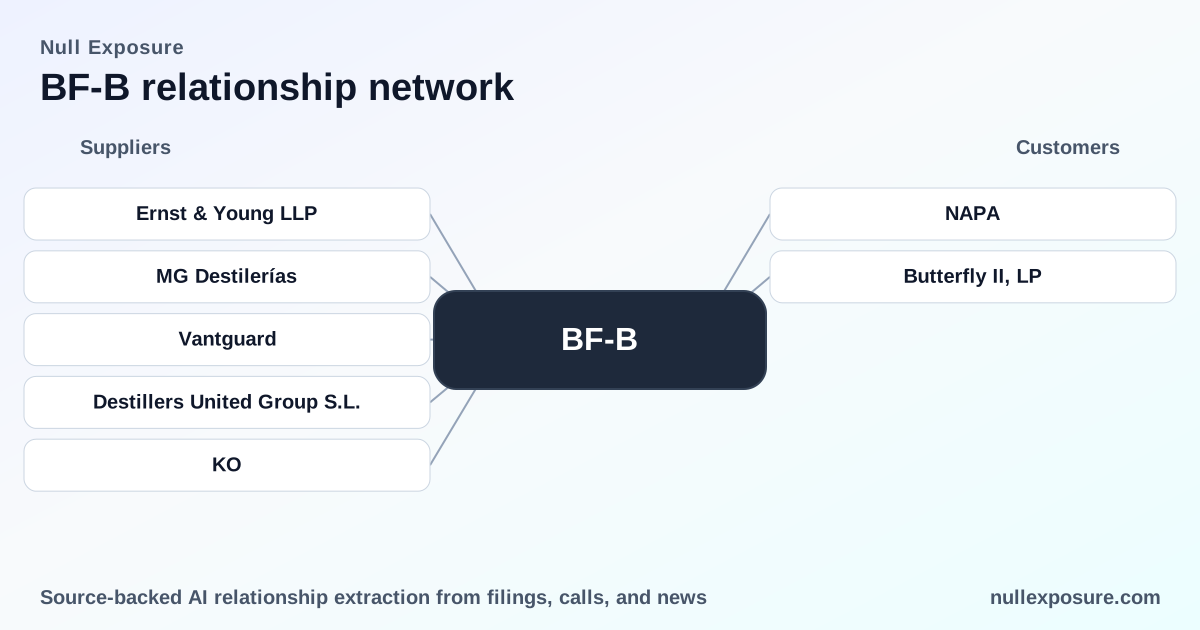
Brown‑Forman (BF‑B): Customer relationships that determine revenue quality and margin durability
Brown‑Forman is a global spirits and wine company that monetizes a portfolio of premium brands through a mix of distributors, state-controlled channels and direct retail in select markets. The company generates durable gross margins (Gross Profit TTM $2.32B on Revenue TTM $3.91B) by licensing and selling branded product—Jack Daniel’s and Woodford Reserve provide pricing power—while relying on third‑party channels for market access. For relationship intelligence and ongoing monitoring, see NullExposure for structured visibility: https://nullexposure.com/
How Brown‑Forman sells: channel strategy and contracting posture
Brown‑Forman’s commercial model is channel‑driven rather than direct retail. The company’s own disclosures state that in the United States it generally sells products to distributors or to state governments that then resell to consumers, and that it also serves travel retail, duty‑free and U.S. military channels. This positioning creates a seller-to‑reseller contracting posture: Brown‑Forman sets pricing, brand programs and supply commitments upstream while distributors and retailers carry the downstream inventory and execution risk. The company’s global footprint—“we sell our products in over 170 countries”—means channels and contract terms vary widely by jurisdiction, from tightly controlled state systems to free‑market distributor networks.
Concentration and criticality: the numbers that matter
Brown‑Forman reports that in fiscal 2025 its two largest customers accounted for roughly 13% and 11% of consolidated net sales, with no other single customer above 10%. That level of concentration is material and creates a dual dynamic: large customers provide predictable volume and bargaining leverage but also concentrate counterparty risk. From a portfolio perspective, the company’s operating margins and EBITDA (Operating Margin TTM 31.9%; EBITDA $1.209B) underline that channel partners are critical to margin realization, not just revenue flow. These are mature commercial relationships: beverage distribution is long‑duration and governed by recurring purchase patterns and regulatory constraints.
Every customer relationship referenced in the public record
Below are plain‑English summaries of each relationship mentioned in the source material.
-
NAPA / The Duckhorn Portfolio, Inc. — The Duckhorn completed the acquisition of Sonoma‑Cutrer Vineyards from Brown‑Forman, reflecting Brown‑Forman’s divestiture of part of its wine holdings. According to Simply Wall St reporting on March 9, 2026, this transaction closed as part of Brown‑Forman’s broader portfolio adjustments. (Source: Simply Wall St, Mar 9, 2026 — company news item)
-
The Duckhorn Portfolio, Inc. (duplicate reference) — The same Simply Wall St report records that The Duckhorn Portfolio (NYSE: NAPA) acquired Sonoma‑Cutrer from Brown‑Forman, confirming the company’s exit of that asset and the reallocation of capital away from that wine holding. (Source: Simply Wall St, Mar 9, 2026)
-
Butterfly II, LP — A private equity consortium led by Butterfly Equity agreed to acquire The Duckhorn Portfolio for approximately $1.6 billion, with Brown‑Forman listed among sellers or former owners involved in the transaction. Simply Wall St captured this acquisition notice on March 9, 2026, which reflects the secondary sale dynamics of wine assets among strategic and financial buyers. (Source: Simply Wall St, Mar 9, 2026)
-
Korbel Champagne Cellars — Brown‑Forman disclosed the end of its Korbel agreement, and management attributed a portion of U.S. net sales decline to this contractual conclusion alongside weaker Jack Daniel’s demand; the note appears in fiscal 2025 commentary. SureDividend summarized the impact on U.S. net sales in a May 2, 2026 article, citing the end of the Korbel arrangement as a revenue headwind. (Source: SureDividend, May 2, 2026 — fiscal 2025 commentary)
What these relationships signal about the operating model
Taken together, the relationships and company disclosures create a coherent picture:
-
Channel outsourcing is structural. Brown‑Forman’s principal customers are distributors, wholesalers, retailers and government bodies, not direct retail consumers; the firm is asset‑light on retail distribution and instead focuses on brand, supply and trade terms.
-
Global reach with heterogeneous contract forms. Selling in over 170 countries means contract structure is not uniform—state‑run systems, duty‑free wholesalers and independent distributors coexist—so counterparty risk is geographically diversified but administratively complex.
-
Material concentration but manageable counterparty mix. With two customers representing ~24% of consolidated sales, concentration is significant; however, the remainder of revenue is widely dispersed across many distributors and markets, reducing single‑counterparty fragility.
-
Lifecycle management of non‑core assets. The Sonoma‑Cutrer sale and the downstream trade sale of The Duckhorn Portfolio stakes show active portfolio pruning and liquidity‑driven exits, indicating management uses M&A and divestitures to refocus on core global spirits brands.
Investor implications: risks and strategic levers
-
Negotiation leverage is asymmetric but guarded. Large distributors and state buyers hold purchasing leverage in certain markets; Brown‑Forman protects margins through brand strength and premium pricing, but any shift in outlet or regulatory policy can compress realized prices.
-
Regulatory exposure is real. Selling through state governments and governments' control of alcohol channels creates a government counterparty vector that impacts timing, pricing and even distribution rights—this is a company‑level exposure derived from the company’s own filings.
-
Portfolio rationalization improves focus but reduces diversification in wine. Divestitures of wine assets reduce non‑core complexity and free capital for core spirit brands, improving margin focus but slightly increasing beverage mix concentration.
-
Maturity of relationships supports predictability. Beverage channel contracts are longstanding and volume patterns are stable; that maturity supports cash flow visibility even as individual contract expiration (e.g., Korbel) can create discrete revenue gaps.
For additional analysis of how these customer dynamics feed into valuation and credit posture, visit NullExposure for deeper relationship mapping: https://nullexposure.com/
Key takeaways for investors
- Brown‑Forman is a brand‑led seller that relies on distributors, wholesalers and government channels to reach consumers; its margins reflect brand pricing, not direct retail capture.
- Two large customers account for a material share of revenue (13% and 11% in FY2025), creating concentration risk that is offset by a broad global footprint.
- Recent transactions (Sonoma‑Cutrer sale and Duckhorn stake transfers) show active portfolio management, improving focus on premium spirits.
- Contracting posture is seller‑to‑reseller with important government and travel‑retail touchpoints, requiring ongoing monitoring of regulatory change and key counterparty terms.
Bold, portfolio‑level claims and relationship events above should shape any valuation or operational diligence on BF‑B; the company’s margin profile and mature channel relationships support resilience, while customer concentration and regulatory counterparty exposure are the principal conditional risks.