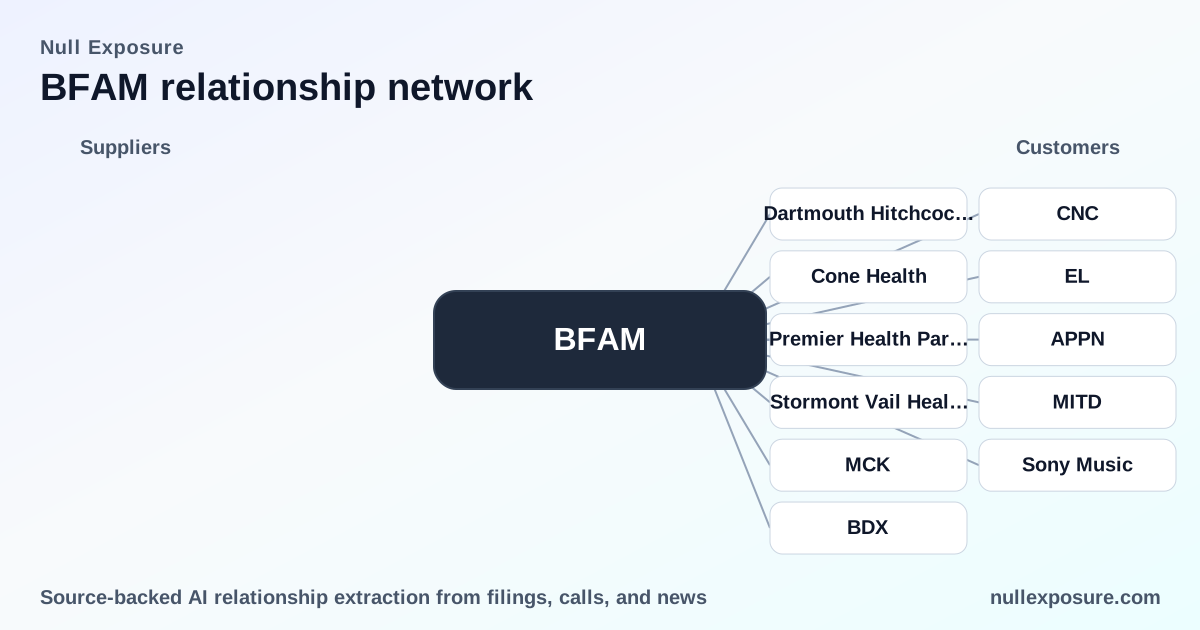
Bright Horizons (BFAM): Employer relationships that drive recurring revenue and expansion
Bright Horizons operates and monetizes a service-heavy benefits platform: it runs full-service child care centers, manages employer-sponsored centers on multi-year contracts, and sells back-up care and education advisory services via subscription and per-use fees. Revenue mixes between long-term management contracts, subscription back-up care, and usage-based fees create predictable recurring cash flow while retaining upside from expansion with large corporate clients. Learn more about relationship signals and sourcing at https://nullexposure.com/.
How Bright Horizons actually gets paid — the business in plain English
Bright Horizons generates cash in three clear ways: (1) multi-year management and operations contracts where employers pay fees to operate on-site or employer-branded centers; (2) subscription revenue from back-up care programs and Sittercity, recognized over contract terms; and (3) usage-based fees and co-payments for ad hoc back-up services. The company’s largest revenue driver is full-service center-based child care, which accounted for roughly three-quarters of revenue in recent fiscal years, while back-up care and educational advisory services provide higher-margin, scalable revenue streams. Management consistently emphasizes low client concentration and strong retention, which supports repeatable sales economics for new corporate deployments.
Client wins and portfolio updates you should know (documented signals)
Premier Health Partners
Bright Horizons disclosed adding Premier Health Partners as a new client in its Q3 2025 earnings call, highlighting continued demand from health-system employers for on-site or managed centers. (BFAM Q3 2025 earnings call, first seen Mar 2026.)
Sony Music
Sony Music was announced as a new employer client in the Q3 2025 call, illustrating Bright Horizons’ reach into media and large corporate employers. (BFAM Q3 2025 earnings call, first seen Mar 2026.)
Dartmouth Hitchcock Medical Center
Management reported adding a center for Dartmouth Hitchcock Medical Center as part of three new centers in Q3 2025, reflecting ongoing expansion into higher-education and health systems. (BFAM Q3 2025 earnings call, fiscal period 2025Q3.)
MIT
MIT was named among new employer clients in Q3 2025, underlining penetration of higher-education accounts and institutional partnerships. (BFAM Q3 2025 earnings call, first seen Mar 2026.)
Appian Corporation
Appian Corporation was cited as a new client in the Q3 2025 call, demonstrating traction with technology and enterprise software employers. (BFAM Q3 2025 earnings call, fiscal period 2025Q3.)
Stormont Vail Health
Bright Horizons added centers transitioned through management for Stormont Vail Health as part of six center openings reported in Q4 2025, signaling healthcare system rollout activity. The same expansion was reflected in an InsiderMonkey transcript of the Q4 2025 call. (BFAM Q4 2025 earnings call; InsiderMonkey Q4 2025 transcript, March 2026.)
Cone Health
Cone Health was recorded as a client transition in Q4 2025 alongside Stormont Vail Health, again emphasizing the company's focus on health system partnerships. (BFAM Q4 2025 earnings call; InsiderMonkey Q4 2025 transcript, March 2026.)
Becton Dickinson (BDX)
Bright Horizons reported launches with Becton Dickinson in Q4 2025, indicating wins with global medical-device and life sciences employers. (BFAM Q4 2025 earnings call; InsiderMonkey Q4 2025 transcript, March 2026.)
Estee Lauder / Estee Lauders (EL)
Management named Estee Lauder among new employer launches in Q4 2025, highlighting adoption among large consumer goods and retail employers. (BFAM Q4 2025 earnings call; InsiderMonkey Q4 2025 transcript, March 2026.)
McKesson (MCK) / Centene (CNC)
Analyst and industry notes highlighted large corporate clients such as McKesson and Centene when discussing Bright Horizons’ expanding employer pipeline; these mentions support the firm’s strategy of selling employer-sponsored childcare as a retention benefit for enterprise clients. (SimplyWallSt coverage referencing FY2026 commentary on employer demand, March 2026.)
Becton Dickinson (news sentiment)
Beyond the earnings transcript, the InsiderMonkey coverage echoed the Becton Dickinson launch as a Q4 2025 client addition, reinforcing the earnings call disclosure. (InsiderMonkey transcript, March 2026.)
Vornado Realty Trust (VNO)
A CityBiz report on Vornado’s workplace amenity program cited an on-site Bright Horizons daycare at a Vornado property, demonstrating the company’s role in building real-estate amenity packages tied to office landlords and mixed-use operators. (CityBiz, May 2026.)
Note: each of the above relationships is documented either in Bright Horizons’ Q3/Q4 2025 earnings call comments or in contemporaneous industry coverage (InsiderMonkey, SimplyWallSt, CityBiz). Where a company name appeared in multiple records, both earnings transcripts and news reports corroborate the client win.
Operating constraints and what those mean for investors
Bright Horizons’ disclosures present a clear, service-led operating model with several defining constraints that shape investor expectations:
- Contracting posture — multi-year orientation. Management states it enters contracts generally ranging from three to ten years for managed centers, supporting predictable renewal streams and capital planning for center operations.
- Mixed pricing architecture. Revenue is a blend of subscription fees (straight-line recognized) for back-up care and usage-based transaction fees for ad hoc services, which produces both recurring revenue and cyclical variability tied to utilization.
- Customer mix and concentration. The company reported more than 1,450 employer clients with the largest client equal to ~1% of revenue and the top 10 representing ~8% in 2024, indicating low single-customer concentration and diversified counterparty risk.
- Geographic footprint. Operations are split between North America and an international cohort (UK, Netherlands, Australia, India), with substantial exposure to the U.S. market and material international revenue that supports scale.
- Business criticality and segment maturity. Full-service center-based child care is material to consolidated revenue (~73% of total), while back-up care and educational advisory services provide higher-margin, scalable adjuncts; management reports high client retention (~95% for employer-sponsored centers), which underscores maturity in the employer-services channel.
These constraints collectively imply stable recurring cash flows with selective growth levers—new employer launches and transitions of existing centers—while leaving Bright Horizons exposed to utilization swings and capital intensity in center operations.
Investment implications and risks
- Growth vector: Wins with large employers and health systems (e.g., McKesson, Centene, hospital systems) validate a scalable sales motion into enterprise HR budgets; new client launches are direct revenue drivers with multi-year economics.
- Margin and capital: The business is capital-intensive where full-service centers dominate revenue; investors should weigh operating leverage against depreciation and occupany costs that are material to profitability.
- Diversification but not immunity: Low client concentration limits idiosyncratic risk, yet sector exposure (education, healthcare, corporate HR budgets) makes revenue sensitive to macro hiring and corporate benefits trends.
- Contract structure: The mix of subscription and usage-based fees provides stability with optional upside, but utilization-driven variability can compress near-term margins.
For a consolidated view of BFAM customer signals and to track how new employer launches affect revenue mix, visit https://nullexposure.com/.
Bright Horizons’ sales cadence — repetitive multi-year contracts, strong client retention, and a mix of subscription and usage economics — positions the company as a predictable, service-led growth story with operational complexity that investors should evaluate alongside capital intensity and utilization risk.