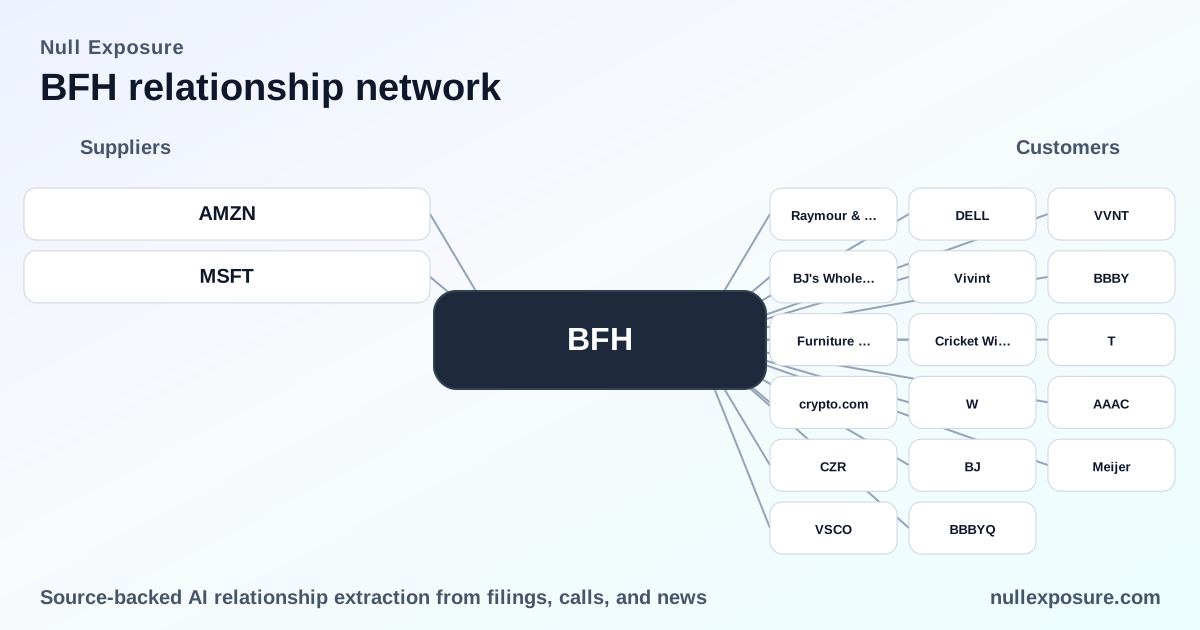
Bread Financial (BFH) — partner map that drives origination and loyalty economics
Bread Financial underwrites and operates co-branded credit and installment-lending programs for retailers and membership brands, monetizing through interest and fee income on credit receivables, interchange and platform fees from payment products, and sale/management of loan portfolios. The company grows volume by signing and renewing brand partnerships (co‑branded cards and BreadPay installment loans) while managing credit performance and periodic portfolio disposition as a capital management lever. For a concise partner coverage signal deck, visit https://nullexposure.com/.
How Bread Financial monetizes partners — a short primer investors need
Bread Financial’s commercial product set is straightforward: co‑branded credit cards, short‑term interest‑free split‑pay loans (BreadPay), and deposit/savings products for consumers. Revenue comes from three primary channels:
- Interest and fees earned on outstanding receivables from card and installment loans.
- Interchange and partnership fees driven by card spend and loyalty programs.
- Portfolio management actions (sales of receivables or portfolios) that can crystallize gains or free capital.
This merchant-partner model makes Bread a revenue amplifier when brand signings scale spend, but also exposes the company to concentration and renewal dynamics that materially affect top-line and credit volumes.
Key business model drivers: partner signings/renewals, card spend per active account, credit-loss trends, and periodic portfolio sales.
Operating constraints and what they signal about durability
Bread’s public disclosures include consistent signals about how the business operates:
- Short-term consumer credit is central. BreadPay “split-pay” loans are short-term, interest-free arrangements repaid in four installments, which emphasizes transaction velocity over long-duration receivables.
- Individual consumers are the primary counterparty. Bread’s core client is the retail consumer — DTC deposit products and consumer loans dominate product design and credit exposure.
- North America is the operating geography. Management frames the business as U.S.-centric, which concentrates regulatory and macro risk in one region.
- Buyer/partner-facing commercial role. Bread acts as the financial buyer and program sponsor for brands, providing capital, underwriting and loyalty mechanics.
- Services segment orientation. The company is effectively a financial-services platform selling credit and payment capabilities to merchants and brands.
Taken together, these signals show a business with high partner dependence, relatively mature product design, and transaction-driven margins, where portfolio liquidity management and renewal cadence are critical levers for investors.
Catalog of partner relationships investors should track
Below are every partner relationships referenced in the public results set, each with a one–two sentence plain‑English summary and the supporting source.
-
BJ’s Wholesale Club — Bread previously non‑renewed its contract with BJ’s and sold the BJ’s loan portfolio, closing that sale in late February 2023 for $2.5 billion on a ~$2.3 billion loan portfolio and recognizing a $230 million gain on the sale, illustrating portfolio monetization as a capital tool. (BFH 2025 Form 10‑K.)
-
Bed Bath & Beyond (BBBY / BBBYQ) — Management cited Bed Bath & Beyond as a notable new brand signing in the home vertical expansion during 2025, reflecting Bread’s push into e‑commerce and home furnishings. (Q4 2025 earnings call; earnings call transcripts published March 2026.)
-
Raymour & Flanigan — Signed as part of the home‑vertical push; management highlighted Raymour & Flanigan as a major furniture retail partner that broadens Bread’s footprint in the Northeast and national furniture channel. (Q3/Q4 2025 earnings calls, March 2026.)
-
Furniture First — Bread added Furniture First, a national cooperative buying group serving hundreds of independent home-furnishings and bedding retailers, signaling an approach that targets dealer networks as a single commercial relationship. (Q3/Q4 2025 earnings calls, March 2026.)
-
Caesars Entertainment (CZR) — Bread renewed a multiyear extension with Caesars and called out Caesars as a long‑term partner that drives travel & entertainment card spend and loyalty economics. (Q4 2025 earnings call; Finviz coverage March 2026.)
-
AAA (AAAC) — AAA is an active T&E partner and source of consistent spend on its co‑branded product; management noted good spend trends in AAA during the call. (Q4 2025 earnings call; Finviz/InsiderMonkey coverage March 2026.)
-
Academy Sports + Outdoors (ASO) — Bread partnered with Academy to launch the national myAcademy Rewards Mastercard and an enhanced loyalty program developed in partnership with Bread Financial, representing a major retail-brand rollout in 2026. (Press release covered by SAHM Capital and Academy announcement, May 2026.)
-
crypto.com — Bread signed and launched a relationship with crypto.com as part of its product diversification and BreadPay installment offerings, marking a move to non‑traditional merchant partners. (Q4 2025 earnings call, March 2026; InsiderMonkey coverage.)
-
Cricket Wireless — Bread launched BreadPay installment-lending with Cricket Wireless, an example of embedding short‑term financing across consumer electronics and telecom channels. (Q4 2025 earnings call; Finviz/InsiderMonkey reporting March 2026.)
-
Vivint — Vivint was launched as a BreadPay partner for installment lending, extending the product into home‑services and subscription-like categories. (Q4 2025 earnings call; Finviz/InsiderMonkey reporting March 2026.)
-
Dell Technologies — Listed among notable partners in the company’s filings and media summaries, Dell represents an anchor technology retail relationship in Bread’s portfolio. (SEC filings summarized by TradingView, March 2026.)
-
Victoria’s Secret — Cited as a notable partner in the 10‑K and media recaps, Victoria’s Secret contributes to Bread’s apparel and lifestyle retail exposure. (TradingView coverage of the 10‑K, March 2026.)
-
Ford Motor Company — Analyst commentary indicates Bread has been selected for a new long‑term cobranded credit card and installment program with Ford, a potential sizable growth catalyst if formalized across dealer and captive channels. (Investor/press reports aggregated by Investing.com, May 2026.)
-
Wayfair — Historical partner losses (e.g., Wayfair migrating to Citi) were noted by analysts as a background risk that underscores revenue concentration issues in retail card portfolios. (Morningstar company report, March 2026.)
-
Meijer — Meijer’s loss to a competitor was cited as an example of partner concentration risk and the volatility of retail partnerships. (Morningstar company report, March 2026.)
Risk / reward framework driven by partner dynamics
- Reward: New brand signings (Academy, Ford pipeline, Bed Bath & Beyond, Raymour & Flanigan, Furniture First) drive incremental card originations and interchange, and BreadPay increases transaction volume with low-interest, high-frequency repayment structures. Finely executed renewals (e.g., Caesars) preserve annuity-style revenue.
- Risk: High partner concentration and renewal risk remain the single largest commercial vulnerability — portfolio sales (BJ’s example) show management will monetize exposures but can reduce future interest income. Consumer credit cycles and U.S.-only exposure concentrate macro downside.
What investors should watch next
- Monitor quarterly KPIs for new‑partner spend velocity and account activation from announced signings (Academy, Ford if confirmed), and watch for further portfolio sales or material renewals that affect long‑run EPS and interest income. Visit https://nullexposure.com/ for structured partner analytics and renewal tracking if you need a deeper partner-exposure view.
Bold takeaway: Bread’s financial trajectory is directly linked to its ability to convert brand signings into durable card spend while controlling credit costs — partner wins accelerate growth, partner losses crystallize revenue declines.