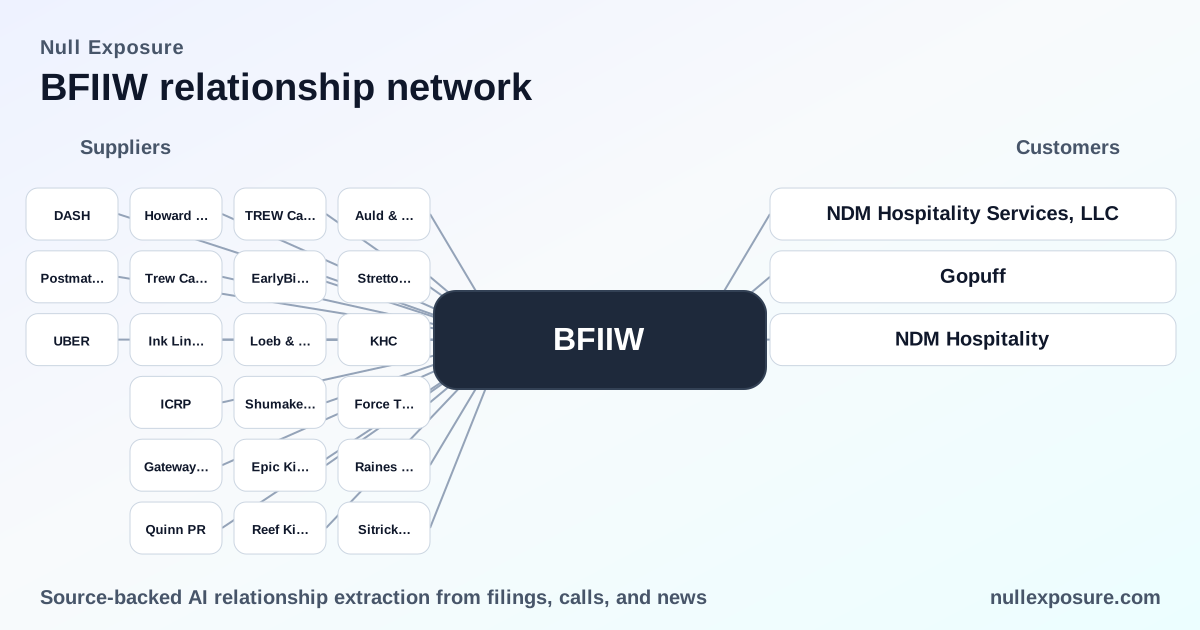
BurgerFi (BFIIW) Customer Relationships: who moves the brand and how value is captured
BurgerFi International operates and monetizes through a hybrid model of franchising, licensing and selective company-owned stores, supplemented by strategic delivery and development agreements; revenue is captured via franchise fees, ongoing royalties, licensing arrangements and retail sales of menu items. The company’s recent capital structure and restructuring activity have materially changed counterparty risk for customers and suppliers, making partner relationships central to any investor underwriting of BFIIW. For a consolidated view of counterparties and monitoring tools, visit https://nullexposure.com/.
Snapshot: partners that drive distribution, development and credit outcomes
BurgerFi’s external relationships break into three commercial buckets: franchise/development partners, delivery/licensing platforms, and credit/financial counterparties. These relationships govern how quickly the brand scales, how reliably revenue flows from same-store sales versus royalties, and how balance-sheet stress translates into ownership and control changes.
- Franchise and development groups expand footprint and deliver recurring royalty revenue.
- Delivery and ghost-kitchen partners extend reach and capture incremental, lower-margin ticket sales.
- Credit acquirers and lenders determine enterprise control in distress and shape recovery outcomes for stakeholders.
Complete roll call of customer and partner relationships
Below I list every relationship captured in the available record with a concise plain-English summary and source note for investor reference.
-
TREW Capital Management Private Credit 2 LLC — TREW executed a credit bid to acquire sister brands BurgerFi and Anthony’s Coal Fired Pizza & Wings out of bankruptcy for $44 million, effectively transferring ownership to a lender-led sponsor as part of the Chapter 11 process (court filings reported in FY2024). This transaction reconfigures counterparty risk: the lender is now a primary economic stakeholder and strategic decision-maker. According to Restaurant Business Online (court filings, FY2024), these assets were sold in a credit bid for $44 million.
-
NDM Hospitality Services, LLC — BurgerFi entered a multi-unit development agreement with NDM Hospitality Services to expand the Anthony’s franchising program, signaling reliance on third-party developers to scale adjacent brand concepts. The deal was announced publicly in FY2022 via a corporate press release. PR Newswire covered the multi-unit development agreement announcing franchising for Anthony’s Coal Fired Pizza & Wings (FY2022).
-
Gopuff — BurgerFi executed a license agreement with Gopuff to expand delivery via ghost-kitchen and instant-delivery channels, targeting up to 30 markets after a successful Tallahassee pilot; this extends the brand’s retail reach without traditional restaurant CAPEX. QSR Magazine reported on BurgerFi’s expansion into Gopuff-operated ghost kitchens and the licensing agreement (FY2022).
-
NDM Hospitality — Independent commentary from NDM Hospitality leadership framed the partnership as a strategic fit for BurgerFi’s product positioning in travel and dining channels, reinforcing the development partner’s role in brand placement in non-traditional venues. Matt Falcone of NDM Hospitality publicly commented on the partnership’s alignment with consumer demand for fresh offerings in QSR Magazine coverage (FY2022).
-
Ground Round Limited — BurgerFi signed a franchise partnership with Ground Round Limited that dates back to 2016 and has been referenced in retrospective reporting; the relationship highlights earlier efforts to secure franchise group partners for expansion. Mashed referenced the Ground Round Limited partnership as part of BurgerFi’s historical franchising strategy (reported in FY2025 referencing a 2016 agreement).
What the relationships reveal about the operating model and constraints
No explicit constraints were flagged in the relationship record; use this absence as a company-level signal while interpreting operating posture and maturity.
-
Contracting posture: BurgerFi executes multi-unit franchise and licensing agreements rather than relying solely on company-owned growth. This lowers near-term capital needs but increases exposure to franchisee execution risk and partner performance variability.
-
Concentration and counterparty mix: The partner set is diversified across franchise groups, a rapid-delivery platform and a financial sponsor, reducing single-counterparty concentration but increasing heterogeneity of dependencies — operational (franchisees), distribution (Gopuff), and financial (credit buyer).
-
Criticality: Delivery licensing and multi-unit developers are mission-critical for top-line growth and market access; the TREW credit bid is existential to corporate control and recovery value for equity and creditors.
-
Maturity and lifecycle: Relationships range from longstanding franchise ties (e.g., Ground Round Limited) to modern delivery/licensing experiments (Gopuff), indicating a mix of legacy agreements and newer distribution strategies.
Key implications for investors and operators
-
Control shifted to a lender-owner. The TREW credit bid for $44 million fundamentally alters governance and strategic priorities; investors must model a sponsor-led recovery or repositioning scenario rather than a standalone organic turnaround. (Restaurant Business Online, FY2024.)
-
Franchise-led growth remains the primary scaling vector. Multi-unit developers such as NDM Hospitality provide low-capex expansion but produce revenue reliant on royalties and franchise fees rather than high-margin company store sales. (PR Newswire, FY2022; QSR Magazine, FY2022.)
-
Delivery licensing buys reach but compresses unit economics. The Gopuff agreement accelerates access to demand-dense urban consumers at the cost of licensing fees and lower average check capture. (QSR Magazine, FY2022.)
-
Legacy partnerships still matter for brand footprint. Historical relationships such as the Ground Round Limited franchise arrangement are part of BurgerFi’s earlier expansion strategy and remain relevant for market coverage considerations. (Mashed, FY2025 referencing 2016.)
Financially, BurgerFi’s public operating figures show $167.3M revenue TTM with narrow reported EBITDA ($2.0M) and negative margins, so partner execution and the lender’s plan have direct balance-sheet consequences for recoveries and ongoing franchise support.
Practical next steps for due diligence and monitoring
- Obtain the court filings and asset-purchase agreements tied to the TREW transaction to understand assumed liabilities and the sponsor’s commercial plan.
- Review franchise agreements and territory commitments with NDM and Ground Round Limited to quantify near-term unit openings and guaranteed minimums.
- Analyze Gopuff performance metrics (order volume, average ticket, fulfillment costs) to assess incremental margin.
- Monitor public disclosures for any consolidation of ownership or re-franchising programs under TREW that will reallocate enterprise value.
For an ongoing, curated view of counterparty exposures and to integrate these relationship signals into underwriting workflows, see https://nullexposure.com/.
Bottom line
BurgerFi is a franchise-first operator that has used licensing and delivery partnerships to extend reach, but the company’s economic upside and downside are now tightly coupled to a lender-led restructuring outcome. Investors should treat TREW’s ownership position as the dominant variable for near-term value realization, while continuing to evaluate franchise and delivery partner performance as the engines of revenue generation and recovery.