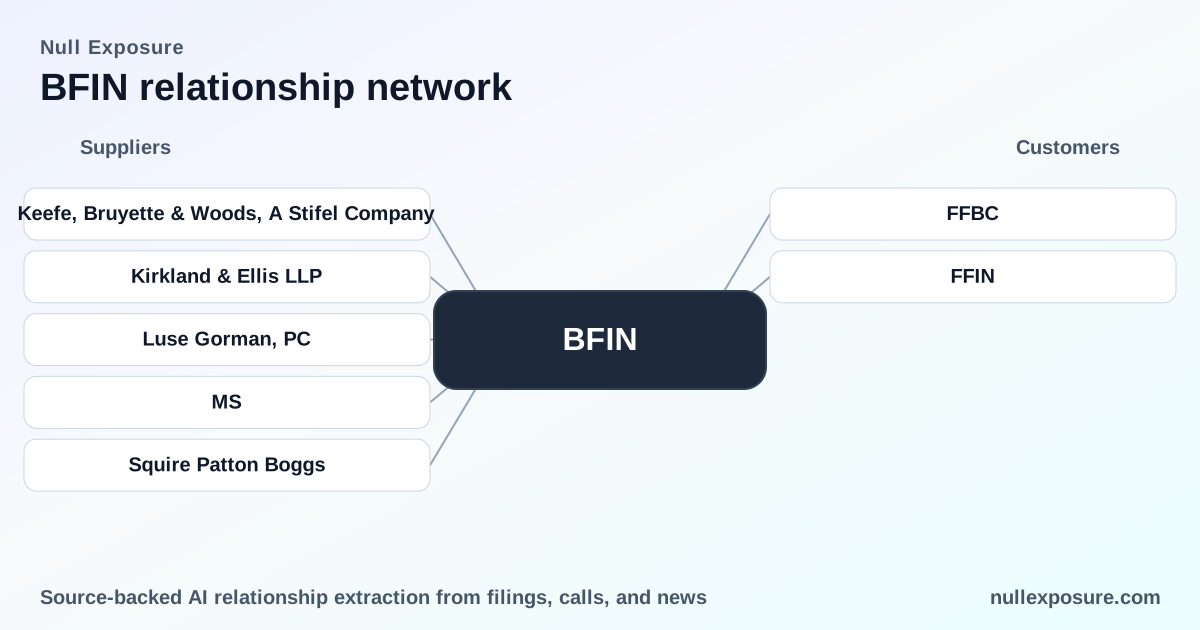
BankFinancial (BFIN) — customer relationships shaped by a strategic buyout
BankFinancial Corporation (BFIN) operated as a regional banking franchise whose primary revenue streams come from interest margin on lending and fee income from retail banking. The company monetized through deposit-gathering and commercial lending in the Chicago footprint, with a business model that made it a natural customer/counterparty for larger regional banking platforms and service providers. The material development for investors is that BFIN’s customer posture and revenue base were fundamentally altered by First Financial Bancorp’s acquisition on January 1, 2026, which consolidates operations and changes contractual counterparties and concentration dynamics going forward. For direct access to more situational analysis and relationship tracing, visit the Null Exposure homepage: https://nullexposure.com/.
Why the January 2026 transaction matters for BFIN counterparties
The all-stock acquisition of BankFinancial by First Financial Bancorp is the decisive event in the relationships captured here. A legal and operational merger transfers customers, contracts, and vendor relationships into the acquirer’s control, shifting counterparty risk from a smaller standalone franchise to a combined bank with roughly $22 billion in assets. That move reduces standalone counterparty risk tied exclusively to BFIN while increasing exposure to the acquirer’s contracting posture and integration execution. According to the public press release reported by The Globe and Mail, the transaction closed on January 1, 2026 and substantially expanded First Financial’s retail footprint in Chicago (press release, March 2026: https://www.theglobeandmail.com/investing/markets/stocks/FFBC-Q/pressreleases/36870896/first-financial-bancorp-completes-bankfinancial-all-stock-acquisition/).
Customer relationships: every named counterparty in the public results
Below are the relationships identified in the public signal set. Each entry is presented plainly with a short description and source reference.
FFBC
FFBC is the ticker label used in the press coverage to refer to First Financial Bancorp in the acquisition announcement; the transaction completed on January 1, 2026 and collapses BankFinancial’s banking subsidiary into the acquirer’s franchise, shifting customer and contract ownership to FFBC. A press release captured by The Globe and Mail documents the closing and the combined entity’s pro forma asset base of about $22 billion (The Globe and Mail, March 9, 2026: https://www.theglobeandmail.com/investing/markets/stocks/FFBC-Q/pressreleases/36870896/first-financial-bancorp-completes-bankfinancial-all-stock-acquisition/).
First Financial Bancorp
First Financial Bancorp is the acquirer that completed an all-stock acquisition of Chicago-based BankFinancial on January 1, 2026; this transaction is the direct mechanism by which BFIN’s customers, vendor contracts, and service relationships migrate to a larger combined institution. According to the same press release, First Financial merged BankFinancial’s banking subsidiary into First Financial Bank as of the closing (The Globe and Mail press release, March 2026: https://www.theglobeandmail.com/investing/markets/stocks/FFBC-Q/pressreleases/36870896/first-financial-bancorp-completes-bankfinancial-all-stock-acquisition/).
FFIN
FFIN is an alternative inferred symbol tied in reporting to First Financial Bank in the same transaction; the language in the filing and press coverage records the operational merger of BankFinancial’s bank into First Financial Bank as part of the integration. The Globe and Mail’s coverage of the closing explicitly references the merger of BankFinancial’s banking subsidiary into First Financial Bank (press release, March 2026: https://www.theglobeandmail.com/investing/markets/stocks/FFBC-Q/pressreleases/36870896/first-financial-bancorp-completes-bankfinancial-all-stock-acquisition/).
First Financial Bank
First Financial Bank is the operating bank that absorbed BankFinancial’s banking subsidiary under the acquisition, and therefore becomes the effective counterparty for any products, services, or customer relationships that had previously been held by BFIN’s banking unit. That operational consolidation is documented in the public announcement of the closing on January 1, 2026 (The Globe and Mail press release, March 2026: https://www.theglobeandmail.com/investing/markets/stocks/FFBC-Q/pressreleases/36870896/first-financial-bancorp-completes-bankfinancial-all-stock-acquisition/).
(Note on duplication: the four results reflect overlapping labels and inferred symbols for the same acquirer and operating bank; all are included here to preserve the original signal set.)
Constraints and what the silence implies about BFIN’s contracting profile
There are no recorded constraint excerpts in the public signals provided for BFIN. That absence is itself an informative company-level signal: no explicitly documented procurement constraints, exclusive supplier clauses, or notable contractual exposures were surfaced in the dataset supplied. From an operating-model perspective this implies several things for investors and vendors:
- Contracting posture: With no high-profile contractual constraints reported, BFIN’s pre-acquisition contracting posture likely reflected standard commercial bank arrangements rather than unusual or bespoke exclusivities. After the acquisition the contracting posture will be governed by First Financial Bancorp’s standard vendor and customer contracting frameworks.
- Concentration: The integration into a larger bank reduces counterparty concentration risk that would have existed with a standalone BFIN; customers and vendors are now concentrated within the combined institution’s vendor and legal frameworks.
- Criticality: For third-party suppliers, criticality of services formerly sold to BFIN should be reassessed under First Financial Bank’s operations and vendor rationalization processes; critical suppliers will be those that support core banking functions carried forward by the acquirer.
- Maturity: The lack of flagged constraints suggests maturity in commercial documentation consistent with regulated banking operations—contracts are likely standard, audit-ready, and subject to the acquirer’s integration and compliance playbook.
These are company-level signals and are not attributed to any specific named relationship from the results unless explicitly stated by a constraint excerpt; none did.
Investment implications — positives and risks investors should track
- Positive: The move into First Financial Bancorp’s balance sheet materially strengthens counterparty credit for obligations formerly tied to BFIN, with the combined institution having roughly $22 billion in assets as reported in the closing announcement. That enhances systemic resilience for counterparties and investors exposed to legacy BFIN cash flows.
- Integration risk: The principal near-term risk is integration: customer attrition, contract renegotiation, and vendor rationalization are typical after a bank merger and can affect revenue continuity and fee streams for providers serving the legacy BFIN franchise.
- Re-contracting exposure: Vendors and service providers should expect requests to re-paper agreements under First Financial Bank’s standard terms; this is when margin pressure or stricter SLAs can materialize.
- Regulatory and operational oversight: The consolidation subjects the migrated assets and contracts to First Financial’s compliance environment and any regional regulatory expectations, which can change the operating cadence for existing service providers.
Final read and next steps
For investors and operators evaluating exposures tied to BankFinancial, the dominant fact is transactional: BFIN’s customer and contractual universe now exists within First Financial Bancorp’s operating and contracting framework, and counterparties should focus diligence on the acquirer’s integration and vendor strategy. For a concise, continuously updated view on customer relationships and how they evolve through transactions, visit Null Exposure: https://nullexposure.com/.
Key takeaway: the acquisition transforms counterparty risk from a small standalone bank into a larger regional institution—stronger credit backdrop but practical execution and re-contracting are the immediate commercial levers investors must monitor.