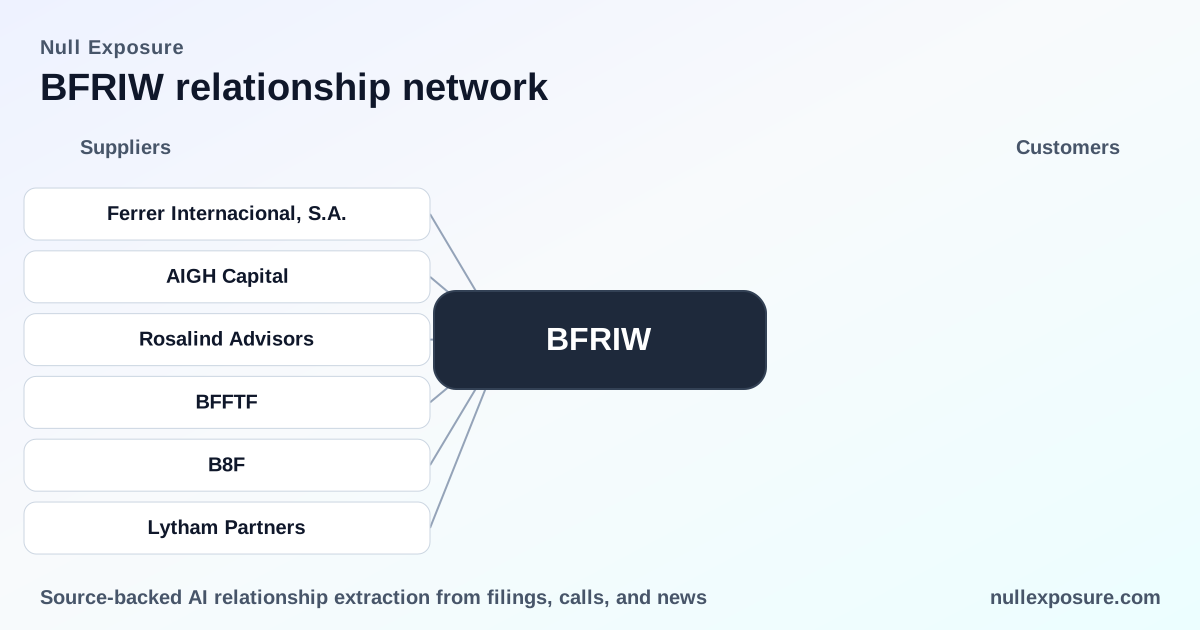
Biofrontera (BFRIW) — Customer relationships and what they imply for commercial value
Biofrontera monetizes through direct commercial sales of specialty dermatology products—chiefly Ameluz® photodynamic therapy and BF-RhodoLED® lamps—to dermatology practices in the United States, supplemented by selective asset divestitures and milestone-linked licensing deals. For investors evaluating the warrant class BFRIW, the critical question is whether Biofrontera’s customer and partner footprint supports scalable recurring revenue and cash generation while preserving upside from product sales and one-off deal receipts. For a concise briefing and deeper corporate relationship intelligence, visit https://nullexposure.com/.
How Biofrontera operates in the market and how that drives revenue
Biofrontera runs a focused commercial model: it owns U.S. commercialization rights for key products and sells directly to dermatology offices via its national sales organization, concentrating revenue on a narrow set of products. The company reported trailing twelve‑month revenue of roughly $41.7M with a gross profit of $30.7M, while ongoing investments drive an EBITDA loss (~$11.2M) and a negative EPS of -1.296 as of the latest quarter (2025‑12‑31). These numbers underline a business that is product-driven and sales-channel controlled—a pattern that favors margin capture on core treatments but also concentrates commercial risk.
The operating model implies:
- High commercial control and margin capture because of direct distribution in the U.S. under exclusive licenses.
- Concentration risk given reliance on a small number of core product lines for most revenue.
- Growth profile with profitability lag, evidenced by strong gross margin but negative EBITDA and EPS while the company scales its U.S. footprint.
The one customer/partner relationship reported: Pelthos Pharmaceuticals
Pelthos Pharmaceuticals — Biofrontera sold the antibiotic cream Xepi to Pelthos for $3 million at closing, an additional $1 million conditional on commercial availability, and up to $6 million in revenue‑linked milestones tied to reaching $10M and $15M in revenue thresholds. This is an outright divestiture intended to monetize a non‑core asset while retaining upside via contingent payments. (Source: Sahm Capital news release, March 19, 2026: https://www.sahmcapital.com/news/content/biofrontera-inc-reports-record-fourth-quarter-and-full-year-2025-financial-results-and-provides-a-business-update-2026-03-19)
Why the Pelthos transaction matters to investors
The Xepi sale is strategically important for three reasons:
- Immediate cash and de‑risking of non‑core inventory: $3M at closing strengthens near‑term liquidity without diluting product focus.
- Milestone structure preserves upside: Contingent payments tied to $10M/$15M revenue bands align seller proceeds with future commercial success at Pelthos.
- Signals deliberate portfolio pruning: The divestiture confirms management’s bias to concentrate commercial resources on Ameluz® and BF‑RhodoLED® rather than operating multiple branded dermatology franchises.
Company‑level commercial constraints and what they reveal
Company disclosures and recent filings characterize Biofrontera’s commercial posture. These constraints are company‑level signals and are not tied to the Pelthos transaction unless explicitly stated by the company.
- Geography: Biofrontera exclusively commercializes key products in the United States under license and supply arrangements, selling through its own U.S. commercial organization. This makes the U.S. market the primary revenue engine and exposes the company to U.S.-specific reimbursement and competitive dynamics.
- Relationship role: The company functions both as a seller (direct-to-practice product sales) and as a buyer in the sense of managing in‑licensing and supply agreements. The primary commercial posture is as an active seller to dermatology offices and groups.
- Segment focus: Core product sales—Ameluz® and BF‑RhodoLED® lamps—drive the business. Ancillary or non‑core products are candidates for divestiture, as exemplified by Xepi.
These constraints translate into investor-relevant implications:
- Contracting posture: Exclusive U.S. licenses and an internal sales force produce tighter margin control and closer customer relationships, but limit upside to organic market penetration and the success of the sales organization.
- Concentration and criticality: Revenue concentration on a small product set raises sensitivity to competitive entries, reimbursement shifts, and clinic adoption cycles; however, high gross margins on core products protect the top line.
- Maturity and capital profile: The company shows healthy revenue growth (quarterly revenue growth YOY ~36.2%) alongside negative profitability metrics, indicating a mid‑stage commercial company investing to scale rather than a mature cash generator.
Operational and market risks investors should weigh
- Milestone dependence for non‑core monetization: Divestitures with contingent payments (like Xepi) shift value capture to future commercial performance at the buyer, creating execution risk outside Biofrontera’s direct control.
- Single‑market dependence: Heavy reliance on U.S. commercialization concentrates regulatory and reimbursement risk geographically.
- Profitability runway: Despite solid gross profit, negative EBITDA and EPS imply continued funding needs or further asset sales unless operating leverage improves materially.
Upside scenarios to monitor
- Acceleration in clinic adoption of Ameluz® and BF‑RhodoLED® would lift recurring revenues rapidly because Biofrontera controls U.S. sales.
- Strategic licensing or selective divestitures (structured like the Pelthos deal) can fund expansion while preserving upside through milestone receipts.
- Improved operating leverage as the sales organization matures would convert gross margin strength into sustainable profitability.
Bottom line and next steps for due diligence
Biofrontera’s commercial model is focused, direct, and product-concentrated, which drives attractive gross margins but creates dependency on a narrow set of products and the U.S. market. The Pelthos transaction is a pragmatic example of management monetizing non‑core assets while retaining upside via milestones. Investors in BFRIW should prioritize tracking U.S. sales trends of Ameluz® and BF‑RhodoLED®, milestone receipts from divestitures, and the company’s path to positive EBITDA.
For a fast, structured read of Biofrontera’s partner and customer exposures and how they affect valuation scenarios, visit https://nullexposure.com/.
Sources referenced in this commentary:
- Sahm Capital press release covering Biofrontera’s FY2025 results and business update, March 19, 2026 (details of Xepi divestiture to Pelthos Pharmaceuticals).
- Biofrontera company disclosures and latest quarter reporting (latest quarter: 2025‑12‑31) for operating and revenue characteristics.