BFS-P-E: Tenant dynamics at a retail-focused REIT and what they mean for income stability
BFS-P-E operates as a real estate investment trust focused on premium retail and mixed-use properties, monetizing through long-term leases, active re‑letting of vacated storefronts, and value creation via targeted redevelopment in high-demand markets. For investors and operators evaluating customer relationships, recent local reporting at a key retail node highlights active leasing, anchor turnover, and rent re-pricing as the immediate drivers of cash flow and valuation sensitivity. Learn more about our coverage at https://nullexposure.com/.
Local reporting that matters to investors: the Seven Corners snapshot
A March 2026 local report on the Seven Corners shopping center provides a concise window into tenant-level churn and leasing strategy that directly informs BFS-P-E’s operating math. The article documents a mix of tenant exits, new openings, and anchor substitutions that illustrate how retail landlords convert turnover into rent resets and tenant mix upgrades. These are concrete operational signals: rent-led churn is generating reletting opportunities, while the presence of a grocery anchor stabilizes foot traffic and leasing economics.
Tenant-by-tenant takeaways from the report
-
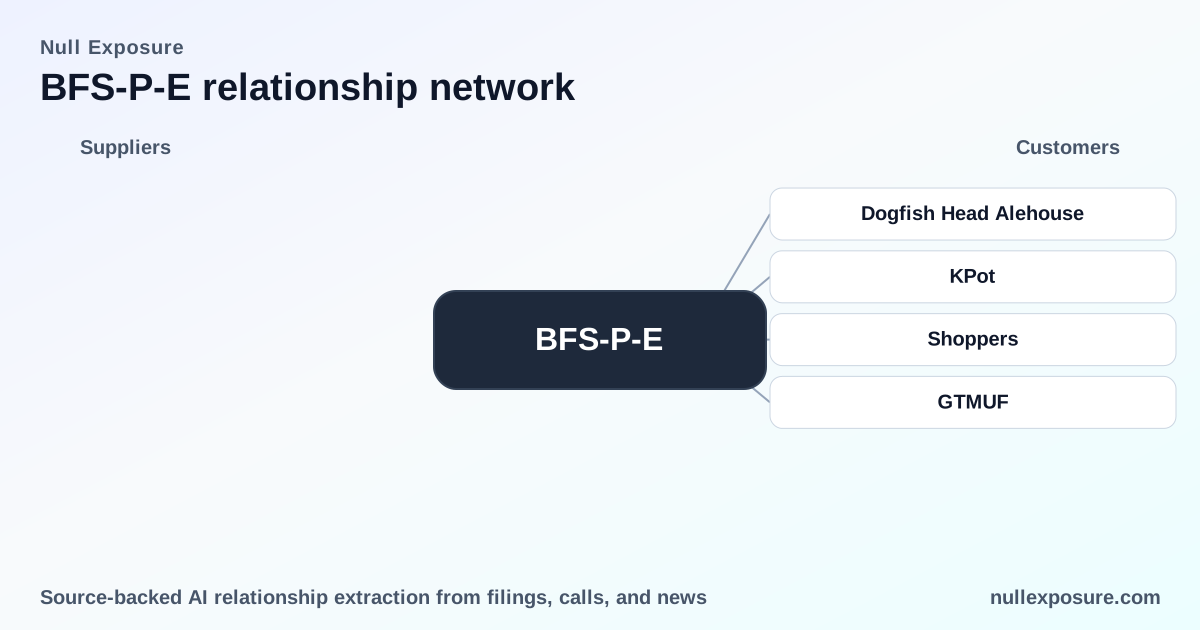
Dogfish Head Alehouse — The restaurant closed as of May 16 following a rent increase, and the landlord expected to announce a replacement tenant by June 1 (Annandale Today, March 2026; fiscal tag FY2022). This represents a near-term vacancy that the landlord is actively filling to restore rental income.
-
KPot — KPot, an all-you-can-eat Korean barbecue and hot pot concept, is scheduled to open in the former Fortune building on Arlington Boulevard (Annandale Today, March 2026; fiscal tag FY2022). This signals an active tenant recruitment pipeline targeting experiential dining that can sustain higher sales per square foot.
-
Shoppers — The local report notes that the former Shoppers location was replaced and that the space was repurposed prior to the current tenant mix (Annandale Today, March 2026; fiscal tag FY2022). This is an example of anchor turnover that required re-tenanting at the mid-to-large box level.
-
Giant (GTMUF) — Giant opened in March 2020 in the space formerly occupied by Shoppers; the report highlights the supermarket as a relatively new anchor (Annandale Today, March 2026; fiscal tag FY2022). The inferred public ticker GTMUF is associated with the Giant entry in the reporting, underlining the commercial importance of a stable grocery anchor for center economics.
-
GTMUF — The record also lists GTMUF separately, reflecting the same supermarket relationship and reinforcing the presence of a large-format grocery tenant as a demand-stabilizing factor (Annandale Today, March 2026; fiscal tag FY2022).
Each of these entries stems from the same center-level coverage and together describe a landlord executing active leasing and tenant-mix optimization to maintain income flows.
What these relationships reveal about BFS-P-E’s operating model
The tenant activity at Seven Corners is consistent with several company-level operating characteristics:
-
Contracting posture: The landlord is exercising active lease management—implementing rent increases and pursuing timely re-leasing when tenants exit. That posture favors rent-roll re-pricing as a lever for revenue growth.
-
Concentration and criticality: Presence of a supermarket anchor like Giant increases the center’s resilience; grocery anchors drive steady traffic and make inline retail tenancy more sustainable, reducing vacancy risk for smaller tenants.
-
Leasing maturity: The center’s ability to replace Shoppers with Giant (opened March 2020) and to attract new dining concepts suggests established market relationships and a functioning leasing pipeline rather than speculative repositioning.
-
Operational risk profile: Tenant churn driven by rent increases creates short-term vacancy risk but also creates upside when market demand supports higher rents; effective asset management converts that turnover into renewed cash flows.
These are company-level signals observed through tenant activity; none of these constraints attribute to a single named relationship unless explicitly stated in source excerpts.
Implications for investors and operators
The facts reported at Seven Corners translate directly into investor-relevant points:
-
Positive: Grocery anchor stability (Giant/GTMUF) supports center-level occupancy and protects base rents; active recruitment of experiential dining (KPot) can increase rental yields and extend evening/weekend traffic.
-
Negative: Restaurant closures after rent hikes (Dogfish Head Alehouse) show sensitivity among some tenants to rent resets, creating short-term vacancy and leasing cost exposure.
-
Net effect: For a retail-weighted REIT, the mix of grocery anchors and higher-turnover food & beverage tenants implies steady base income with episodic upside from successful re-leasing. Asset-level execution—speed of re-letting, tenant credit quality, and the quality of lease terms—will determine whether turnover is accretive or dilutive to cash flow.
Key monitoring items for investors:
- Occupancy trends and time-to-lease for vacated units.
- Rent step-ups achieved at lease renewals and new leases.
- Anchor lease expiration profiles and renewal likelihood.
- Local permitting or redevelopment changes that could alter foot traffic or competitive supply.
Risks, opportunities, and next steps
BFS-P-E’s operating model benefits from being landlord to essential anchors while exposing it to turnover risks typical of experience-based tenants. Investors should treat the reported tenant movements as actionable signals rather than anomalies: rent re-pricing is occurring, anchors are stabilizing traffic, and the leasing engine is active.
To stay current on tenant-level developments and to integrate them into portfolio analytics, use a disciplined monitoring cadence that tracks anchor performance, lease maturities, and re-leasing outcomes. If you want deeper tracking and relationship analysis tailored to underwriting and monitoring, visit https://nullexposure.com/ for coverage and subscription options.
Bold, decisive asset management at the center level will determine whether re-letting converts into durable income growth or transient vacancy. For investors focused on retail REIT preferred exposure, the interplay between anchor stability and tenant turnover at centers like Seven Corners is the most direct signal of near-term distribution resilience and longer-term value creation.