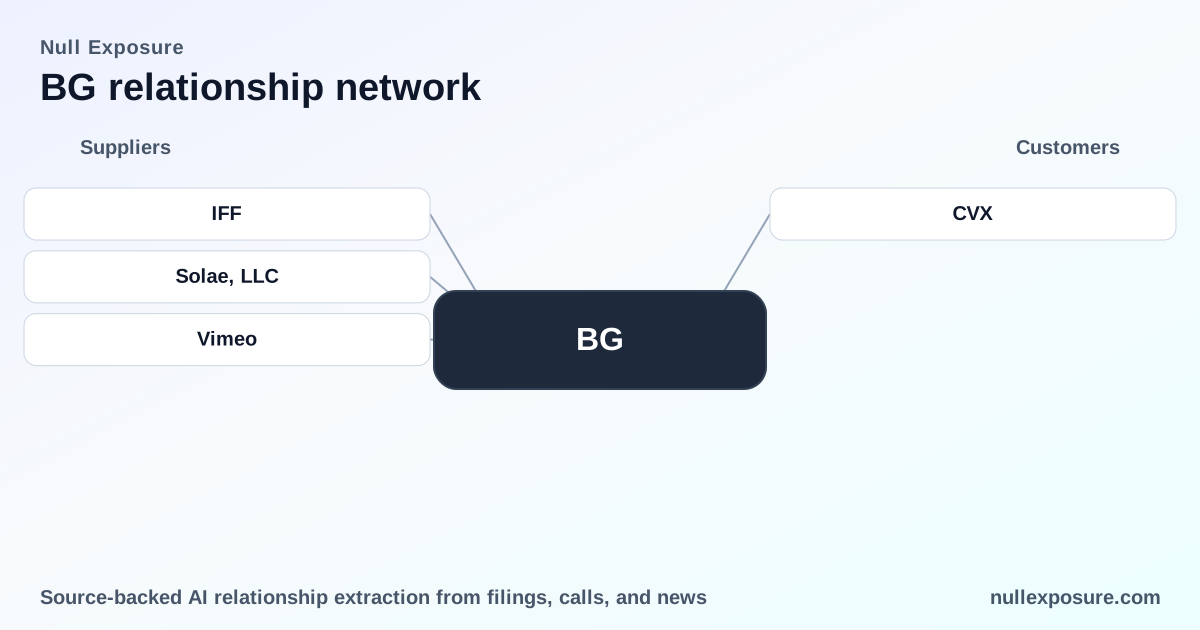
Bunge (BG) — customer map and what counterparties reveal about the business
Bunge is a global agribusiness that earns money by buying, processing and selling agricultural commodities and value‑added food ingredients — from oilseeds and edible oils to milled grains and fertilizer products — and by operating the logistics and crushing assets that connect farm supply to industrial and consumer buyers. Its monetization is concentrated in commodity merchandising, processing margins in oils and milling, and fees/turnaround from asset management of crush and storage facilities; this combination produces cyclical revenue with embedded logistics value. Investors should read the counterparty map as an operating map: disposals, joint ventures and R&D partners reveal where Bunge is concentrating capital, who consumes its feedstocks, and how the company manages commodity exposure. For further detail on counterparties and data-driven customer mapping, visit https://nullexposure.com/.
Quick take: what the recent relationships signal for investors
Bunge is actively reshaping its portfolio through asset sales and operational alliances while keeping upstream processing and logistics control over feedstocks. Recent FY2026 transactions show a tilt toward monetizing non‑core assets and partnering with energy majors for renewable feedstock offtake, while targeted R&D ties reinforce its processed‑product pipeline.
Explore the full customer map at NullExposure
Deal-by-deal briefing: every relationship in the public results
Bp Biofuels Brazil Investments Limited (FY2026)
Bp Biofuels Brazil Investments Limited completed the acquisition of the remaining 50% stake in BP Bunge Bioenergia S.A. from Bunge Global SA for $830 million, representing Bunge’s exit from a previously held biofuels joint venture and a meaningful portfolio monetization in Brazil in FY2026. According to Simply Wall St reporting (Oct 2026), the transaction converts a joint‑venture exposure into cash and reduces Bunge’s direct operating footprint in Brazilian bioenergy.
Grain Craft, Inc. (FY2026)
Grain Craft completed the acquisition of Bunge’s Corn masa milling businesses in North America as of Jul 2, FY2026, indicating Bunge’s decision to divest a regional milling asset line and to rationalize its U.S. milling portfolio. Simply Wall St reported the deal (Jul 2026), which reflects portfolio simplification and cash redeployment away from some downstream consumer‑food assets.
MLECW — R&D collaboration (2024Q4)
MLECW signed an R&D collaboration agreement with Bunge to develop safflower varieties aimed at improving productivity for specific applications and markets; the tie is a targeted agricultural research collaboration rather than a traditional customer or buyer contract. The arrangement was disclosed on MLECW’s Q4 earnings call (2024Q4; referenced Mar 2026), and signals Bunge’s continued investment in crop genetics and input optimization to secure processing feedstock quality and yield.
Chevron (news mention as "Chevron") (FY2026)
An agreement with Chevron positions Bunge to manage crushing facilities while Chevron receives purchase rights to the oil for conversion into low‑carbon transportation fuels, turning Bunge’s processing footprint into a strategic feedstock supply channel for an energy partner. GlobalAgInvesting reported the arrangement in FY2026 (Mar 2026), underlining Bunge’s role as operational manager and feedstock supplier in a renewable fuels supply chain.
CVX (duplicate Chevron mention) (FY2026)
A second report reiterates that Bunge will operate the crushing assets and that Chevron (CVX) holds offtake rights for the vegetable oil as renewable feedstock, emphasizing the commercial structure: asset operations by Bunge, offtake and downstream processing rights to Chevron. The same GlobalAgInvesting coverage (Mar 2026) documents this joint commercial posture and highlights how Bunge monetizes processing beyond commodity spreads.
CSAN / Cosan S.A. (FY2012)
A Mercopress report from 2012 recounts BG Group plc’s sale of a 60.1% stake in Comgas to Cosan S.A. for roughly 3.4 billion Brazilian Reais; the item concerns BG Group plc (a British natural gas company) and is not related to Bunge Limited’s customer relationships, reflecting a historical/sectoral name collision in public sources. Mercopress (May 2012) documents the transaction and underscores the necessity of distinguishing corporate identifiers when mapping counterparties.
What these relationships reveal about Bunge’s operating model and contract posture
The relationship map and supporting constraints point to a company that operates globally, sells commodity and processed products under short‑term commercial contracts, and leverages asset operations as a revenue and strategic axis.
- Short contracting posture: Bunge’s commodity sales typically do not extend beyond a single crop cycle; this establishes a short‑term revenue cadence and requires continuous merchandising and hedging. The company‑level signal from contract evidence places contracting risk on active commercial teams rather than long‑dated offtakes.
- Global footprint with regional concentration: Net sales data show material exposure to North America, Europe, Asia‑Pacific and Latin America — the company runs integrated operations across these regions, which supports scale in logistics and merchandising but also exposes Bunge to multinational regulatory and trade shifts.
- Seller and operator roles: Bunge is not only a seller of commodity products but also an operator of physical assets (crush plants, mills, storage), which it both uses to capture processing margin and, increasingly, monetizes through operational management agreements and selective divestitures.
- Portfolio maturity and maturity signals: The FY2026 disposal activity (BP Bunge Bioenergia stake, North American corn masa milling sale) indicates a portfolio rebalancing strategy toward core processing and merchanting rather than diversified consumer manufacturing.
These signals combine into a working model: Bunge executes short‑cycle commodity sales, uses global scale in logistics and processing to extract margin, and selectively partners with energy and industrial counterparts to convert processing assets into contractable feedstock supply channels.
Investment implications — where to be constructive and where to be cautious
- Constructive: The Chevron joint structure and continued R&D collaborations demonstrate Bunge’s ability to convert processing assets into fee/operational roles and to lock industrial buyers to its feedstock funnel; this supports margin stability beyond pure trading spreads. Bunge’s global scale and asset control create defensible channels into industrial offtakers.
- Cautionary: Short‑term contract posture means earnings are exposed to seasonal crop cycles and commodity price volatility; asset disposition activity reduces diversification and can create one‑time cash boosts without addressing margin cyclicality. Global revenue concentration across multiple regions offers diversification, but also geopolitical and trade execution risk.
- Valuation context: The company posts large revenues with modest operating margins (Revenue TTM ~$80.5B; Operating Margin TTM ~1.24%); investors should weigh operational improvements and strategic partnerships against cyclicality and the capital intensity of processing and logistics.
Bottom line and next steps
Bunge is actively reshaping where it participates in the value chain — from cashing out non‑core assets to monetizing crush and storage capabilities through partnerships with energy majors. For investors evaluating customer relationships, the map shows a firm that sells short‑cycle commodity and processed products, runs global operations, and uses targeted partnerships to convert assets into recurring industrial supply roles. For a comprehensive, investor‑grade customer relationship map and ongoing monitoring of counterparties, see how NullExposure maps these interactions at https://nullexposure.com/.
Bold bets on Bunge should be predicated on conviction in management’s ability to stabilize processing margins and to harness strategic offtake agreements into durable earnings streams; absent that, the short‑term contracting posture will continue to drive earnings variability.