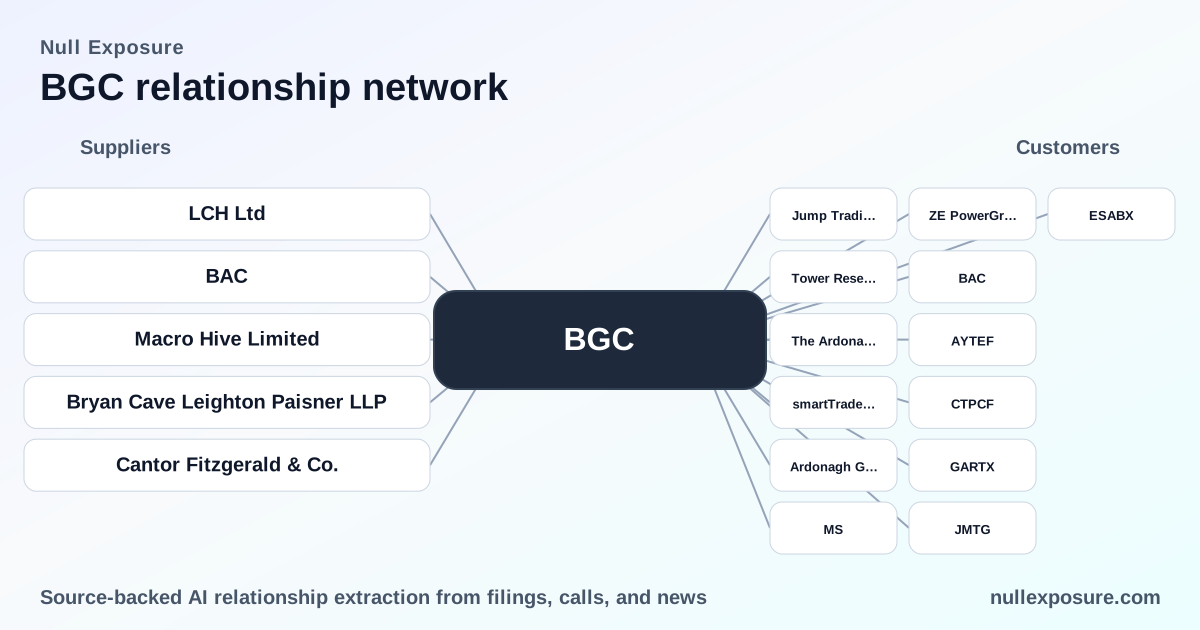
BGC Group: Customer Relationships That Drive Liquidity, Data and Tech Revenues
BGC Group operates as a global brokerage, market‑data and financial‑technology platform that monetizes through transaction commissions (trade‑date spot recognition), recurring data subscriptions, and software/services contracts. Its business model blends high‑frequency commission revenue from inter‑dealer broking with subscription fees for market data and targeted software sales, supplemented by occasional asset dispositions (e.g., business sales). For investors, the critical lens is how concentration among very large financial counterparties, a global footprint, and a mixed contract posture (spot + subscription + limited long‑term agreements) shape revenue durability and operational risk. Explore the primary relationship map at https://nullexposure.com/.
How these customers shape economics and risk
BGC’s customer roster reads like a who’s‑who of global capital markets, and that confirms several structural attributes: commission income is transactional and sensitive to volumes, while data and software generate recurring, higher‑margin revenue. The company reports limited long‑term contracts overall, implying revenue is partly volatile but cushioned by subscription-style data sales and the company’s role as a critical liquidity provider to institutions and governments across EMEA, Americas and APAC. Top‑ten customers contributed ~27.1% of revenue in 2024, so counterparty concentration is material and requires monitoring for client churn or regulatory shifts.
A brief reminder: you can request a consolidated view of BGC customer exposures and filings at https://nullexposure.com/ for deal-level diligence.
Company‑level operating signals (what the constraints tell us)
- Contracting posture: Revenue mixes include spot (commission) recognition at trade date and subscription‑based data contracts, with only a limited set of long‑term contracts disclosed. This creates a dual‑layer revenue profile — transactional cycles plus recurring data cash flows.
- Counterparty profile and criticality: Clients include governments and very large enterprises; BGC functions as both a service provider (brokerage, market data, post‑trade) and a buyer of liquidity access where needed — positioning it as operationally critical to institutional counterparties.
- Geographic diversification: BGC is global, with material revenue exposure to EMEA, the U.S. and APAC, reducing single‑market dependency but increasing regulatory complexity.
- Concentration and materiality: Top ten customers ~27.1% of revenue (2024) — concentration is meaningful and should be tracked alongside the company’s client retention metrics.
- Segments and maturity: The firm runs a services‑first franchise (brokerage, market making and connectivity) with a smaller but strategic software/data arm (kACE historically) that served hundreds of client sites, indicating product maturity in analytics and price discovery.
- Spend scale: Related‑party and service relationships can run into tens of millions annually for major clients, suggesting enterprise‑level procurement dynamics for key accounts.
The customer relationships disclosed (direct excerpts mapped to plain English)
Tower Research Capital
Tower Research Capital is listed among a group of institutional firms that became minority equity owners in FMX, reflecting strategic marketplace participation tied to BGC’s FMX asset. This is disclosed in BGC’s 2024 Form 10‑K. (Source: BGC 2024 10‑K)
Jump Trading Group
Jump Trading Group is similarly noted as a minority equity investor in FMX, positioning it as a market participant/investor aligned with BGC’s execution venue strategy. (Source: BGC 2024 10‑K)
GFI
GFI is referenced in market commentary describing institutional client access to a Swap Execution Facility either directly or via BGC or GFI brokers, indicating overlapping distribution channels and a cooperative competitive dynamic in derivatives execution. (Source: TradingView / FinanceMagnates coverage, FY2025)
smartTrade Technologies SAS
BGC entered into a definitive agreement to sell its kACE Financial business to smartTrade, transferring kACE’s real‑time FX derivatives pricing and analytics capabilities to a multi‑asset electronic trading vendor. This sale was announced in December 2025 / March 2026 press coverage. (Source: BGC press announcements / markets.financialcontent and PR coverage, FY2025–FY2026)
The Ardonagh Group / Ardonagh Group
BGC sold its Insurance Brokerage business to The Ardonagh Group for $500 million in cash consideration, a completed deal first announced in 2021 and referenced in public press releases. This divestiture removed a non‑core insurance brokerage line from BGC’s operating mix and crystallized cash for the balance sheet. (Source: PR Newswire and Insurance Business reporting, FY2021)
Morgan Stanley
Morgan Stanley is listed among institutions that took minority stakes in FMX, underscoring the strategic alignment between large dealer institutions and BGC’s trading venues or assets. (Source: BGC 2024 10‑K)
ZE PowerGroup
Fenics Market Data (a BGC division) partnered with ZE PowerGroup to distribute energy and commodities pricing through ZE’s data management platform, extending Fenics’ market‑data distribution to channel partners and end‑users. (Source: Fenics press release via PR Newswire, FY2023)
Bank of America (BAC)
Bank of America is enumerated with other major banks as a minority equity owner in FMX, reflecting bank participation in BGC’s venue interests and reinforcing inter‑dealer ties. (Source: BGC 2024 10‑K)
Barclays
Barclays is also listed as a minority investor in FMX, consistent with the pattern of major global dealers taking stakes in the platform. (Source: BGC 2024 10‑K)
Citi
Citi appears alongside peers as a minority equity owner of FMX, again emphasizing the platform’s alignment with large dealer liquidity providers. (Source: BGC 2024 10‑K)
Goldman Sachs
Goldman Sachs is named among the FMX minority investors, signaling deep dealer engagement with BGC’s trading infrastructure. (Source: BGC 2024 10‑K)
J.P. Morgan
J.P. Morgan is recorded as a minority equity participant in FMX, reinforcing the same institutional backing from top global banks. (Source: BGC 2024 10‑K)
Wells Fargo
Wells Fargo rounds out the list of major banks that took minority ownership in FMX, confirming broad dealer participation across the US and international bank syndicate. (Source: BGC 2024 10‑K)
(Each of the FMX investor references above comes from the same 2024 Form 10‑K disclosure listing the group of minority equity owners.)
Investment implications and what to watch
- Revenue mix monitoring: Track quarterly splits between commission/spot volumes and subscription/data sales to assess cash flow stability. The combination of spot recognition and subscriptions creates asymmetric volatility that investors need to model explicitly.
- Client concentration risk: Top‑10 = 27.1% of revenue (2024) is material; any attrition among large dealers or shifts in inter‑dealer relationships could move margins quickly.
- Regulatory and geographic exposure: With meaningful revenues from the U.K., U.S. and APAC, regulatory changes in key markets will materially affect execution and data businesses.
- Asset rationalization: The sale of kACE and the 2021 insurance‑brokerage divestiture show active portfolio management; further strategic exits or tuck‑ins will change the revenue composition and should be priced into forecasts.
For a consolidated, investor‑grade view of BGC’s customer exposures, filings and relationship disclosures, visit https://nullexposure.com/ — the source for structured counterparty intelligence and file‑level citations.