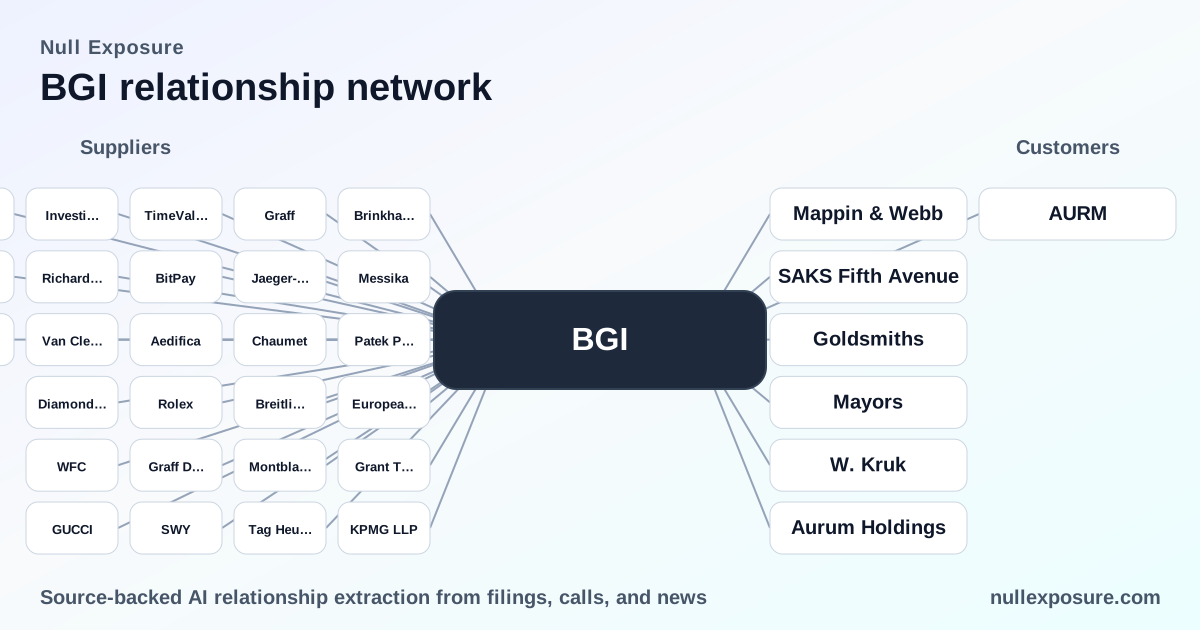
Birks Group (BGI) — Retail partnerships drive brand reach; wholesale placements underpin near‑term revenue
Birks Group designs, manufactures and retails fine jewelry, watches and sterling silver, monetizing through a mix of owned retail, e‑commerce and wholesale placements with department and specialty jewelers across North America and the UK. For investors, the operating model is straightforward: product margin from manufacturing plus distribution margin through partner retailers; expanding brand presence with third‑party retailers is the primary lever for incremental revenue. For deeper customer relationship intelligence, visit https://nullexposure.com/.
How Birks actually goes to market
Birks operates an omnichannel consumer luxury model that blends company‑owned stores and third‑party retail distribution. Public filings and press material consistently list a network of well‑known retail partners—SAKS Fifth Avenue, Mappin & Webb, Goldsmiths, Mayors and W. Kruk—used to place Birks‑brand collections into premium retail footprints in the United States, Canada, the United Kingdom and Poland. These are stocking/wholesale relationships rather than exclusive, captive channels; they extend reach without the fixed costs of store expansion and allow Birks to monetize inventory and brand licensing through partner shelf space.
Operational characteristics that investors should treat as model fixtures:
- Contracting posture: partner stocking agreements and wholesale placements anchored to established luxury and specialty retailers rather than exclusive distributorships.
- Concentration: geographic diversification across North America, the UK and Poland reduces single‑partner risk; no single wholesale partner is identified as revenue‑critical in the sourced materials.
- Criticality: third‑party placements are material to distribution strategy, functioning as the primary route to international customers for the Birks brand.
- Maturity: the relationships are established over multiple fiscal periods in disclosed press releases and industry coverage, indicating an existing, operational wholesale channel rather than one‑off retail experiments.
Customer relationships: who carries Birks products (and what the sources say)
Below are every relationship flagged in the reporting sample, each described in plain English with the published source.
SAKS Fifth Avenue
Birks fine jewelry collections are sold through select SAKS Fifth Avenue stores in Canada and the U.S., providing Birks with premium department‑store exposure in core North American luxury retail corridors. This placement is documented in Birks’ mid‑year fiscal press material reported via PR Newswire and carried by The Globe and Mail (FY2025/FY2024 press releases).
Mappin & Webb
Maison Birks signed an agreement to have its own‑brand jewelry stocked by the UK retailer Mappin & Webb, giving Birks direct access to the British market through an established luxury jeweler. The Jewellery Editor profiled this placement in an article discussing Birks pieces (FY2018), and Birks’ later press releases reiterate Mappin & Webb as a stocking partner (FY2024–FY2026).
Goldsmiths
Birks collections are available at select Goldsmiths locations in the United Kingdom, establishing another UK wholesale channel for the brand. The inclusion of Goldsmiths is listed in Birks’ mid‑year results and accompanying PR material reported by The Globe and Mail and PR Newswire (FY2024–FY2026).
Mayors
Birks product lines are carried in Mayors stores in the United States, placing Birks in U.S. specialty jeweler locations to augment department‑store distribution. Mayors is named explicitly in Birks’ fiscal press disclosures (reported in The Globe and Mail and BizWire coverage, FY2024–FY2025).
W. Kruk
In Poland, Birks collections are distributed through W. Kruk stores, giving the brand a foothold in Central Europe via a regional specialty jeweler. W. Kruk is listed among Birks’ international retail partners in the company’s mid‑year fiscal reporting (PR Newswire / FinancialContent coverage, FY2024–FY2025).
Aurum Holdings / Aurum (AURM)
Historically, Birks completed the sale of Mayor’s Jewelers to Aurum, shifting strategic focus toward promoting the Birks brand internationally rather than owning that U.S. retail asset; this transaction is recorded in prior PR disclosures summarized on investor news sites (FY2015). Finviz and contemporaneous PR reporting reference the Aurum transaction as part of Birks’ strategic repositioning (FY2015).
What these relationships imply for revenue quality and risk
- Revenue channels are diversified by partner and geography. Birks uses a mix of department stores and specialty jewelers to reach consumers across North America, the UK and Poland; this reduces single‑partner dependency while enabling the company to scale brand distribution without equivalent capex.
- Wholesale placements are tactical and mature. The recurring mentions of the same partners across multiple fiscal periods show established stocking arrangements rather than ephemeral test programs.
- No vendor‑specific contractual constraints are reported in the relationship‑scope crawl. The absence of flagged constraints in the review indicates there are no published, partner‑level legal encumbrances captured in these sources.
Financial and governance context investors should weigh
Birks is a small‑cap luxury retailer with FY‑trailing revenue of about $191M and gross profit of roughly $71.5M, but the company reports negative EPS (−$0.46) and negative book value per share (−0.771) in the most recent public metrics. Insiders control ~76% of shares, while institutional ownership is minimal (1.2%), concentrating governance influence with insider holders. These factors combine with a low market capitalization ($13.9M) to produce a stock that reflects both operational scale and acute financial stress.
Investment takeaways
- Positive: distribution through marquee retailers gives Birks credible international exposure without heavy retail capex. Department‑store and specialty placements expand brand reach and support wholesale volume.
- Negative: weak profitability, negative equity metrics and concentrated insider ownership present clear governance and solvency risks. The wholesale model extends reach but does not substitute for improved margins and balance‑sheet repair.
- Actionable: investors valuing brand growth should track same‑store sales and wholesale replenishment reported in upcoming fiscal releases; credit‑focused investors should prioritize cash‑flow signals and any changes to partner terms that could affect inventory turns.
For detailed relationship intelligence and ongoing monitoring of retail partner activity, visit https://nullexposure.com/.
Bold summary: Birks leverages third‑party retail partnerships as the primary channel for international expansion; these relationships are established and geographically diversified, but the company’s weak profitability and concentrated ownership create material investment risk.