BGMS Customer Relationships: What Investors Should Know About Revenue Sources and Strategic Partners
Bio Green Med Solution, Inc. operates a hybrid business that distributes and installs protective and fire-safety equipment while also owning clinical-stage pharmaceutical assets; it monetizes through product and service sales in its safety business, recovery of clinical manufacturing costs for investigator-sponsored trials, and one-off asset dispositions of drug intellectual property. Revenue is concentrated, episodic, and supplemented by asset sales rather than a diversified recurring commercial franchise. Learn more about the firm’s customer profile and relationship signals at Null Exposure.
Why customers matter for BGMS: a concise investor framing
BGMS’s customer map exposes two distinct commercial realities: a traditional safety-equipment distribution channel that generates modest, point-in-time receipts, and a biotech/IP arm that converts intangible assets into discrete cash events. The company’s recent disclosures show spot, point-in-time revenue recognition for clinical supply and an explicit transaction where patent rights for its lead compound were sold to a third party for a fixed cash consideration plus contingent milestones. These dynamics define BGMS’s operating posture as transactional and asset-driven, not subscription-based or scale-dependent on a large installed base.
Key operating signals investors should track
- Contracting posture — spot sales dominate. The company recognizes revenue when control transfers, reflecting single-performance-obligation engagements for clinical supply rather than long-term contracts.
- Global IP ownership vs. limited commercial scale. BGMS retains global marketing rights to its Plogo program historically, but monetized IP through an asset sale in 2025, signaling a shift from holding to realizing asset value.
- Concentration and criticality. Revenue is small in absolute terms (Revenue TTM: $747k) and the firm’s operating losses are large relative to sales (EBITDA: -$8.42M), so single customers and asset transactions exert outsized influence on reported results.
- Maturity of relationships — transactional and active. The filing notes completed collections on the cited clinical engagement, with no outstanding performance obligations recorded as of year-end.
Relationship snapshots — what the filings and press coverage disclose
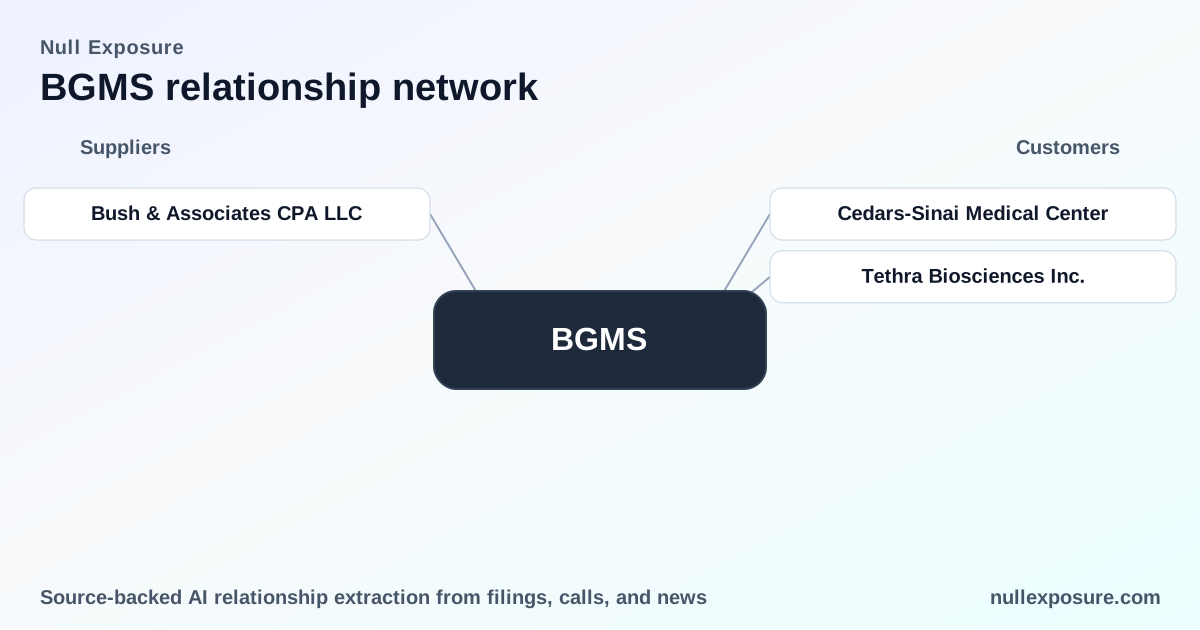
Cedars‑Sinai Medical Center
BGMS recognized revenue as a recovery of clinical manufacturing costs related to an investigator‑sponsored study managed by Cedars‑Sinai Medical Center; the arrangement was treated as a single performance obligation and revenue was recognized at the point in time when clinical supplies transferred to CSMC. According to the company’s 2024 Form 10‑K, all amounts due from CSMC had been collected and no receivables or remaining performance obligations were outstanding as of December 31, 2024. This relationship is therefore a completed, spot commercial engagement rather than an ongoing revenue stream (Source: BGMS 2024 Form 10‑K).
Tethra Biosciences Inc.
BGMS entered into an Asset Purchase Agreement in October 2025 under which it sold patent rights related to Plogosertib (a PLK1 inhibitor) to Tethra Biosciences for a base purchase price of $300,000 plus a contingent milestone payment of $170,000; the company publicly reported the transaction in a November 13, 2025 press release on GlobeNewswire and subsequent market reporting. This is a cash-conversion event of intellectual property rather than recurring sales revenue, and it materially changes the company’s exposure to that compound. (Sources: GlobeNewswire press release, Nov 13, 2025; related market reports).
How the constraints in disclosures translate into business model characteristics
The company-level constraints derived from BGMS disclosures create a clear operational profile for investors:
- Contract Type — spot: The CSMC engagement is documented as a point-in-time sale with a single performance obligation, which signals BGMS’s reliance on transactional clinical-supply recoveries rather than multi-period contracts. (Company-level evidence in 10‑K language about point-in-time recognition for CSMC.)
- Relationship Role — seller: BGMS positions itself as the seller of goods and IP, holding global marketing rights historically and executing asset sales when appropriate; this underlines a monetization strategy focused on asset realization and vendor transactions.
- Geography — global rights for Plogo: The company retains (and historically retained) worldwide marketing rights to product candidates like Plogo, indicating the firm’s IP ambitions were global even if commercial execution was limited.
- Relationship Stage — active/completed: The CSMC engagement is reported as collected and closed at year-end, with the filing acknowledging the possibility of additional orders but no existing liabilities; treat such relationships as episodic and opportunistic.
- Segment — core product focus on Plogo: Disclosures tag Plogo as a core asset, though the subsequent sale to Tethra shifts that asset out of BGMS’s ongoing pipeline.
Investment implications and risk checklist
BGMS’s customer disclosures and financial profile create a distinct risk-reward dynamic for investors:
- Balance-sheet and liquidity context: Market capitalization (~$5.69M) and small TTM revenue ($747k) leave limited runway absent asset monetization or meaningful recurring income. Operational losses are material — EBITDA is negative $8.42M — which elevates refinancing and dilution risk.
- Revenue volatility: With spot clinical-supply recoveries and occasional IP sales driving cash, quarter-to-quarter top-line performance will be volatile and lumpy. Do not model BGMS as having stable recurring revenues.
- Concentration risk: Few named counterparties and the completed nature of the CSMC engagement mean new contracts will be required to replicate revenues; the company’s high insider ownership (54%) and low institutional ownership (1.44%) underline governance and liquidity constraints that investors must factor into valuation assumptions.
- De-risking via asset disposal: The sale of Plogosertib rights reduces program-related development risk for BGMS but also removes upside if the compound achieves significant commercial milestones under a new owner.
Bottom line: what investors should watch next
BGMS is executing a transactional, asset-focused commercial strategy rather than building a diversified recurring-revenue business. Key near-term indicators to monitor are the cadence of clinical-supply contracts, further IP monetizations or milestone receipts, and any moves to convert distribution activities into higher-margin recurring services. For a detailed look at customer relationships and to track further disclosures, visit Null Exposure.
Bold takeaways:
- Revenue drivers are episodic: clinical supply recoveries and IP sales dominate.
- Financials reflect a small operating base with outsized losses, making each customer or asset transaction materially important.
- The Plogo asset sale to Tethra crystallizes cash value but removes future upside tied to that program.
Investors should treat BGMS as an opportunistic, transaction-led company where single-customer and single-asset outcomes will disproportionately affect valuation.