BGMSP Customer Relationships: What Investors Need to Know Now
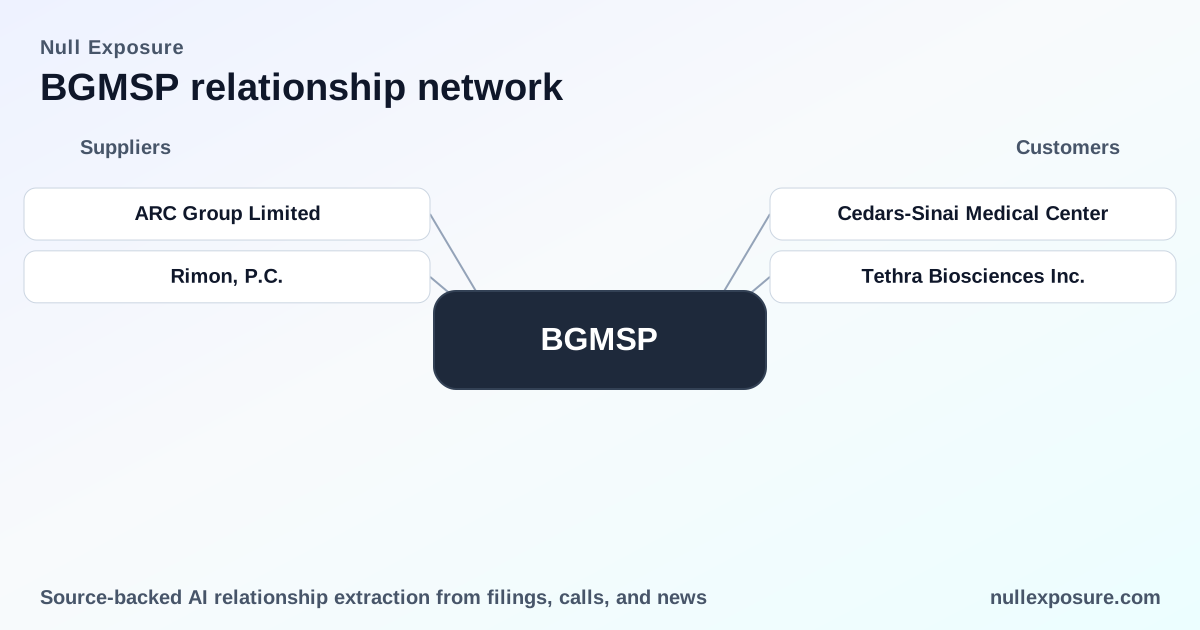
Bio Green Med Solution, Inc. (BGMSP) operates as a distributor and services provider for protective and fire-safety equipment and has been monetizing a small portfolio of clinical manufacturing recoveries and one-off asset sales; its commercial cash flows today are episodic and tied to discrete transactions rather than recurring operating revenue. For investors and operators evaluating customer exposure, the company’s record shows a nominal revenue contribution from a clinical supply recovery with Cedars‑Sinai and a separate asset-sale transaction to Tethra Biosciences that converts intellectual property into immediate cash plus contingent milestone upside. For more context on transaction-level signals and relationship risk, see additional analysis at https://nullexposure.com/.
One-line investment thesis for relationship risk
BGMSP’s customer relationships are transactional and low-scale: clinical manufacturing recoveries for investigator-sponsored studies and discrete asset monetizations dominate reported interactions, producing predictable legal/contractual obligations but unpredictable revenue scale.
Cedars‑Sinai Medical Center — small, defined clinical-supply buyer
BGMSP recognized $43,000 of revenue in FY2024 for recovery of clinical manufacturing costs related to an investigator‑sponsored study managed by Cedars‑Sinai Medical Center; revenue was recognized at a point in time when CSMC obtained control of the goods, and the company treats the arrangement as a single performance obligation. This description is drawn from the company’s FY2024 Form 10‑K filing, which explicitly documents the transaction accounting and the $43,000 recognition. According to the 2024 Form 10‑K, the Cedars‑Sinai relationship is a buyer arrangement for manufacturing cost recovery and is contractually simple, point-in-time in nature.
- Source: Bio Green Med Solution, Inc., Form 10‑K (FY2024) — disclosure of revenue recognition and the $43,000 clinical manufacturing recovery.
Tethra Biosciences Inc. — asset purchaser, immediate cash plus contingent milestone
In October (reported in FY2025 filings and reiterated in FY2026 releases), BGMSP entered an Asset Purchase Agreement with Tethra Biosciences under which BGMSP sold patent rights and other assets related to Plogosertib (a PLK1 inhibitor) for $300,000 up‑front plus a potential $170,000 milestone. The company announced the transaction in a November 13, 2025 GlobeNewswire release and the deal detail is recapped in 2026 reporting and external news; additional coverage appeared on industry news sites in May 2026. This is an asset-sale relationship rather than a continuing customer supply contract, converting IP into near-term liquidity while leaving limited contingent upside.
- Sources: GlobeNewswire press release (Nov 13, 2025) describing the Asset Purchase Agreement; subsequent FY2026 reporting and industry news summaries (May 2026) restating the $300,000 purchase price and $170,000 potential milestone.
What the relationships together tell investors about BGMSP’s operating model
BGMSP’s reported customer activity shows a company operating at the intersection of low-volume clinical manufacturing services and opportunistic asset monetization. That dual posture creates a particular set of business-model characteristics:
- Contracting posture: Contracts are discrete and event-driven. The Cedars‑Sinai engagement is a single performance‑obligation sale recognized at transfer of control; the Tethra arrangement is a definitive asset purchase with contingent milestone language. These are not multi-year supply agreements.
- Concentration and scale: Revenue instances documented are small in absolute dollars (the Cedars‑Sinai recovery is $43,000) and an asset sale was $300,000 upfront; customer concentration risk is high in the sense of reliance on isolated transactions, but exposure per transaction is low compared with industrial-scale suppliers.
- Criticality and maturity: The Cedars‑Sinai relationship is operationally specific (clinical manufacturing cost recovery) and contractually mature—simple transfer-of-goods accounting. The Tethra sale signals strategic monetization of R&D assets, shifting value from future development risk into current cash.
- Geographic posture: Management states it retains worldwide marketing rights to its product candidate Plogo, which is a company-level signal of global intent rather than evidence of global commercial execution to date.
Practical implications for investors and operators
BGMSP’s current revenue profile implies three actionable lines of focus for credit and equity analysis:
- Liquidity vs. sustainability: The Tethra transaction demonstrates an ability to monetize IP for one-time liquidity, but recurring cash generation from customer contracts is not established. Investors should treat up-front cash from asset sales as non-recurring.
- Contract risk and predictability: Point-in-time recognition and single‑obligation contracts (Cedars‑Sinai) reduce long-term revenue predictability; model revenue as episodic unless recurring supply contracts are disclosed.
- Contingent upside is small and binary: The $170,000 milestone in the Tethra deal is modest and contingent; investors should value it conservatively and focus on the confirmed $300,000 immediate payment disclosed in company releases.
Quick checklist for further due diligence
- Confirm whether future manufacturing recoveries are expected to repeat or were specific to the investigator‑sponsored study with Cedars‑Sinai (check next 10‑Q/10‑K cycles).
- Track any subsequent licensing or sale agreements that follow the Tethra pattern; recurring asset monetization is a viable short-term liquidity strategy but not a substitute for scalable revenue.
- Monitor cash balance and burn relative to one-off receipts; a string of asset sales can support operations but increases event‑risk if monetization opportunities dry up.
Conclusion: a transactional customer book, actionable signals
BGMSP’s public disclosures and press releases present a compact customer footprint dominated by transactional events: a $43,000 clinical manufacturing recovery with Cedars‑Sinai and a $300,000 upfront asset sale to Tethra (with a $170,000 contingent milestone). These items are precise, contractually straightforward, and small in scale, defining BGMSP as an operator that currently converts specific assets and services into near-term cash rather than generating recurring commercial revenue. For investors prioritizing underwriting clarity, the company is straightforward to model—predictable contract mechanics but limited revenue depth.
For a deeper look at relationship-level signals and how they map to financing options, visit https://nullexposure.com/.