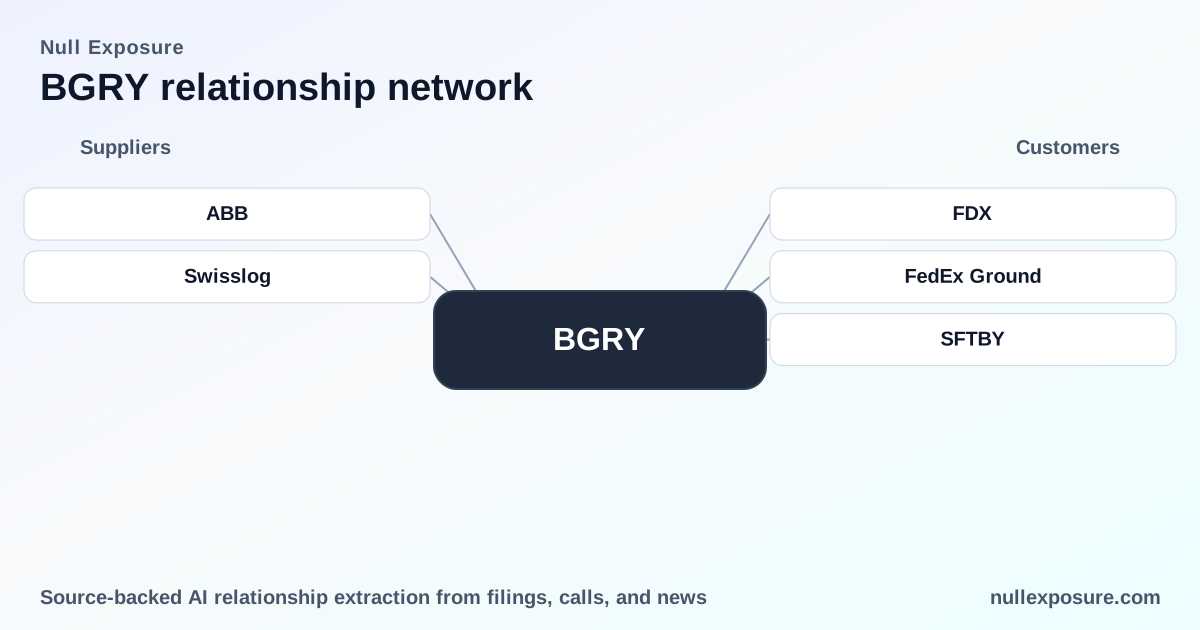
Berkshire Grey (BGRY) — Customer relationships and strategic implications
Berkshire Grey builds AI-enabled robotic automation systems for logistics and retail and monetizes through systems sales, development agreements and ongoing deployment services and software support. The company converts product innovation into commercial contracts with large logistics operators, while recent sale activity and litigation introduce governance and valuation risk that investors must price alongside customer momentum. For a consolidated view of enterprise relationships and signals, visit https://nullexposure.com/.
Executive summary: the investment thesis in one paragraph
Berkshire Grey’s core commercial play is platformized robotics sold into high-volume logistics operations where automation replaces manual sortation and handling; validation from marquee partners like FedEx accelerates commercial adoption, while the announced sale to SoftBank and attendant shareholder investigations create a governance overlay that affects near-term investor returns. Operationally, the business combines engineering-led product deliveries with strategic co-development contracts that push the company from pilots into scaled deployments.
What the relationships look like at a glance
-
FedEx (FedEx Corp. / FedEx Ground): a strategic customer and co-development partner for AI-enabled robotic automation and Robotic Product Sortation systems. These contracts are both revenue-generating deployments and technology-development agreements that signal movement from proof-of-concept to enterprise rollouts. (Sources: Sourcing Journal, March 9, 2026 — https://sourcingjournal.com/topics/logistics/fedex-berkshire-grey-robotic-automation-product-sortation-supply-chain-360288/; Transportation Today News, March 9, 2026 — https://transportationtodaynews.com/news/27660-fedex-expands-agreement-with-berkshire-grey-on-ai-enabled-robotic-automation/)
-
SoftBank / SoftBank Group Corp. (SFTBY): a corporate acquirer whose agreed purchase price and affiliated transactions have triggered shareholder litigation focused on board process and valuation. These legal and governance developments are material to equity valuation and strategic continuity. (Sources: GlobeNewswire, March 28, 2023 — https://www.globenewswire.com/news-release/2023/03/28/2636241/0/en/berkshire-grey-inc-company-investigated-by-the-portnoy-law-firm.html; GlobeNewswire, May 25, 2023 — https://www.globenewswire.com/de/news-release/2023/05/25/2675787/0/en/SHAREHOLDER-INVESTIGATION-Halper-Sadeh-LLC-Investigates-FOCS-RTL-BGRY.html)
Below I unpack each named relationship in the reporting set and explain the operational and investment implications.
FedEx expands development and deployment — why this matters
FedEx Corp. signed an expanded agreement with Berkshire Grey to develop broader AI-enabled robotic automation capabilities intended to improve global package handling safety and efficiency. This is a development-style contract that combines joint engineering work with pathway-to-deployment commitments—a commercialization pattern that directly converts R&D into revenue and operational scale. (Sourcing Journal, March 9, 2026 — https://sourcingjournal.com/topics/logistics/fedex-berkshire-grey-robotic-automation-product-sortation-supply-chain-360288/; Transportation Today News, March 9, 2026 — https://transportationtodaynews.com/news/27660-fedex-expands-agreement-with-berkshire-grey-on-ai-enabled-robotic-automation/)
FedEx Ground is explicitly named as the operational unit already working with Berkshire Grey’s Robotic Product Sortation and Identification (RPSi) systems to sort small packages. That deployment is tangible commercial validation: it represents product fit in a high-throughput environment where automation reduces labor and error costs. (Transportation Today News, March 9, 2026 — https://transportationtodaynews.com/news/27660-fedex-expands-agreement-with-berkshire-grey-on-ai-enabled-robotic-automation/; Sourcing Journal, March 9, 2026 — https://sourcingjournal.com/topics/logistics/fedex-berkshire-grey-robotic-automation-product-sortation-supply-chain-360288/)
SoftBank acquisition and shareholder actions — governance is now a return driver
SoftBank (SFTBY) is the acquirer whose transaction terms and process prompted shareholder investigations focused on whether Berkshire Grey’s board met fiduciary standards and whether the sale price undervalued the company. The existence of multiple investigations raises execution risk on the deal timeline and introduces potential for litigation costs or reopening of terms, which investors must treat as a material corporate governance event. (GlobeNewswire, March 28, 2023 — https://www.globenewswire.com/news-release/2023/03/28/2636241/0/en/berkshire-grey-inc-company-investigated-by-the-portnoy-law-firm.html)
Separate reporting recorded the sale to SoftBank Group Corp. and its affiliate at $1.40 per share; that announced price point is the concrete valuation anchor for public holders and informs expected exit value in models. The convergence of a definitive price and active shareholder scrutiny creates both a valuation floor and legal tail risk for investors. (GlobeNewswire, May 25, 2023 — https://www.globenewswire.com/de/news-release/2023/05/25/2675787/0/en/SHAREHOLDER-INVESTIGATION-Halper-Sadeh-LLC-Investigates-FOCS-RTL-BGRY.html)
How these relationships shape Berkshire Grey’s operating model
- Contracting posture: The company executes both product sales and joint development agreements; FedEx-style deals are strategic co-development contracts that include long-term operational integration rather than one-off equipment sales.
- Concentration: Partnerships with large logistics operators concentrate revenue potential but also concentrate commercial risk; a small number of large customers can meaningfully influence topline growth and deployment cadence.
- Criticality: For customers like FedEx Ground, the RPSi systems are operationally critical—automation sits inside daily sortation flows—so service levels and reliability will be central to contract economics.
- Maturity: Expanded development agreements and named deployments indicate a transition out of pilot stage into scaled rollouts for specific use cases, though the company-level maturity is tempered by ongoing corporate-level events (the SoftBank transaction and related investigations).
Risks and positives investors must weigh
- Positive: Strategic partnerships with FedEx validate product fit at scale and represent a clear path to recurring service and maintenance revenue.
- Negative: The SoftBank deal and shareholder investigations introduce governance and valuation tail risk that can compress public liquidity and affect management continuity.
- Operational risk: Deployment into mission-critical logistics operations amplifies service-level and warranty obligations; successful scale requires disciplined installation, aftermarket support, and software maturity.
For investors tracking customer-driven commercial momentum, these relationships are the primary signal set. For those who want systematic tracking of counterparty and contract signals, see https://nullexposure.com/ for broader coverage and alerts.
Concluding recommendation
Berkshire Grey’s customer engagements with FedEx constitute a material commercial endorsement and support an industrial automation growth narrative; however, the SoftBank acquisition and attendant litigation are immediate governance variables that influence the timing and certainty of shareholder returns. Investors should value the commercial pipeline differently depending on whether they expect the sale to close cleanly or anticipate litigation-driven adjustments to price or timeline.
Key action: monitor FedEx deployment milestones and legal filings tied to the SoftBank transaction—those two threads will determine whether contract momentum translates into realized value for equity stakeholders.