BGSF: A cash sale and a narrower focus — what investors need to know
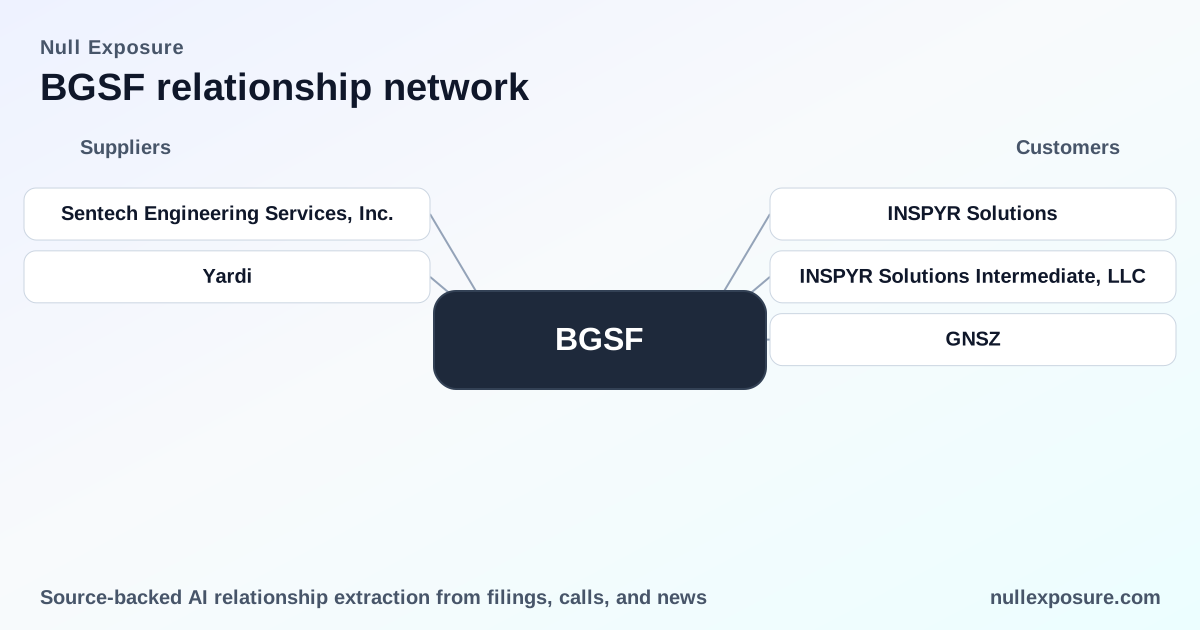
Thesis: BG Staffing (NYSE: BGSF) monetizes by providing workforce solutions and placement services across two segments — Property Management and Professional — collecting a mix of fixed-fee, usage-based and contingent placement revenue from small, mid-market and enterprise clients. The company has executed a material strategic divestiture of its Professional division and is now operating as a streamlined, property-management-focused staffing and consulting business, with near-term revenue supported by a paid Transition Service Agreement and a nascent PropTech partnership that together drive the direction and predictability of next-year revenues. Read a concise provider-risk and partner map below; more detailed relationship evidence and citations follow. For an expanded view of counterparty exposure and filings, visit https://nullexposure.com/.
The transaction that reset the business
BGSF closed the sale of its Professional Division to INSPYR, extracting immediate liquidity and narrowing operating scope. Multiple filings and press releases document the sale proceeds, the transition mechanics, and the compensating services that bridge the handoff.
INSPYR Solutions — buyer of the Professional Division
BGSF closed the divestiture of its Professional Division to INSPYR Solutions, a portfolio company of A&M Capital Partners, for approximately $99 million in cash, completing the transaction in early FY2026. This was announced in BGSF press releases and syndicated local press coverage (Clarion Ledger, Green Bay Press-Gazette; March–May 2026).
INSPYR Solutions Intermediate, LLC — the named purchaser in the equity agreement
BGSF signed a definitive Equity Purchase Agreement on June 14, 2025 to sell the Professional Division to INSPYR Solutions Intermediate, LLC for $99 million in cash, subject to customary working-capital and other adjustments, as disclosed in the Company’s transaction documents and public summaries (SEC filing and related press reposts, March 2026).
INSPYR / GNSZ — transition services and integration payments
Following closing, BGSF executed a Transition Service Agreement (TSA) to provide paid services for up to six months (and in practice “or longer”) while INSPYR integrates the acquired operations; these TSA services are compensated and management states the transition is progressing smoothly (company press release Q3 2025 financial results and local press distribution, March 2026). Several regional press outlets and release aggregators referenced the TSA and the share-holder-approved sale (GreenvilleOnline, SavannahNow, LubbockOnline; March 2026). Some coverage carries the purchaser/inferred symbol as GNSZ in syndicated feeds.
Yardi — strategic partner for PropTech implementations
BGSF announced a strategic partnership with Yardi to supply consultant specialists into PropTech implementations, initially staffing an 8–12 person consultant pool that management expects could generate $1 million to $2 million of revenue in 2026, signaling a targeted growth channel within the Property Management segment (earnings call commentary and press coverage, The Globe and Mail / earnings release, May 2026).
What the relationships collectively mean for revenue and risk
- Immediate liquidity and balance-sheet relief: The $99 million cash consideration materially improves BGSF’s liquidity profile relative to its market cap and trailing revenue; transaction documents show customary purchase price adjustments were anticipated and applied in FY2025–FY2026 disclosures.
- Short-term compensated services cushion: The TSA provides a near-term revenue bridge and cash inflow while INSPYR completes integration, limiting immediate churn risk from the divestiture.
- Concentration reduced: Company-level disclosures show no single client exceeded 10% of revenue in recent years, meaning revenue is broadly distributed and the Professional sale reduces operational breadth without introducing concentration risk.
- Emerging strategic channel: The Yardi agreement is structurally small but strategically meaningful as a repeatable placement channel for consultants into PropTech projects.
(If you are mapping counterparties for diligence, see the annotated relationship list above and the public press filings aggregated on our site: https://nullexposure.com/.)
Operating-model constraints and what they imply for investors
BGSF’s publicly reported contract and customer characteristics create a distinct revenue profile:
- Contracting posture: Engagements are generally non‑exclusive, short‑term and terminable with little or no notice, which keeps sales flexibility high but limits long-term revenue visibility.
- Revenue recognition mix: The Company recognizes fixed-fee revenues over intervals, usage-based/inputs-based revenues for certain services (input-method revenues <8% of total), and contingent placement revenues recognized when placements occur — a mix that produces variability tied to hiring cycles.
- Counterparty footprint: BGSF serves small and medium businesses as well as divisions of Fortune 500 firms, producing a balanced client roster across SME, mid-market and enterprise accounts.
- Geography and operations: Primary operations are U.S.-centric through Property Management and Professional segments; some professional services have nearshore/offshore components (Arroyo Consulting operations noted in U.S., Colombia, India).
- Materiality signal: Customer-level concentration is immaterial (no client >10% revenue), a favorable investor signal for cash-flow diversification.
- Role and maturity: BGSF functions as a service provider, delivering field talent, managed services and consulting — an established, lower‑capital-intensity model but one sensitive to labor market cycles.
These constraints combine into a business with high operational flexibility but lower revenue stickiness; the divestiture increases focus but does not materially alter the short-term predictability profile because the remaining contract types and client behaviors are unchanged.
Investment implications and risks
- Balance-sheet improvement versus operating profitability: The sale’s cash proceeds materially strengthen liquidity at a time when trailing EBITDA and EPS are negative (Company TTM figures show EBITDA loss and negative EPS), improving optionality for buybacks, debt paydown, or reinvestment into growth channels.
- Near-term revenue profile: Expect a small, finite contribution from the TSA and a modest initial revenue contribution from the Yardi PropTech channel; neither is large enough to restore profitability alone, but both improve the quality of property-management revenues.
- Execution risk concentrated in re-scaling: BGSF’s ability to convert the Yardi pipeline and to reallocate freed capital into higher-margin services will determine whether the company transitions from a restructuring story to sustainable growth.
- Customer and contract dynamics: Short-term, non-exclusive contracts and contingent placement recognition keep topline elastic; economic slowdowns or lower hiring activity will compress revenue quickly.
Final read and how to follow up
BGSF’s divestiture and TSA reduce operational complexity and inject substantial cash, while the Yardi partnership provides a clear tactical growth axis within the Property Management segment. Investors should treat the company as a lean, service-oriented operator with limited revenue stickiness but improved liquidity which supports multiple strategic options.
For a deeper counterparty map and to track new filings and partner disclosures, visit https://nullexposure.com/.