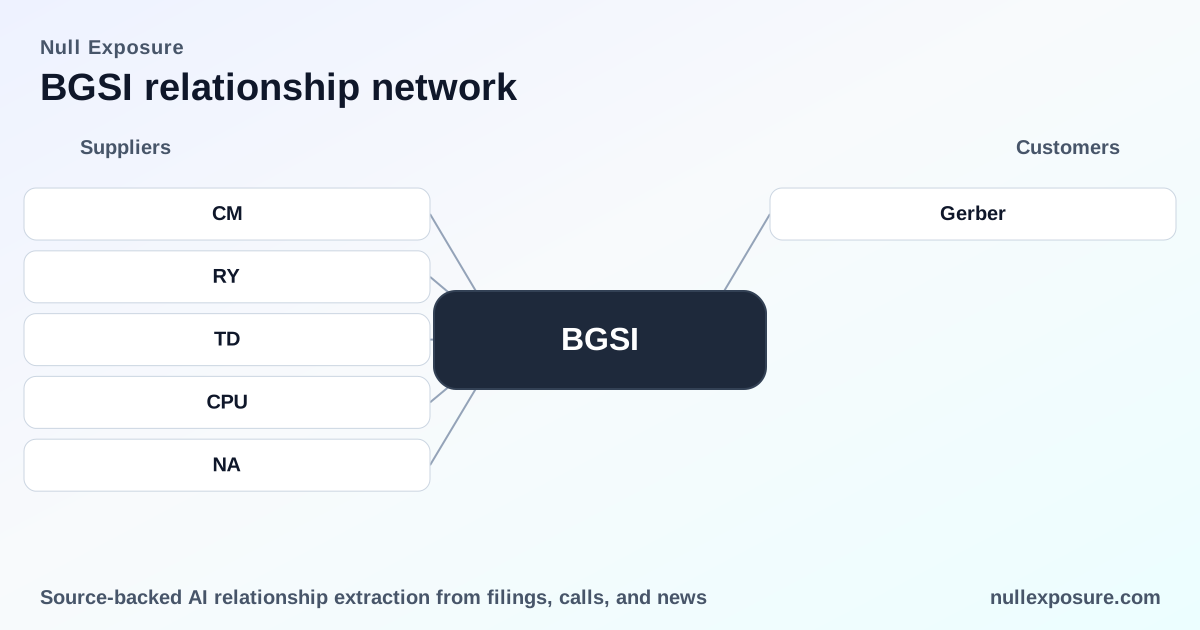
Boyd Group Services (BGSI) — customer relationships and the commercial gravity pulling the stock
Boyd Group Services operates a network of non‑franchised collision repair centers across North America and monetizes primarily by selling vehicle collision repair work, parts and related services to retail customers, insurers and national account partners; revenue scale is driven by location density, paid claims flow and negotiated servicing agreements with large payors. For investors, the company's topology is simple: asset-backed local service operations aggregated to deliver scale economics to insurers and national accounts — and revenue concentration in a handful of major relationships is the single clearest commercial exposure.
For more granular relationship analytics and ongoing monitoring, see https://nullexposure.com/.
Quick financial and operating read — scale with tight margins
Boyd generated roughly $3.14 billion in trailing revenue with EBITDA of ~$245 million, a thin reported profit margin (0.59%) and an operating margin near 5.1%, according to public financials through FY2025. The market values that operating profile at a premium: forward P/E ~30x versus a trailing P/E above 140x, signaling growth expectations against modest current profitability. Institutional ownership is high (over 90%), insiders own under 0.1%, and the company is materially U.S.‑centric for revenue generation. These metrics shape how customer risk maps into valuation — a large account disruption compresses an already tight margin structure and would be quickly visible in earnings.
What the relationship data shows (one clear concentrated customer)
Gerber — the single dominant commercial anchor
A Repairer Driven News report from May 13, 2021 stated that Boyd derives about 90% of its income from the U.S., with the bulk of that coming from Gerber, identifying Gerber as a principal commercial source for Boyd’s U.S. revenue. This disclosure signals material customer concentration that directly influences Boyd’s top line and leverage to U.S. claims flow. (Repairer Driven News, May 2021: https://www.repairerdrivennews.com/2021/05/13/boyd-all-gerber-production-auto-body-shops-restored-tech-development-restarted/)
Why that single relationship matters to investors and operators
- Revenue concentration is direct value exposure. When one partner accounts for a large portion of revenue, contract terms, pricing pressure, and service level negotiations with that partner become paramount to profit stability.
- Operational dependency translates into bargaining asymmetry. A dominant customer can extract price concessions, operational mandates (turnaround targets, parts sourcing rules), and data/integration requirements that reduce margin or increase capital intensity.
- Market perception and multiple compression hinge on stability. Given Boyd’s premium valuation relative to current earnings, any sign of customer churn or renegotiation with its largest commercial partner will be rapidly reflected in the multiple.
Operating model and business‑model constraints (company‑level signals)
Because the provided sources do not list prescriptive contractual constraints, consider these company‑level signals that frame BGSI’s operating posture and strategic risks:
- Contracting posture — centralized and direct. Boyd operates non‑franchised, company‑owned repair centers, which implies direct contracting with payors rather than franchise fee models; that gives Boyd operational control but also centralizes counterparty exposure to large national accounts and insurers.
- Concentration — commercially material. Public data and the Gerber report indicate a concentrated customer base in the U.S.; concentration is a structural constraint on diversification and a principal input into stress scenarios for revenues and working capital.
- Criticality — high to payors, moderate to consumers. Repair capacity is operationally critical for insurers’ claims workflows (cycle time, customer satisfaction). For consumers, alternatives exist, but insurers’ routing and recommendations make Boyd strategically important to national accounts.
- Maturity — scale achieved, margin improvement is the lever. The company is large and established, with modest year‑over‑year revenue growth (~5.5% quarterly revenue growth YOY in recent reporting) and low current profit margins; future value depends on margin expansion, network utilization and pricing power rather than large incremental revenue surprises.
Investment implications — risks and drivers
- Key risk: customer concentration. The Gerber relationship is the clearest single point of failure; a deterioration in that business relationship would have outsized top‑line and EBITDA impact given current margins.
- Execution driver: margin expansion over revenue growth. With revenue already in the billions and limited upside from sheer scale alone, operating leverage and negotiated pricing with major payors will drive earnings accretion.
- Valuation sensitivity: premium multiple to execution. The current forward multiple implies investors expect operational improvements; underperformance on the largest accounts would compress multiples meaningfully.
- Governance and ownership: institutional ownership high. With ~90% institutional ownership, market reactions to material account news will be fast and potentially amplified by coordinated portfolio moves.
What operators should watch in contract and relationship management
- Track payment terms, pricing clauses, and performance SLAs with the largest payors; small changes in reimbursement or cycle time guarantees can swing thin margins.
- Build secondary customer diversification and national‑account diversification to reduce single‑counterparty exposure.
- Measure utilization and productivity per repair center explicitly against payor contract terms to guard margin erosion from service mandates.
Closing assessment and next steps
Boyd Group is a scalable operator whose near‑term value is governed more by customer dynamics and margin delivery than by raw revenue growth. The Gerber relationship, as reported, is the dominant commercial reality and should be treated as the headline risk and negotiating focus for management and investors. For continual monitoring and to examine additional customer relationship signals as they emerge, visit https://nullexposure.com/ for ongoing analytics and alerts.
Bold takeaway: customer concentration—centered on Gerber—is BGSI’s defining commercial exposure; margin execution and contractual stability with that partner will determine whether the stock’s premium multiple is justified.