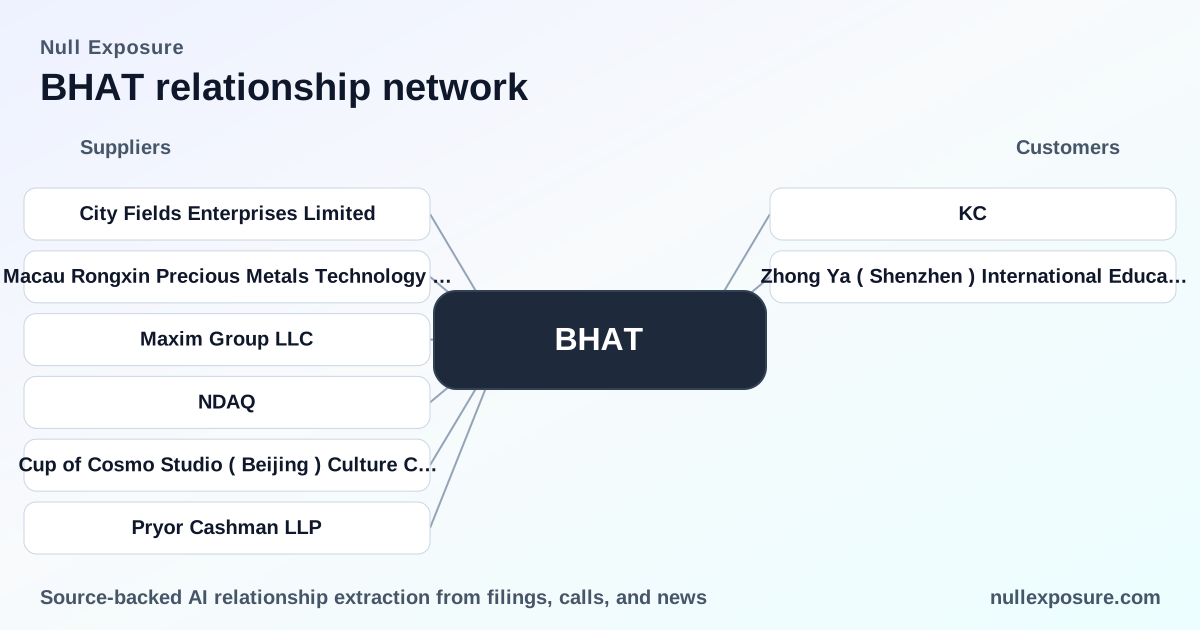
BHAT Customer Map: Who Pays Blue Hat and Why it Matters
Blue Hat (BHAT) operates as a hybrid product-and-services provider that monetizes through multi-year commercial agreements for software and AR services alongside recurring hosting, maintenance and systems-support contracts. The company's revenue profile combines scalable content/licensing to education customers with higher‑margin, mission‑critical operations services for cloud platforms—giving investors exposure to both recurring service economics and contract-driven growth. For a concise view of documented customer links, visit the NullExposure hub: https://nullexposure.com/.
What the disclosed customers collectively reveal about BHAT's operating model
The public record for BHAT shows a small number of high‑visibility, contract-based relationships rather than a broad retail or freemium user base. That shape of customer book produces several company-level signals investors should track:
- Contracting posture: BHAT relies on formal, time‑bound agreements (an explicitly reported three‑year education contract and initial assessment periods for hosting), indicating a preference for negotiated commercial engagements rather than ad hoc transactions.
- Revenue concentration: Only a handful of named counterparties appear in the results; this implies customer concentration risk unless management discloses broader customer diversification.
- Criticality of services: The reported work—mainframe hosting, system maintenance and AR delivery to hundreds of kindergartens—reads as operationally critical to clients, which supports stickiness and potential renewal leverage.
- Commercial maturity: The mix of a three‑year deal and an “initial assessment period” suggests BHAT is operating across both established, multi‑year deployments and earlier-stage pilots or proofs of concept.
These signals are company-level interpretations derived from the disclosed relationships and their contract descriptions; they function as a compact risk/reward checklist for investors evaluating BHAT’s customer franchise.
Detailed customer relationships investors should know
KC
Since August of the reported period BHAT provided mainframe hosting, system maintenance, troubleshooting and related services to KC’s platform as part of an initial assessment engagement, indicating a service‑first relationship with potential to scale into longer term operations. This engagement is documented in a PR Newswire release covering FY2021 results (reported March 2026 via WillWork4Games).
Source: PR Newswire release cited in the FY2021 results announcement (reported March 9, 2026).
Kingsoft Cloud Holdings Limited
Kingsoft Cloud Holdings Limited is separately recorded in the same FY2021 disclosure as receiving mainframe hosting and systems support from BHAT under an initial assessment arrangement that began in August, signaling BHAT’s capability to service large cloud platforms and the potential for expanded managed‑services revenue. This appears in the company’s FY2021 commentary in a PR Newswire release.
Source: PR Newswire release cited in the FY2021 results announcement (reported March 9, 2026).
Zhong Ya (Shenzhen) International Education Investment Co., Ltd.
In February 2021 BHAT signed a three‑year agreement to deliver ARIC to Zhong Ya’s 680 kindergartens in Guangdong Province, representing a sizable, multi‑year content/licensing deal that ties BHAT revenue to the education vertical at scale. The transaction is disclosed in BHAT’s FY2021 materials reported via the same PR Newswire release.
Source: PR Newswire release cited in the FY2021 results announcement (reported March 9, 2026).
Why these relationships matter for revenue quality and risk
The two service engagements with KC/Kingsoft Cloud position BHAT as a vendor capable of managing infrastructure for enterprise cloud platforms, which supports higher‑margin, recurring services if initial assessments convert to long‑term contracts. The Zhong Ya deal provides addressable scale in the education market and predictable, multi‑year licensing cash flows tied to deployment across 680 locations.
At the same time, the public record shows limited breadth of disclosed customers, which concentrates revenue risk. Investors should model both upside from contract renewals or expansions and downside from client churn or non‑conversion of assessment periods. In practical terms:
- Upside: A successful conversion of hosting pilots into long‑term managed services and expansion of AR offerings across institutional education clients will materially raise revenue visibility.
- Downside: Heavy reliance on a small number of counterparties increases earnings volatility if contracts are not renewed or if procurement cycle timing slips.
How operators and portfolio analysts should use this map
Operators should treat the documented deals as a baseline for product‑market fit: expand hosting playbooks to capture further cloud platform work and productize ARIC distribution for education. Portfolio analysts should request disclosure on customer counts, revenue concentration by client, contract lengths, and renewal rates to convert the relationship map into a revenue‑build model.
For a deeper, consolidated view of BHAT’s customer relationships and to track updates, visit NullExposure: https://nullexposure.com/.
Bottom line
BHAT’s disclosed customer relationships reflect a dual commercial model: enterprise services that secure recurring, mission‑critical revenue and multi‑year content/licensing that enables scale into verticals such as education. The core investment thesis hinges on converting pilots into durable hosting contracts and leveraging the Zhong Ya deployment into adjacent education accounts. Investors should weigh the growth opportunity against clear concentration risk and seek management metrics on contract conversion and client diversification before extrapolating sustained earnings momentum.