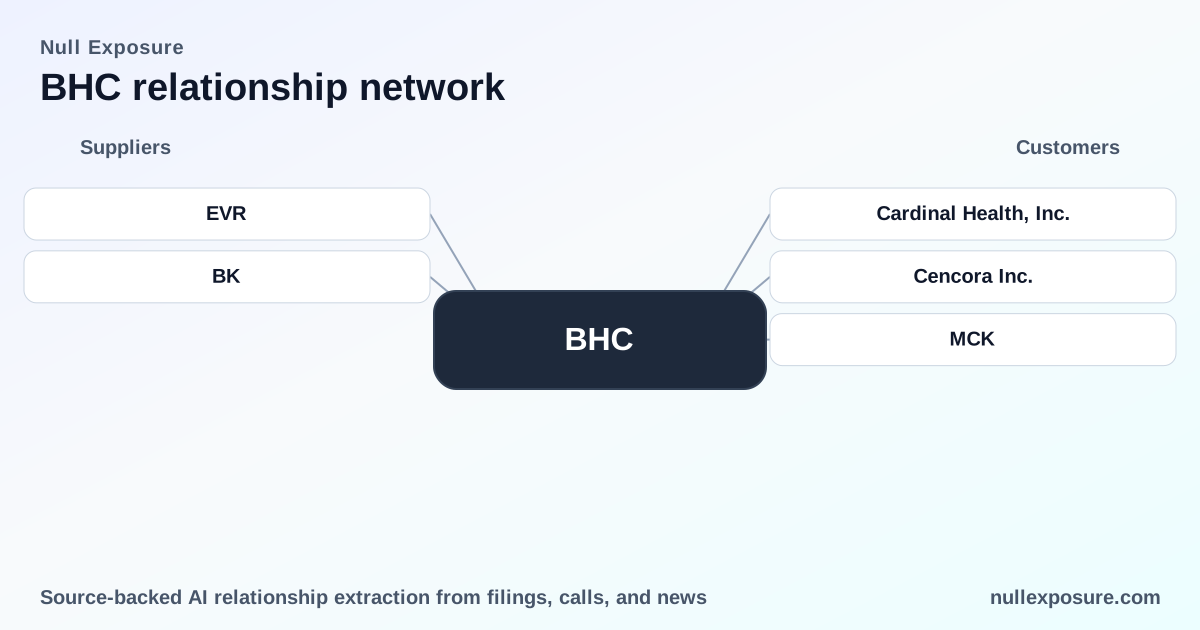
Bausch Health’s customer footprint: concentrated wholesalers, selective licensing, and distribution risk
Bausch Health Companies Inc. (BHC) manufactures and sells prescription drugs, medical devices and OTC products across eye health, gastroenterology and dermatology, monetizing primarily through product sales to wholesalers, pharmacies, hospitals and direct online channels; the company also monetizes legacy intellectual property through brand and rights sales. Revenue flows are heavily concentrated in a handful of large distributors and in the U.S. market, while product-level concentration (notably the Salix/Xifaxan franchise) creates asymmetric exposure to payor and distribution dynamics. For a fuller company profile and underlying document references, visit https://nullexposure.com/.
Why customer relationships dictate the investment case
Bausch Health runs a classic specialty/generic pharmaceutical commercial model: it develops and procures products, then routes them to market mostly through wholesalers and large drug chains. That distribution-first posture compresses margins and centralizes counterparty risk — losing preferred placement or facing reimbursement changes at a major wholesaler or government program can meaningfully compress revenue. The company also uses selective divestitures and licensing for non-core brands, converting product assets into cash while shrinking future revenue diversity.
The company's public filings and recent press coverage together signal four operating constraints that investors must weight when evaluating BHC customer risk and durability:
- Concentration and counterparty leverage: A small set of wholesale distributors account for a material share of revenue, giving those buyers meaningful pricing and placement leverage.
- North American revenue dependency with global presence: About 60% of revenue is sourced from the U.S. and Puerto Rico, even though the company markets into roughly 90 countries.
- Payor and government exposure: Reimbursement from government programs and third-party payors is integral to revenue realization for certain products.
- Product-level criticality: Some segments (Salix/Xifaxan) are highly concentrated within their segment, making those revenue lines particularly sensitive to clinical, regulatory or payor shifts.
These signals reflect company-level operating characteristics rather than isolated anecdotes; they shape contracting posture, maturity of relationships, and commercial vulnerability.
Line-by-line: every reported customer relationship
Below I cover each relationship disclosed in the provided results with a concise, source-backed description.
Cencora Inc.
Cencora (formerly AmerisourceBergen’s distribution business) accounted for 19% of Bausch Health’s total revenue in FY2024, making it the single largest customer by disclosed percentage and a structural counterparty in BHC’s distribution chain, according to Bausch Health’s FY2024 10‑K filing. (Source: BHC 2024 Form 10‑K)
Cardinal Health, Inc.
Cardinal Health represented 14% of BHC’s revenue in FY2024 and has been a consistent top-three distributor across recent years, underscoring Cardinal’s role as a key wholesale channel for Bausch product flows. (Source: BHC 2024 Form 10‑K)
MCK (inferred symbol: MCK)
McKesson is listed among customers representing 10%+ of revenue; McKesson contributed 15% of total revenue in FY2024, reinforcing BHC’s dependence on the three major U.S. wholesale distributors for scaled market access. (Source: BHC 2024 Form 10‑K)
McKesson Corporation
The company’s filing repeats McKesson’s position as a top customer with 15% of 2024 revenues, confirming that McKesson is an individual revenue-concentrated counterparty rather than an aggregation artifact. (Source: BHC 2024 Form 10‑K)
XENE (Xenon Pharmaceuticals) — news reference #1
Press coverage notes that Xenon acquired rights to the molecule azetukalner that originated at Valeant/Bausch Health; this demonstrates BHC’s role as an originator/licensor of legacy assets and the company’s occasional monetization of assets through third-party licensing and rights transfers. (Source: The Globe and Mail, March 2026)
MedQuímica Indústria Farmacêutica (MedQuímica)
A Lupin press release states that MedQuímica (Lupin’s Brazilian unit) signed an agreement to acquire rights to nine medicines from BL Indústria Ótica Ltda., a Bausch Health subsidiary, illustrating active brand divestiture and geographic rights sales as part of BHC’s portfolio management. (Source: Lupin press release, May 2026)
XENE (Xenon Pharmaceuticals) — news reference #2
A second Globe and Mail story recounts the licensing arc of azetukalner from Valeant to a researcher and then to Xenon, reinforcing that Bausch-originated molecules have been transferred through licensing chains, which is relevant for investors tracking legacy asset monetization. (Source: The Globe and Mail, March 2026)
Amazon
Bausch Health’s dermatology business has taken steps to sell OTC and consumer skincare products through online retail channels; a PR Newswire release notes that the Biafine skincare product is being offered through select online channels including Amazon, signaling direct-to-patient retailing alongside traditional wholesale distribution. (Source: PR Newswire, May 2026)
What investors should infer about contracting posture and risk
Bausch Health’s reported relationships and the firm-level constraints point to a commercial model that is:
- Distributor-centric and buyer-concentrated: Top-three wholesalers (Cencora, McKesson, Cardinal) collectively represent nearly half of reported revenue in the disclosure excerpt, giving buyers negotiating leverage over pricing, inventory cadence and product placement.
- Geographically skewed toward North America: U.S./Puerto Rico revenues account for roughly 60% of total sales, concentrating macro, regulatory and payor risk in a single region even as the firm maintains a global footprint.
- Product-concentrated at the segment level: Salix sales and the Xifaxan franchise create critical revenue dependency for BHC’s gastrointestinal portfolio, which elevates sensitivity to clinical or formulary changes.
- Mature, long-term commercial relationships: The presence of repeated top-customer listings across 2022–2024 indicates longstanding commercial ties rather than transient one-off purchasers.
Investment implications and closing takeaways
Bausch Health’s revenue profile is clearly concentrated at both the counterparty and product levels. For investors evaluating customer durability, the central question is whether BHC can diversify away from the top wholesalers and broaden direct-to-consumer channels without sacrificing margins. Contractual leverage currently sits with the wholesalers, and reimbursement dynamics with governmental payors add a second dimension of exposure.
Key takeaways:
- Top-three wholesalers are systemically important to BHC’s revenue.
- U.S. payor dynamics and product concentration (Salix/Xifaxan) are primary sources of downside risk.
- Brand/rights sales and licensing are active levers BHC uses to monetize non-core assets.
For a complete dossier of BHC’s customer disclosures and primary-source filings, explore the company profile at https://nullexposure.com/.