Benchmark Electronics (BHE): customer relationships that drive revenue and risk
Benchmark Electronics operates as a global provider of design engineering, technology solutions and advanced manufacturing services, monetizing through contract manufacturing, program engineering and long-term supply relationships with OEMs. The company converts engineering-led services into recurring manufacturing revenue, with a concentrated customer base where a handful of large enterprise partners account for the majority of sales. For a deeper look at how these dynamics matter for investors, visit https://nullexposure.com/.
The quick thesis for investors
Benchmark is a service-led manufacturer: it wins master supply and manufacturing agreements with large enterprise OEMs, then monetizes through recurring production runs and program ramps. Revenue recognition skews toward short-duration performance obligations inside broader framework agreements, and material customer concentration amplifies upside when ramps succeed and downside when large programs complete.
How Benchmark contracts and where that matters
Benchmark’s operating model blends near-term commercial contracts with overarching commercial frameworks and long-term program relationships. Key company-level signals:
- Contracting posture: Performance obligations are generally short term (expected duration of one year or less), but Benchmark frequently operates under master supply agreements that govern multiple programs and launches.
- Concentration and criticality: The business is highly concentrated—the top ten customers represent roughly half of revenue—and Benchmark acts predominantly as a service provider and manufacturer to multinational OEMs.
- Global footprint and maturity: Manufacturing and sales are global across the Americas, Asia and Europe, and most customer relationships are active and mature, though individual programs carry a ramp phase that requires incremental launch investment and pressures gross margin.
- Spend scale: With $2.7bn of sales in 2024 and a single largest customer representing double-digit percent share, Benchmark operates at >$100m spend bands with strategic OEM partners.
These signals shape capital intensity, working capital exposure and program risk — important inputs for valuation or operational due diligence.
Customer relationships that matter (full coverage)
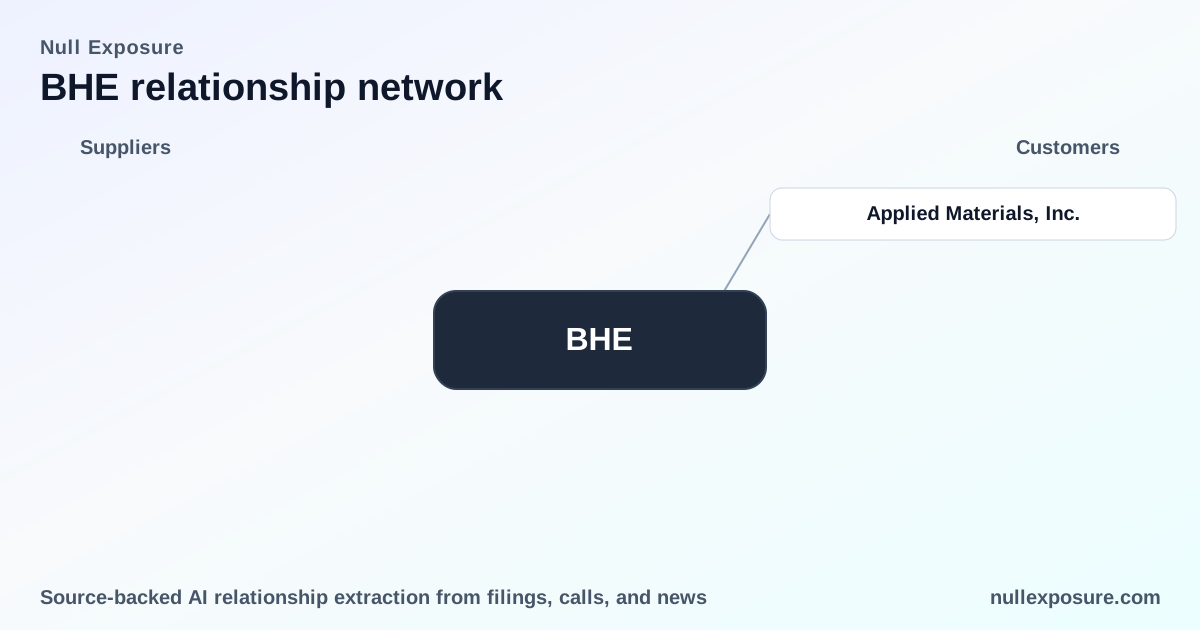
Applied Materials, Inc.
Applied Materials is Benchmark’s largest single customer; sales to Applied Materials represented 14% of total sales in 2024, a material contribution to consolidated revenue. According to Benchmark’s FY2024 Form 10‑K, Applied Materials and its subsidiaries accounted for that 14% share in 2024, reflecting a persistent large-account relationship documented in the company filing for FY2024. (Source: FY2024 Form 10‑K filing)
Hewlett Packard Enterprise (HPE) / HP Enterprise / HP Enterprise Corp.
Benchmark reports a strategic manufacturing relationship with Hewlett Packard Enterprise: Benchmark was named HPE’s 2026 Manufacturing Partner of the Year, a recognition the company highlighted on its Q1‑2026 earnings call and in related transcripts. That accolade signals an elevated supplier status on key HPE programs and validates Benchmark’s customer-centric initiatives. (Sources: Q1‑2026 earnings call transcripts reported by InsiderMonkey and Investing.com)
Ouster (OUST / OUST‑WS‑A)
Public filings and press coverage from 2021–2025 repeatedly identify Ouster’s dependence on Benchmark as a key third‑party supplier, with Benchmark named alongside other contract manufacturers in multiple Ouster press releases. Those statements reflect a supplier relationship where Benchmark is a material manufacturing partner for Ouster’s lidar products across several reporting periods. (Sources: Ouster press releases and investor communications across 2022–2025, cited in multiple news outlets including BizWire and Yahoo Finance)
KeyMe Locksmiths (KeyMe)
Benchmark is the manufacturing partner for KeyMe’s AI‑powered kiosks; press announcements note KeyMe deployed its 8,000th kiosk “through partnership with Benchmark,” indicating an ongoing U.S. manufacturing engagement to scale KeyMe’s kiosk rollout. This is a clear example of Benchmark’s work for high‑volume consumer-facing hardware programs. (Sources: KeyMe press release coverage cited on Finviz and MarketScreener, March 2026)
What these relationships mean for valuation and operational risk
- Revenue concentration is a double-edged sword. Applied Materials alone contributed a double-digit share of revenue in FY2024; the top‑ten customer concentration (roughly 50% of sales) means that program wins and losses move the top line materially, which drives both upside volatility and downside exposure.
- Framework agreements reduce negotiation friction but not execution risk. Benchmark’s master supply agreements create a predictable commercial structure, but performance obligations are typically short‑term, so revenue visibility within a framework depends on program-level awards and ramp schedules.
- Ramping programs are margin drivers and working capital sinks. New-program investment during launch and ramp phases exerts downward pressure on gross profit and requires incremental working capital; this is an operational characteristic investors must model explicitly.
- Global manufacturing footprint mitigates single‑site risk but increases complexity. Operations across the Americas, Asia and Europe spread capacity risk, but add execution and supply‑chain complexity that affects lead times and cost volatility.
- Customer-type skews to large enterprise OEMs. That positioning reduces credit risk relative to smaller customers but increases dependence on cyclical capital spending cycles and program timing of a handful of large buyers.
Risks investors should weigh (concise)
- Concentration risk: Loss or downsizing of a major program would have outsized impact given top customer shares.
- Program execution risk: Ramp-related margin pressure and working capital needs are recurring operational realities.
- Cyclicality: Exposure to enterprise OEM capital cycles (HPC, communications, data center) creates earnings cyclicality.
Bottom line and next actions
Benchmark converts engineering services into recurring manufacturing revenue through a small set of material, largely enterprise customers; that structure supports attractive program economics when ramps succeed but concentrates execution and revenue risk. For investors evaluating BHE, models should explicitly allocate program‑level ramp costs, account for potential top‑customer churn and stress test margins under delayed ramp scenarios.
For a structured view of how customer concentration and contract posture affect enterprise supplier risk and valuation, explore our analytical coverage at https://nullexposure.com/.