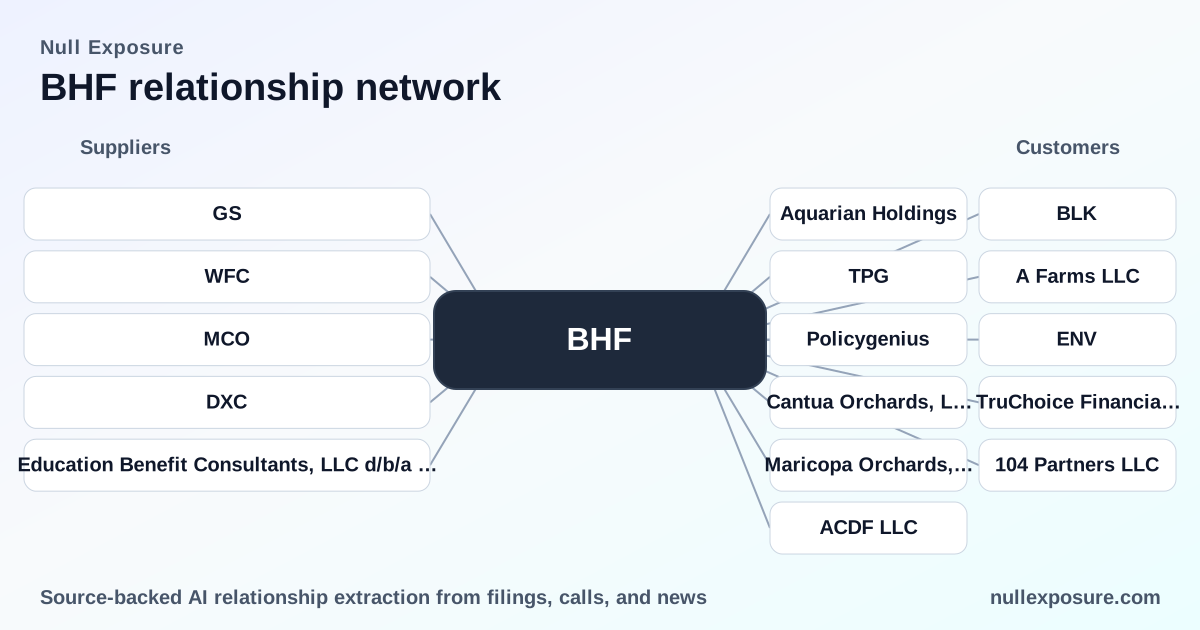
Brighthouse Financial (BHF): Customer Relationships and Strategic Implications
Brighthouse Financial sells life insurance and annuity products to U.S. retail customers and monetizes through premiums, annuity reserves, investment income and servicing fees (including 12b‑1 style fees on fund distributions). The business runs long-duration insurance contracts concentrated in the U.S., distributed through a mix of independent channels and digital partners, with recurring fee and investment-return economics that make distribution relationships and capital strategy central to shareholder value. For a rapid view of relationship signals and sourcing, visit https://nullexposure.com/.
How Brighthouse operates — a concise operating thesis
Brighthouse is primarily a seller of annuities and life insurance, owning the underwriting and asset management economics while relying on third‑party distribution partners and platforms to scale new sales. The company captures value in three ways: upfront and recurring product fees, investment spread on general account assets, and ancillary service fees tied to fund relationships. Long-term liability duration and U.S. geographic concentration mean capital markets access, reinsurance strategy and distribution channels directly affect earnings volatility and strategic optionality.
Constraints that shape the business model
- Long‑term contracting posture: Brighthouse’s product portfolio is dominated by annuities and life products that create multi‑decade obligations, making liability valuation, LDTI accounting and capital management persistent strategic issues (company filings, effective Jan 1, 2023).
- Usage‑based fee elements: Some revenues — notably 12b‑1 style fees tied to funds — are proportional to customer balances and hence variable with market moves and sales momentum.
- U.S. concentration: Substantially all premiums and fees originate in the United States, aligning regulatory, interest‑rate and demographic risk to a single geography.
- Role diversity: The company functions mainly as seller and service provider, while also being a buyer of distribution and capital solutions; its model depends on active partnerships with digital marketplaces, platforms and reinsurance counterparties.
These constraints position Brighthouse as a capital‑intensive insurer whose profit trajectory is highly sensitive to distribution effectiveness, interest‑rate movements and execution on liability management.
Counterparty map — every relationship in the available results
Below are the documented relationships surfaced in recent coverage; each entry is one or two sentences with the cited public source.
Aquarian Holdings (buyout interest — Investopedia, Mar 9, 2026)
Investopedia reported that private equity firm Aquarian Holdings was linked to active buyout talks for Brighthouse, a development that triggered an immediate share price reaction on March 9, 2026. (Investopedia article, 2026-03-09: https://www.investopedia.com/brighthouse-financial-stock-pops-on-report-of-buyout-talks-with-aquarian-11773191)
Policygenius (distribution partnership — Life & Health, FY2020)
Brighthouse partnered with Policygenius to offer an online term life product, Brighthouse SimplySelect, making the insurer’s term product directly available through Policygenius’ digital marketplace (Life & Health Coverage, originally announced FY2020; article archived 2026).
Maricopa Orchards, LLC (litigation / credit exposure — Insurance Business, FY2024)
Brighthouse Life filed suit against Maricopa Orchards as part of a broader claim alleging default on loans totaling $48.6 million, signaling credit and litigation activity tied to legacy lending exposures (Insurance Business, report referencing Oct 2024 filing).
ACDF LLC (litigation / successor counterparty — Insurance Business, FY2024)
ACDF LLC, identified as a successor to related entities, is named in the same Brighthouse Life lawsuit alleging borrower default on nine loans; the case highlights precarious recoverability of collateralized agricultural loans (Insurance Business, Oct 2024 filing described).
Cantua Orchards, LLC (litigation / borrower) — Insurance Business, FY2024
Cantua Orchards was named alongside other orchard entities in Brighthouse’s suit over loan defaults, reinforcing the insurer’s active recovery efforts on non‑core credit assets (Insurance Business coverage of the October 2024 suit).
TPG (private equity interest — Investopedia, Mar 9, 2026)
Investopedia noted that other private equity buyers including TPG had shown interest in acquiring Brighthouse, underscoring the company’s attractiveness as an annuity and fee‑generating platform (Investopedia, 2026-03-09).
Aquarian Holdings (strategic merger note — The Globe and Mail, May 2, 2026)
The Globe and Mail reported shareholder approval of an Aquarian‑led acquisition/merger, describing the transaction as a strategic merger with Aquarian Holdings in early May 2026. (The Globe and Mail, press release/coverage, 2026-05-02: https://www.theglobeandmail.com/investing/markets/stocks/BHF-Q/pressreleases/216575/brighthouse-financial-shareholders-approve-aquarian-capital-acquisition/)
BlackRock / BLK (annuitization option partnership — ThinkAdvisor, May 28, 2020)
ThinkAdvisor covered an arrangement where Brighthouse and Equitable would power a BlackRock annuitization option, linking Brighthouse’s annuity capability to BlackRock’s retirement solutions ecosystem (ThinkAdvisor, 2020-05-28).
BLK (duplicate ThinkAdvisor record — ThinkAdvisor, May 28, 2020)
A second record cites the same ThinkAdvisor report confirming the BlackRock annuitization option partnership; the repeat emphasizes the commercial tie to BlackRock’s retirement distribution efforts (ThinkAdvisor, 2020-05-28).
104 Partners LLC (successor / borrower in litigation — Insurance Business, FY2024)
104 Partners LLC is named as a predecessor or related entity in the litigation concerning the same loan defaults, highlighting complex borrower entity structures in Brighthouse’s recovery actions (Insurance Business, Oct 2024).
A Farms LLC (borrower / litigation) — Insurance Business, FY2024
A Farms LLC appears in the litigation roster for loan defaults on the orchard exposures, part of the insurer’s effort to resolve non‑performing private credit positions (Insurance Business coverage).
ENV / Envestnet (platform distribution — InvestmentNews, FY2020)
InvestmentNews documented that Envestnet’s MoneyGuide platform expanded to include annuities from multiple carriers including Brighthouse, signaling platform distribution access to financial advisors via Envestnet (InvestmentNews, platform rollout announcement).
Envestnet MoneyGuide (product integration — InvestmentNews, FY2020)
The MoneyGuide integration specifically includes Brighthouse annuities in advisor workflow, supporting scaled access to the company’s annuity products through financial planning technology (InvestmentNews, product rollout report).
TruChoice Financial Group, LLC (RILA product shelf — Newswire, FY2022)
TruChoice added Brighthouse as a RILA (registered index‑linked annuity) carrier to its product shelf, confirming distributor relationships in the RIAs/independent agent channel (Newswire release, 2022).
Aquarian Capital LLC (acquisition vehicle / affiliate) — The Globe and Mail, May 2, 2026
The Globe and Mail noted that an affiliate of Aquarian Capital LLC will acquire Brighthouse in an all‑cash transaction valued near $4.1 billion, formalizing the private‑equity exit route and ownership transition (Globe and Mail press coverage, 2026-05-02).
What investors should take from the relationship map
- Private equity interest and a completed acquisition cycle materially change the strategic path; the Aquarian transaction converts a public annuity franchise into a sponsor‑owned platform, reducing public market visibility but potentially unlocking operational simplification.
- Distribution diversification is a strength: partnerships with Policygenius, Envestnet/MoneyGuide and TruChoice show a deliberate mix of direct digital channels, advisor platforms and independent distributors that support new business flows.
- Legacy credit and litigation risk is present: the orchard‑loan litigation shows non‑insurance credit exposures requiring active legal recovery and reserve management.
- Revenue mix includes both long‑duration fixed economics and usage‑based fees, so investment returns and market flows will continue to govern earnings sensitivity.
Overall, Brighthouse’s value is levered to capital strategy, distribution execution and liability management; recent PE interest and the Aquarian acquisition represent the most consequential near‑term pivot for equity investors and counterparties.
For deeper relationship analytics and ongoing monitoring, see https://nullexposure.com/.
Conclusion: Brighthouse operates a classic annuity/life insurer model complicated by legacy credit exposures and enhanced by multiple distribution partnerships; the completed private‑equity transition and the catalog of digital and platform relationships will determine whether the company is repositioned for growth or optimized for runoff under new ownership.