Brighthouse Financial (BHFAL): distribution-driven annuity franchise under active sale conversations
Brighthouse Financial distributes life insurance and annuity products in the U.S., monetizing through insurance premiums, policy fees and recurring fund‑related servicing fees (including 12b‑1 payments) while relying on a concentrated set of third‑party distributors for new sales. The company’s economics combine sticky liabilities and fee income with distribution concentration that creates strategic optionality — and transaction value — as private capital circles the business. For a structured view of counterparties and deal dynamics, visit https://nullexposure.com/.
Why Brighthouse’s partner map matters now
Brighthouse is a traditional annuity and life insurer that generates revenue from premiums, policy fees and ancillary fund servicing arrangements; those revenue lines are concentrated in the U.S. and routed through a small number of large distribution partners. That operating model produces stable recurring cash flows, but also concentration risk: Brighthouse relies on core distributors to produce the majority of sales and reports that a termination or significant reduction by one of these partners would adversely affect results. The company also collects and maintains individually identifiable customer information, making data governance and regulatory compliance operational priorities.
Key company metrics that contextualize partner risk: market capitalization roughly $3.44 billion, a high dividend yield (~7.7%), and a narrow trading band (52‑week high/low: $19.76 / $15.81) for investors watching capital‑structure outcomes.
The sale process and strategic counterparties in public reporting
Recent press coverage documents a live strategic process for Brighthouse that has drawn interest from multiple bidders and an insurance partner. That process influences valuation expectations, counterparty negotiation posture and potential changes to distribution agreements.
- According to StockTwits reporting from March 9, 2026, Brighthouse’s board turned down a final bid from Aquarian Holdings, signaling a competitive auction dynamic and active negotiations with alternate bidders. (StockTwits, March 2026)
- The same March 2026 coverage reported that Brighthouse entered talks with Sixth Street and an affiliated insurance partner, Talcott, after negotiations with Aquarian cooled. (StockTwits, March 2026)
If you follow the process, recognize that private‑capital bids and strategic insurance partnerships will impact both near‑term capital decisions and long‑term distribution stability.
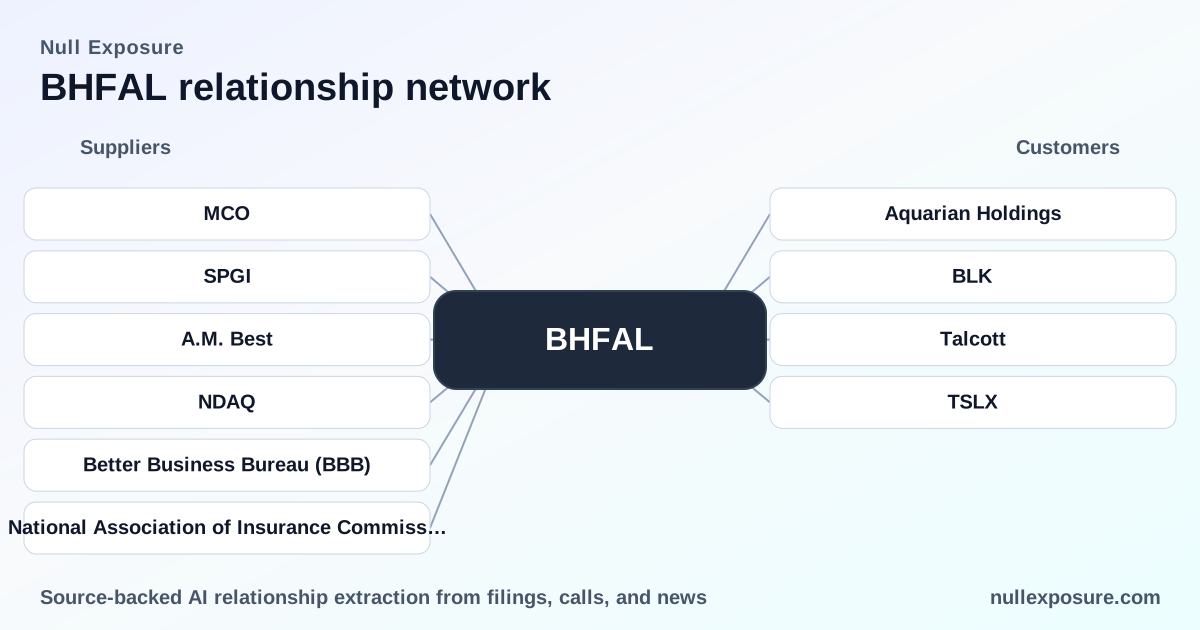
Relationship map: the counterparties you need to know
Below are the counterparties identified in the public reporting and what each relationship implies for Brighthouse’s operating and strategic position.
Aquarian Holdings
Brighthouse’s board rejected Aquarian’s final bid, indicating that Aquarian was a serious potential buyer but did not clear Brighthouse’s valuation or terms threshold. This rejection is reported in a March 9, 2026 news article covering the sale process. (StockTwits, March 2026)
Sixth Street (listed in the reporting with inferred symbol TSLX)
Brighthouse initiated negotiations with global investment firm Sixth Street as part of a pivot in the sale process, positioning Sixth Street as a leading bidder in the later rounds. The approach and associated press were documented on March 9, 2026. (StockTwits, March 2026)
Talcott (insurance partner)
Press accounts indicate Sixth Street is working with an insurance partner, Talcott, to structure a potential acquisition of Brighthouse, signaling a transaction model that pairs private capital with insurance‑industry capacity. This coupling was noted in coverage of the evolving talks. (StockTwits, March 2026)
BlackRock (BLK)
Brighthouse recorded the first deposits — more than $340 million — from its LifePath Paycheck product partnership with BlackRock, demonstrating the company’s ability to win and scale third‑party product placements and to convert distribution relationships into tangible inflows. This detail is reported in an InsuranceNewsNet article discussing quarterly results (FY2024). (InsuranceNewsNet, FY2024)
What the constraints tell investors about the business model
The public disclosures and constraint signals form a coherent picture of Brighthouse’s operating characteristics:
- Geographic concentration: Substantially all premiums and product fees originate in the U.S., anchoring regulatory, demographic and interest‑rate risk to a single jurisdiction. This is a company‑level signal supported by multiple disclosures.
- Counterparty profile: The company handles individual (retail) customer data, so privacy and AML/consumer protection rules are material operational controls.
- Distribution concentration and criticality: Management states that a core number of distributors produce the majority of sales; this creates vendor concentration risk and elevates the commercial importance of each distribution partner.
- Dual relationship roles: Brighthouse operates both as a distributor (through third‑party channels) and as a service provider to funds (collecting recurring 12b‑1 fees), so it earns across the value chain rather than solely on underwriting margins.
- Service segment maturity: The company receives meaningful 12b‑1 fee income (reported tens to hundreds of millions in recent years), giving revenue diversification within annuities but also exposure to fund flows and changes in distributor economics.
These constraints imply a contracting posture that is defensive on distribution continuity and opportunistic on strategic transactions: the firm must protect sales channels while extracting value from fee streams and balance‑sheet management.
Investment implications and risk checklist
- Transaction optionality is a valuation lever. The active interest from private capital and insurance partners creates a near‑term catalyst; bidders who can combine capital and insurance capacity (e.g., Sixth Street + Talcott) change the economics relative to pure financial sponsors.
- Distribution concentration is the single largest operational risk. Loss or reduction of a major distributor would impact new sales materially, which compresses long‑term growth prospects and stresses the importance of contract renewals.
- Fee income provides earnings stability but is not immune to pressure. 12b‑1 and servicing fees have been a steady component of revenue; shifts in fund flows or distributor economics will affect those streams.
- Privacy and regulatory compliance are non‑trivial. Handling retail financial and health information requires robust controls and can create remediation costs if standards slip.
- Yield and capital profile matter for equity investors. With a high dividend yield (~7.7%) and a modest market cap (~$3.44bn), investors should price both income expectations and the possibility of a strategic transaction that could remap equity value.
For more granular deal timelines and counterparty intelligence, see https://nullexposure.com/.
Bottom line
Brighthouse is a U.S.‑centric annuity and life insurer with recurring fee income and concentrated distribution exposure. The current sale process — involving Aquarian, Sixth Street and an insurance partner (Talcott) — is the primary near‑term value driver for equity holders, while operational stability hinges on preserving core distribution relationships and managing fund servicing economics (including the BlackRock LifePath Paycheck accumulation). Investors should weigh the immediate transaction dynamics alongside persistent distribution concentration and regulatory exposures before concluding on risk‑adjusted upside.