Brighthouse Financial (BHFAM) — customer relationships and strategic posture for investors
Brighthouse Financial underwrites and services U.S. life insurance and annuity contracts and monetizes through premiums, policy fees and investment-related fee streams (including 12b-1 and other fund servicing fees) plus returns on invested assets; distribution is executed primarily through third‑party channels and contractual servicing arrangements. This profile puts Brighthouse at the intersection of insurance balance‑sheet economics and fee‑for‑service revenue models, and the company’s recent strategic discussions with private capital buyers underscore the value of its distribution and fee income to potential acquirers. Learn more about the customer relationships that shape that value proposition at https://nullexposure.com/.
Deal context: a near-term strategic sale process led by Sixth Street
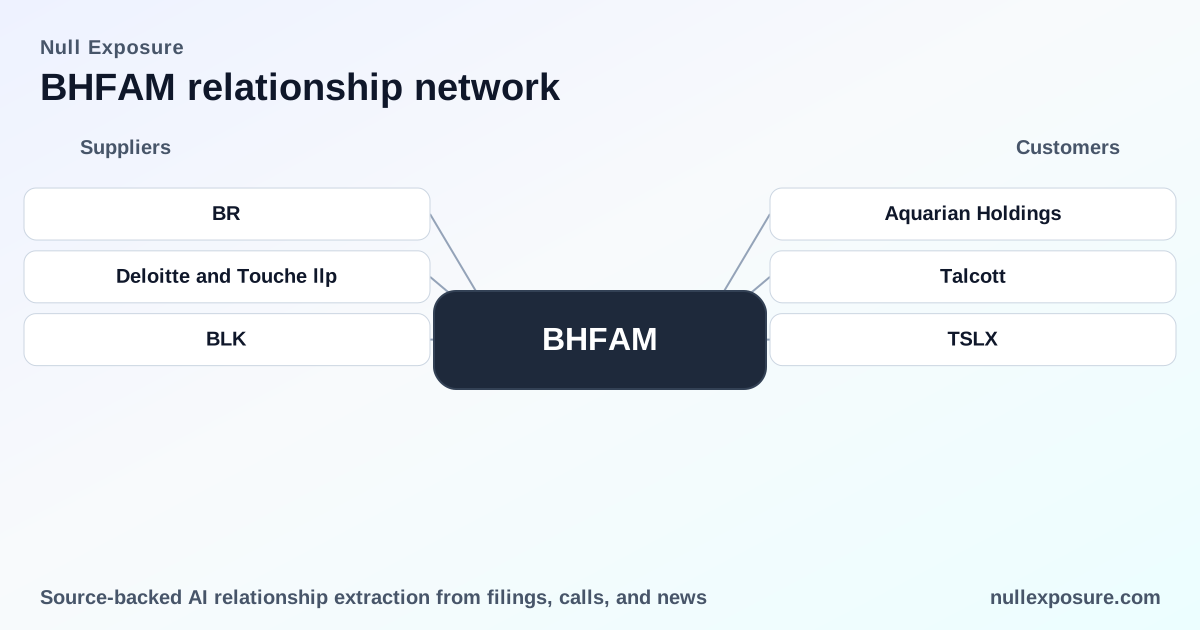
Brighthouse entered a negotiation phase with Sixth Street and its insurance partner Talcott after an earlier approach from Aquarian Holdings stalled in September; the negotiating parties and a reported $55-per-share bid were disclosed in press coverage on March 9, 2026. According to that March 9, 2026 report in Newsable/Asianet, Sixth Street positioned itself with an insurance partner for a potential acquisition, signaling strong private capital interest in Brighthouse’s earnings streams and distribution footprint. Key takeaway: the company’s distribution and recurring fee income have transaction value that private capital is actively bidding for.
Who Brighthouse has been negotiating with — the relationships in this file
Aquarian Holdings
Brighthouse engaged in weeks‑long talks with Aquarian Holdings that ultimately went cold in September, making Aquarian a former active bidder in the strategic process. This timeline was reported in March 2026 coverage of the sale process by Newsable/Asianet.
Talcott
Talcott acted as the insurance partner in the Sixth Street approach and was named in the coverage as the transactional insurance counterparty conducting negotiations with Brighthouse. The role of an insurance partner like Talcott positions it as an acquirer or backer of insurance liabilities, according to the March 9, 2026 report in Newsable/Asianet.
Sixth Street (inferred symbol: TSLX)
Sixth Street led the reported $55-per-share offer and entered direct negotiations with Brighthouse, leveraging an insurance partner structure to bid for the company’s franchise. The March 9, 2026 Newsable/Asianet article describes Sixth Street as the lead bidder in the renewed process.
TSLX (inferred reference)
TSLX appears in the dataset as an inferred identifier connected to Sixth Street in the March 2026 coverage; the document associates TSLX with the Sixth Street-led bid and related negotiations, as reflected in the same Newsable/Asianet story.
(Each of the four items above is drawn from the March 9, 2026 Newsable/Asianet report summarizing the buyer interest and negotiation timeline.)
Operational and commercial constraints that matter to investors
Several company-level constraints extracted from filings and disclosures explain how Brighthouse structures customer contracts and manages distribution:
-
Usage‑based fee contracts govern a material portion of fee revenue. Brighthouse discloses that 12b‑1 fees and similar fund servicing fees are calculated as fixed percentages of average asset balances and are collected monthly or quarterly under contract language. This is a cash‑flow‑stable, balance-sensitive revenue lever drawn directly from customer assets under management, according to Brighthouse filings covering the recent fiscal periods.
-
Geography is concentrated in the U.S. Substantially all premiums, policy fees and other revenues are U.S.-originated, making Brighthouse a domestic franchise whose distribution economics are tied to U.S. retail savings and retirement markets.
-
No single customer drives revenue concentration. The company reports that no individual customer contributed more than 10% of premiums and fee revenue in the recent years, which positions Brighthouse with low client concentration risk at the top line.
-
Dual roles: distributor relationships and service provider contracts. Filings describe Brighthouse distributing through a diverse set of third‑party channels while also earning 12b‑1 fees by providing fund services such as call center support, record‑keeping and training. That combination means Brighthouse is both a channel-dependent originator and a third‑party service vendor to fund complexes.
-
Corporate commitments are large and balance‑sheet relevant. Unfunded partnership and lending commitments reported at roughly $1.7 billion at December 31, 2024, and mortgage loan commitments in the hundreds of millions, indicate significant off‑balance sheet or committed capital exposures that investors should treat as material for capital allocation and liquidity planning relative to reported revenue of roughly $6.95 billion TTM.
Together these signals define Brighthouse’s operating model: recurring, asset‑tied fee income; U.S.-centric distribution; low counterparty concentration; and significant capital commitments that make funding and credit lines central to enterprise risk management.
What investors should watch next — risks and opportunities
-
Transaction and strategic‑process risk: Active bids from Sixth Street and earlier talks with Aquarian demonstrate real strategic optionality, but the outcome will materially affect control of distribution channels and fee agreements. The March 9, 2026 press coverage is the primary public signal of that process.
-
Distribution dependency and contract termination flexibility: Distribution agreements are cancellable by either party under the company’s standard contracts, which introduces execution risk if independent channels re-contract or defect.
-
Fee elasticity tied to asset balances: Because a material portion of other revenues is usage‑based (12b‑1 and similar), asset market movements and net flows directly compress or expand fee income; this links revenue volatility to market performance and net fund flows.
-
Capital commitments create funding pressure but also scale benefits: Large unfunded partnership and mortgage commitments signal both the potential for outsized returns and the need for robust liquidity and credit capacity.
Review the customer map and provider relationships that drive these dynamics at https://nullexposure.com/.
Bottom line
Brighthouse is a U.S.-focused life and annuity specialist whose value to buyers rests on stable, asset‑tied fee streams and a broad independent distribution footprint. Current buyer interest — led publicly by Sixth Street with an insurance partner — validates the market value of those recurring revenues. Investors should evaluate both the upside from transaction value and the operating sensitivities: asset‑linked fee volatility, cancellable distribution contracts and large capital commitments. These are the levers that will determine how a sale or strategic restructure translates into shareholder value.