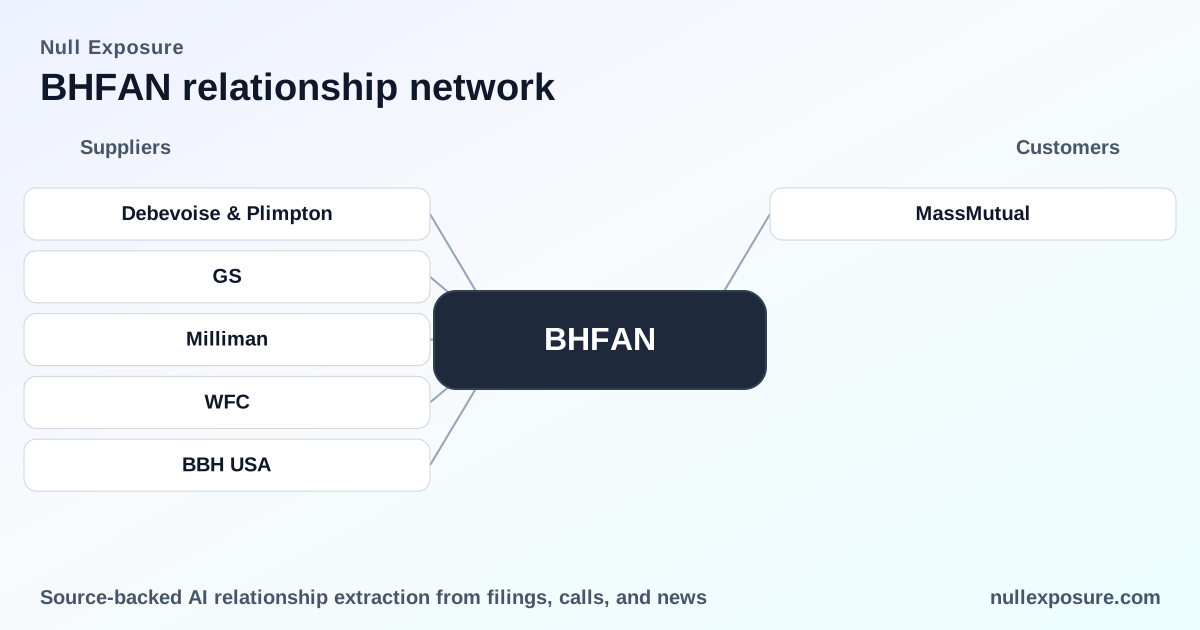
Brighthouse Financial (BHFAN) — how the company monetizes distribution relationships and where MassMutual fits
Brighthouse Financial sells life insurance and annuity products through a mix of direct underwriting and partnerships with third-party distributors, and it monetizes through premiums, policy fees, investment income and usage-based distribution and service fees (notably 12b-1 style fees paid by funds). For investors and operators evaluating Brighthouse’s customer relationships, the key story is a business built on recurring premium streams plus fee income tied to product flows through external channels — a model that amplifies revenue visibility but concentrates commercial sensibilities in distribution and contract design. For depth on relationship mapping and contractual signals, see https://nullexposure.com/.
The operating model in plain English: product manufacturing with distribution leverage
Brighthouse functions primarily as a product manufacturer in the U.S. life and annuity market: it designs and underwrites annuity and life products, then places them through a broad network of independent distributors and marketing arrangements. Revenue drivers are therefore twofold — insurance economics (premiums, investment spread and policy fees) and recurring contract fees tied to customer balances and distribution activity (for example, fixed-percentage 12b-1 style fees). Public filings show scale — over 2.2 million annuity contracts and policies in force as of year-end 2024 — which anchors both fee income and the company’s risk profile.
- Monetization levers: premiums and investment return on reserves; policy and administrative fees; usage-based fees tied to invested balances; distribution-margin economics.
- Commercial posture: product-focused, distribution-dependent; contracts commonly specify fee percentages tied to customer balances rather than fixed retainers.
Visit https://nullexposure.com/ to review relationship detail and contract signal summaries.
How contracts, geography and distribution shape risk and upside
Brighthouse’s contractual posture and operating constraints define both resilience and vulnerability. Company-level signals derived from filings and public commentary show several consistent characteristics:
- Usage-based fee structure: Filings describe 12b-1 type fees “equal to a fixed percentage of the average daily balance of the customer's investment in a fund,” indicating revenue scales with asset accumulation and distribution flows rather than fixed retainer income.
- U.S.-centric footprint: The company states that “substantially all” premiums and fees originate in the United States, making geographic concentration a structural fact and tying growth to U.S. interest-rate and retirement-savings cycles.
- Distribution and service roles: Brighthouse both distributes through third-party channels and contracts with funds and fund managers for services, creating a hybrid manufacturer-distributor-service provider posture that increases commercial complexity but widens possible monetization points.
- Active and mature business: Public data record Brighthouse as an active issuer with material scale — a signal of operational maturity and recurring revenue streams.
These characteristics imply predictable, balance-sensitive revenue with commercial exposure concentrated in U.S. distribution partners. For investors, that means growth and downside track closely with annuity sales cycles, interest-rate regimes and the health of intermediary channels.
Relationship snapshot — MassMutual
MassMutual
- Brighthouse entered a product development agreement under which Brighthouse exclusively develops certain annuity products that are issued by MassMutual; this is an exclusive product development arrangement rather than a simple sales relationship. According to an InsuranceNewsNet article discussing prior deals (FY2021), the agreement ties Brighthouse’s product development capability directly to MassMutual’s issuance and distribution channels. Source: InsuranceNewsNet (article on Brighthouse annuity sales and product development agreement, FY2021).
This relationship is contractually focused on product development and issuance mechanics rather than a plain vendor-customer resale arrangement; for investors, that elevates the strategic importance of Brighthouse’s product engineering capability and its ability to secure issuance slots on large mutual-company balance sheets.
What each signal implies for investors and operators
Operational constraints are not abstract — they translate into tangible investor considerations:
- Contracting posture: Usage-based revenue (12b-1 style fees) means top-line scales with asset balances and sales velocity, making short-term volatility in annuity flows more impactful than with fixed-fee business lines.
- Concentration risk: The U.S.-only orientation concentrates macroeconomic and regulatory risk geographically; product performance and sales are tied to U.S. interest-rate dynamics and retirement-savings patterns.
- Distribution dependence: Reliance on third-party channels and partner-issued products (as with MassMutual) produces counterparty concentration and execution risk; strong partner relationships amplify distribution reach but create potential single-point weaknesses if partner economics shift.
- Service-provider revenue: Fees for fund and distribution services create ancillary, recurring income but are linked to fund AUM dynamics and contractual fee schedules rather than underwriting margins.
These dynamics make Brighthouse an attractive candidate for investors seeking income exposure with balance-sensitive growth — but also a company where underwriting, distribution contracting and product innovation are the key operational levers.
Strategic takeaways and risk checklist
- Strength: Large installed base (millions of contracts) and multiple monetization channels produce steady fee and premium income. Book value and reported EPS suggest embedded capital and earnings power.
- Risk: Revenue sensitivity to asset flows and distributor economics; U.S.-only exposure concentrates macro risk.
- Operational focus: Product development capability and contract economics (how 12b-1 and other fees are structured) determine both margin and resilience; relationships like the MassMutual product development deal exemplify how Brighthouse leverages its product expertise to embed itself in partner ecosystems.
For a concise map of counterparties, contracts and the signal-level evidence that drives these conclusions, consult the relationship brief at https://nullexposure.com/.
Bottom line for investors
Brighthouse monetizes by combining insurance underwriting with usage-based fee income tied to distribution and fund balances. Its relationship with MassMutual is a strategic product-development arrangement that demonstrates the company’s role as a manufacturer of annuity products that can be issued by major life insurers. Investors should underwrite both actuarial performance and the contract economics of distribution fees when evaluating Brighthouse exposure; the company’s U.S.-centric, distribution-dependent model rewards product competitiveness and partner stability.