Brighthouse Financial (BHFAO) — Customer relationships and strategic posture after the March 2026 bid noise
Brighthouse Financial underwrites and manufactures annuity and life-insurance products and monetizes through insurance premiums, investment-management fees and distribution-related fees (notably 12b-1 payments). The company distributes principally through third‑party channels while its affiliate Brighthouse Advisers provides investment advisory services that underpin variable products; trailing twelve‑month revenue is roughly $6.95 billion with operating margin around 21%, reflecting a fee‑based, contract‑anchored business. For detailed mapping of counterparties and relationship risk, see Null Exposure’s collection of customer signals: https://nullexposure.com/
Quick read: what the March 2026 headlines changed
A March 2026 Menafn report put Brighthouse in active strategic discussion with private capital and insurance partners, producing multiple named counterparties and a rejected cash approach. The market is reacting to buyer interest more than to any change in fundamental distribution economics, but counterparty identity matters because Brighthouse’s revenues are contractually backed and concentrated in the U.S. (2.2 million policies in force as of December 31, 2024). For further context and counterparty detail visit https://nullexposure.com/
Who is at the table — the named relationships from the March 2026 report
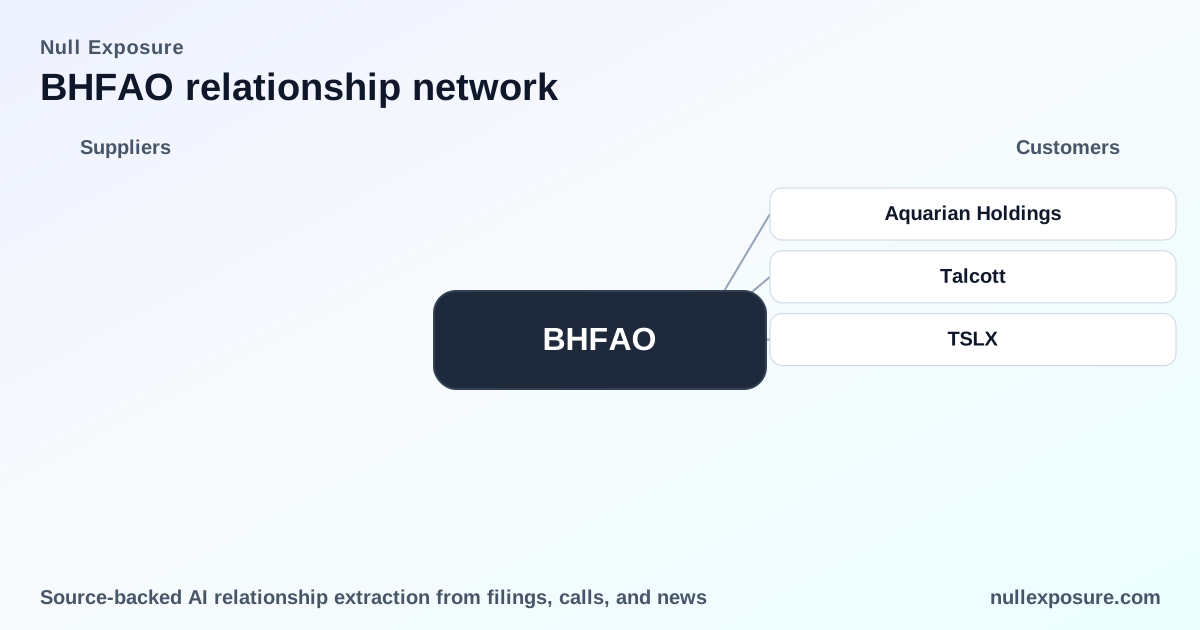
Below I cover each relationship mentioned in the public reporting, with a 1–2 sentence investor‑focused take and the source.
Aquarian Holdings
Brighthouse’s board reportedly rejected Aquarian’s final bid, signaling management’s view of Aquarian’s price or structure as insufficient relative to intrinsic value or strategic alternatives. According to a Menafn report dated March 9, 2026, Aquarian’s offer was turned down by Brighthouse’s board (Menafn, March 2026).
Talcott (insurance partner)
Negotiations referenced an insurance partnership with Talcott in connection with Sixth Street’s interest, indicating buyers were considering a structured market approach pairing capital with insurance-operating capability. Menafn noted that Brighthouse engaged with Sixth Street and its insurance partner Talcott after talks with Aquarian cooled (Menafn, March 9, 2026).
Sixth Street
A global investment firm, Sixth Street emerged as a reported potential acquirer, with reporting that Brighthouse was exploring a sale to Sixth Street, a development that shifts the M&A narrative toward private‑capital strategic transactions. The Menafn piece links Sixth Street to Brighthouse interest (Menafn, March 9, 2026).
TSLX (ticker linkage in reporting)
The coverage also referenced the ticker TSLX in association with Sixth Street in the public reporting, reflecting either an inferred market vehicle or media shorthand tying Sixth Street’s public affiliates into the discussion. The Menafn article lists the TSLX symbol alongside Sixth Street in the March 9, 2026 story (Menafn, March 2026).
What these counterparty signals imply about how Brighthouse operates
Use the relationship list above together with company disclosures to draw enterprise‑level conclusions about Brighthouse’s operating model and risk posture.
- Geographic concentration is high: Brighthouse’s operations and almost all premiums and policy fees originate in the U.S., with 2.2 million contracts in force at December 31, 2024; this produces single‑jurisdiction exposure to regulatory, interest‑rate and longevity trends (company disclosures, year‑end 2024).
- Multi‑role franchising (manufacturer + distributor + service provider): The company functions as a product manufacturer while relying on third‑party distribution and operating an in‑house adviser (Brighthouse Advisers) that collects management and 12b‑1 fees. That mix generates contractual, recurring revenue streams tied to asset balances and policy persistency.
- Contracting posture is formal and fee‑based: Brighthouse’s contracts with funds and distributors include explicit 12b‑1 arrangements (monthly or quarterly fee mechanics and non‑refundable payments), which creates predictable cashflow recognition linked to service performance and asset balances (company disclosures).
- Concentration and counterparty diversification: Distribution occurs across multiple independent channels, which reduces single‑partner concentration risk, but the business remains concentrated by product type and geography — a counterparty event that affects distribution partners or capital providers would have outsized repercussions.
- Maturity and criticality: As one of the largest U.S. annuity and life insurers, Brighthouse is a mature, scale player whose underwriting and fund‑sponsorship roles are strategically critical to affiliated products and distribution partners.
Financial and strategic implications for investors
Brighthouse’s core economics—$6.95B revenue TTM, operating margin ~21% and EPS of $12.61—support a cash‑generative business that is attractive to private capital seeking stable insurance cashflows. The March 2026 interest from Sixth Street and approaches from Aquarian illuminate two distinct buyer rationales: one focused on pure balance‑sheet/insurance operations pairing (Talcott + Sixth Street), the other on price arbitrage. For investors and operators evaluating customer relationships, the key takeaways are:
- Counterparty quality matters: An insurer sold to a strategic insurance partner (e.g., Talcott) preserves operating continuity; a sale to opportunistic financial buyers changes distribution and capital priorities.
- Contractual revenue insulation: 12b‑1 and advisory fees provide a defensive revenue layer during transition, but scale and persistency will determine realized margins post‑transaction.
- Regulatory and capital implications: A change in ownership structure (strategic vs private equity) alters capital allocation, reinsurance posture and fee strategies that directly influence distributors and third‑party partners.
Risks that investors should watch in the customer map
- Single‑country exposure increases sensitivity to U.S. interest rates and life‑assumption updates.
- Distribution dependency means buyer decisions that alter compensation or product availability will show up quickly in new sales and persistency.
- Deal execution risk: Board decisions (as with Aquarian) and choice of partner (insurance operator vs financial sponsor) will determine integration costs, franchise stability and the value of long‑dated liabilities.
Conclusion: actionable perspective
For investors assessing Brighthouse’s customer relationships, the March 2026 reporting confirms active strategic interest but also highlights that Brighthouse’s economics are tied to contractual fee streams and U.S. policy concentration. Monitor definitive deal disclosures and any changes to distribution agreements or advisory mandates as primary drivers of near‑term operational risk.
For ongoing counterparty and relationship intelligence on Brighthouse and peer insurers, see Null Exposure’s coverage at https://nullexposure.com/ — the repository connects buyer naming, filing excerpts and relationship‑level signals into investor‑grade summaries.