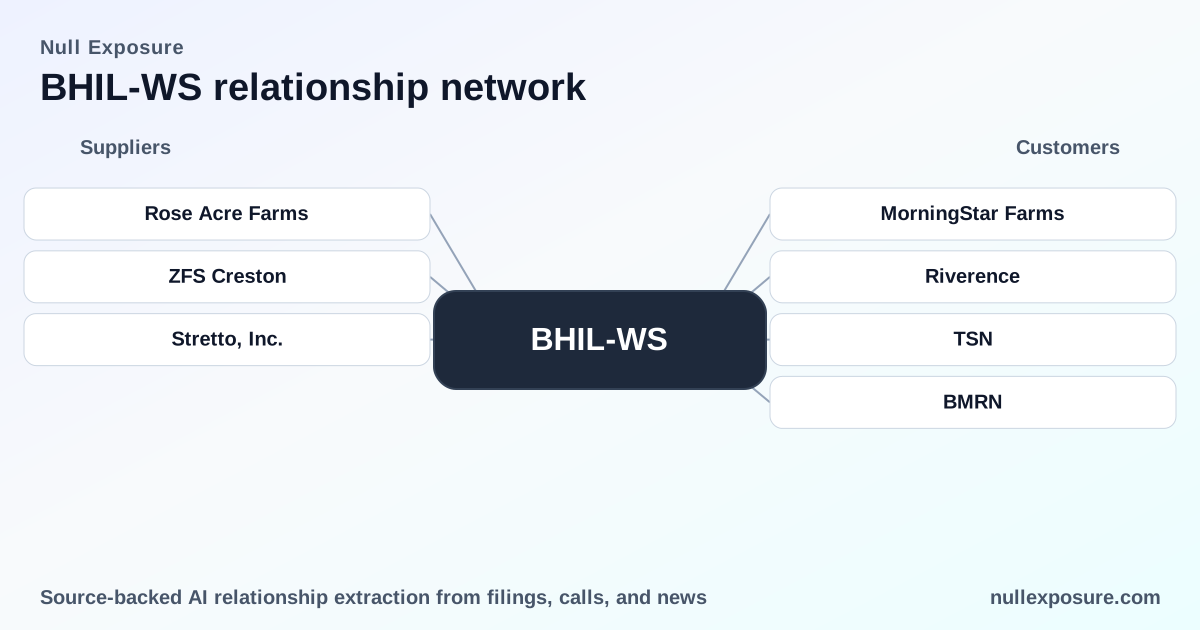
Benson Hill (BHIL-WS) — customer map and what it means for investors
Benson Hill operates as a crop genetics and ingredient company that commercializes proprietary soy and pea varieties and sells processed protein ingredients and genetics-derived solutions to food manufacturers and animal nutrition customers. The company monetizes through ingredient supply contracts, distribution partnerships, licensing of proprietary germplasm, and selective asset divestitures that recycle capital into its strategic priorities. For a concise investor view of customer exposures and counterparty concentration, read on or visit https://nullexposure.com/ for expanded company relationship dashboards.
Quick investor thesis
Benson Hill has repositioned from a consumer-facing alternative-protein supplier to a B2B ingredient and animal nutrition play, leveraging strategic distribution partners and large integrators to scale UHP soy and low-impact soy ingredients. This operating posture reduces direct-to-consumer commercialization risk while concentrating revenue exposure into a handful of high-value commercial partners.
Customer and partner relationships you need to know
Dakota Dry Bean, LLC
Benson Hill completed an asset sale of its pea products business to Dakota Dry Bean, LLC for approximately $23.2 million, reflecting a tactical divestiture to sharpen focus on core soy and animal feed initiatives. According to a TipRanks company announcement, the transaction closed on February 12, 2025 (FY2025).
MorningStar Farms
Benson Hill supplies soy ingredients to MorningStar Farms (Kellogg-owned) for alt‑meat products, establishing a commercial route into large consumer food manufacturers that require consistent ingredient specifications. This partnership was reported by AgFunderNews in FY2022.
Riverence
Riverence, a trout grower, used planet‑friendly soy varieties developed by Benson Hill as feed inputs, illustrating Benson Hill’s access to aquaculture feed channels. Fish Farming Expert covered this linkage when reporting on asset transactions in FY2025.
ADM (ADM)
ADM entered a North American distribution and commercialization agreement to process Benson Hill’s Ultra‑High Protein (UHP) soybeans and bring proprietary ingredients to market, giving Benson Hill scale in processing and route-to-market. Nutritional Outlook reported this distribution agreement as originating in FY2022.
White River Nutrition
Benson Hill sold a soy processing facility in Creston to White River Nutrition in February 2024, converting an owned-processing asset into cash and third-party processing capacity. The facility sale was reported via a regional news item in FY2025.
TSN (entry in results)
Benson Hill partnered with Tyson Foods and an unnamed poultry integrator on broiler studies that support its strategic pivot toward animal nutrition, reinforcing its commercial interest in poultry feed markets. AgTech Navigator discussed these studies and strategic timing in a FY2025 article.
Tyson Foods
The company-level partnership with Tyson Foods underpins Benson Hill’s decision to prioritize animal nutrition since October 2023 and validates demand from large protein integrators for its ingredient solutions. AgTech Navigator reported on the partnership and related study work in FY2025.
BioMar
BioMar contracted to source “low‑impact” soy from Benson Hill for aqua feed formulations, giving Benson Hill entrée to international aquafeed buyers and specialty feed value pools. AgTech Navigator and Fish Farming Expert covered the BioMar sourcing relationship and associated asset movements in FY2025 and earlier reporting.
BMRN (entry in results)
The BMRN-labeled result mirrors reporting on BioMar’s sourcing of Benson Hill soy for aquafeed; it reinforces that institutional aquafeed buyers documented Benson Hill as an input supplier in FY2025. Fish Farming Expert included this naming in its coverage of asset sales and feed-market linkages.
Additional BioMar / BMRN mentions
Multiple items in the results reiterate BioMar’s sourcing relationship and the acquisition of related assets by other industry players, underscoring recurring market acknowledgement of Benson Hill’s role in low‑impact soy supply for feed customers. Fish Farming Expert and AgTech Navigator reported these connections in FY2025.
Operating model signals and business-model characteristics
- Contracting posture — partner‑centric. Benson Hill outsources processing and distribution through partners such as ADM and has sold processing assets to third parties, showing a deliberate move toward a capital-light, partner-led commercialization model rather than vertically integrated manufacturing.
- Concentration — revenue funnels through large customers. The company’s commercial footprint is concentrated with a small number of large processors and integrators (ADM, Tyson, BioMar, Kellogg/MorningStar Farms), which speeds scale but creates single‑counterparty sensitivity.
- Criticality — differentiated input for specific end-markets. Benson Hill’s proprietary UHP soy and low‑impact soy varieties are value-add ingredients for alt‑meat and animal-feed customers, making its products strategically important when formulations demand higher protein or sustainability attributes.
- Maturity and capital management — active portfolio pruning. The pea business sale to Dakota Dry Bean and the Creston facility sale to White River Nutrition demonstrate a disciplined approach to redeploy capital away from non-core assets into feed and ingredient commercialization.
These characteristics collectively point to a company that is managing operational risk by ceding manufacturing scale to partners while embracing concentration risk in exchange for higher-margin, differentiated ingredients.
What this means for investors — concise implications
- Upside if partners scale commercial adoption. Distribution via ADM and supply agreements with major integrators accelerate revenue visibility without proportional capital outlay.
- Margin leverage with concentration risk. Large partners can drive rapid volume growth, but loss of any single major partner would have outsized near-term impact.
- Strategic clarity reduces execution risk. Recent divestitures and publicized feed partnerships show management is focusing resources on higher-return channels (animal nutrition and specialty ingredients).
- Monitoring priorities: track renewal/expansion of ADM processing agreements, commercial trial outcomes with Tyson/BioMar, and any new distribution or licensing deals.
For a deeper look at counterparty exposures, see our relationship dashboards at https://nullexposure.com/.
Bottom line
Benson Hill has restructured from direct consumer-facing product plays toward a partner-distributed ingredient business focused on high-protein and low‑impact soy for food and feed customers. This model accelerates scale and limits capital intensity but concentrates commercial risk into a few strategic partners; investors should assign valuation weight to partner execution and contract durability when modeling BHIL-WS.