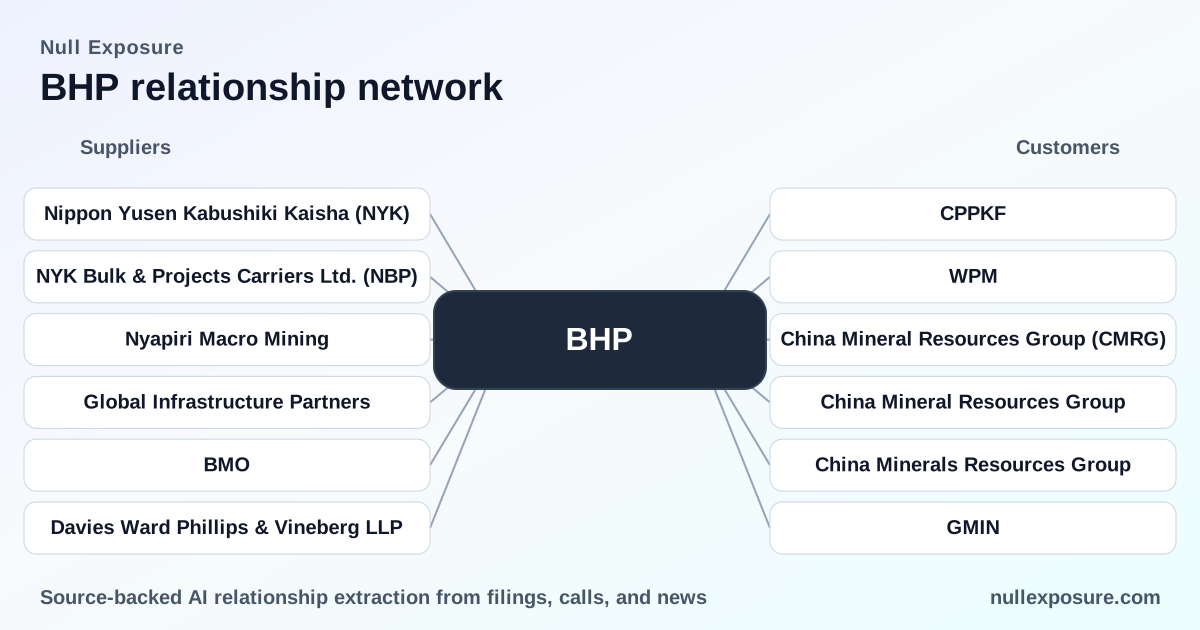
BHP’s customer playbook: monetizing mines through sales, streams and selective divestments
Thesis — BHP monetizes its global resource portfolio by selling commodities into spot and contract markets, recycling capital through asset sales and large-scale streaming/royalty agreements, and selectively transferring non-core operations to third parties to sharpen balance-sheet optionality. Investors should view recent customer relationships as deliberate liquidity and risk-management moves that prioritize cash generation and copper/silver exposure management.
For a consolidated view of these developments and supporting source links, see https://nullexposure.com/.
How these deals map to BHP’s commercial strategy
BHP’s recent customer-facing transactions illustrate a clear commercial posture: capitalize today on existing resource rights while retaining portfolio optionality where it supports scale and margins. The company is executing three simultaneous plays:
- Capital recycling via streaming: selling future metal-byproduct streams for large upfront cash receipts to redeploy into core growth (notably copper).
- Strategic divestments: disposing discrete assets or subsidiaries to simplify operations and unlock value.
- Negotiated supply management: active price and supply talks with large national buyers to protect margins and market share.
No formal constraint excerpts were returned with the relationship data, so these operating-model signals are company-level observations derived from the set of counterparty transactions and public notices. They indicate a contracting posture that is transactional and opportunistic, counterparty concentration toward large specialist financiers and regional buyers, high criticality of copper and silver flows for near-term cash, and a mix of mature (long-term streaming) and one-off (asset sales) commercialization instruments.
Relationship roll call — what counterparties tell investors
Faraday Copper Corp (CPPKF)
Faraday Copper agreed to acquire a wholly‑owned BHP subsidiary on February 20, 2026, representing a targeted divestment that funnels a specific asset into a junior copper operator and frees BHP capital. This was reported by InsiderMonkey on March 9, 2026 (InsiderMonkey, Mar 9, 2026).
Takeaway: targeted asset disposals are being used to reallocate capital toward core copper positions.
Wheaton Precious Metals / Wheaton Precious Metals International (WPM / WPMI)
BHP completed a long‑term silver streaming agreement with Wheaton (WPM/WPMI) that delivers silver equivalent to 33.75% of BHP’s interest in the Antamina mine (subject to payable adjustments) in exchange for an upfront US$4.3 billion and ongoing payments linked to the spot price. The transaction was widely reported across The Assay (May 2026), Research‑Tree (Mar 2026), Benzinga (Feb 26, 2026) and Global Mining Review (Mar 10, 2026).
Takeaway: this is a large, definitive capital‑recycling move that monetizes silver byproduct while preserving BHP’s operational focus on copper and base metals.
Whitehaven Coal Limited (WHC / WC2.FRK)
Whitehaven agreed to acquire metallurgical coal assets from Mitsubishi Development and BHP for about US$4.1 billion, a sale flagged in SimplyWallSt reporting on May 2, 2026.
Takeaway: BHP is continuing to slim non‑strategic thermal/metallurgical coal exposure via large asset transfers.
China Mineral Resources Group (CMRG / China Minerals Resources Group)
Multiple reports in early March 2026 described a supply dispute and negotiation posture between BHP and China Mineral Resources Group, including temporary limits on purchases of certain BHP iron‑ore brands and later confirmation of dispute resolution. See TS2.tech and TradingKey coverage (Mar 2026).
Takeaway: BHP faces active bilateral negotiation risk with large national buyers that can affect short‑run seaborne iron‑ore sales and pricing.
Gold Royalty Corp (GROY)
Gold Royalty Corp disclosed royalty acquisitions tied to the Pedra Branca mine in Brazil and noted that the asset is operated by BHP even as ownership transitions; the reference appeared in InsiderMonkey commentary (May 3, 2026).
Takeaway: BHP’s operations generate royalty/stream interest for juniors and royalty firms, reinforcing the company’s role as a counterparty to capital markets into producing assets.
G Mining Ventures (GMIN)
BHP entered a transaction to transfer the CentroGold project to G Mining Ventures, documented in a BHP 6‑K filing republished via StockTitan on March 9, 2026.
Takeaway: BHP is selectively exiting non‑core development projects and crystallizing value via disposals to smaller, project‑focused operators.
Dominion Diamond Corp (DDC)
Historical transactions show Dominion (DDC) acquiring BHP’s diamond assets—most notably the Ekati mine—and references were covered in JCKOnline and mining industry write‑ups (articles referencing the 2012/2013 transactions, surfaced in 2026 reporting).
Takeaway: BHP’s exit from lower‑fit commodities (diamonds) is consistent with a longer‑term portfolio concentration on large‑scale base metals and iron ore.
(Second resource link for more context: https://nullexposure.com/)
Valuation and risk implications for investors
- Immediate cash lift: the US$4.3 billion Wheaton stream is a material one‑time cash inflow that improves liquidity and funds capital allocation without increasing leverage; markets priced that as positive for near‑term free cash flow.
- Earnings optionality: streaming deals reduce commodity exposure to byproduct price upside but transfer volatility risk to streaming buyers; investors should model lower byproduct earnings volatility and greater near‑term cash.
- Contract concentration risk: active supply negotiations with large Chinese buyers signal a commercial risk to seaborne iron‑ore volumes and pricing in the short term; this is a counterparty concentration issue, not a structural demand failure.
- Portfolio simplification: recurring asset disposals (coal, development projects, diamond exits) increase management focus on copper, iron ore and base metals, supporting the company’s growth‑through-core thesis.
Bottom line: what to watch next
- Monitor Wheaton’s payment and delivery schedule and how BHP redeploys proceeds (growth capex vs buybacks/dividend). Coverage in Benzinga and MarketScreener referenced expected closing timing in late Q1/Q2 2026.
- Track supply negotiations with Chinese state buyers for evidence of pricing concessions or contract term changes—these will drive near‑term iron‑ore margin variability. TS2.tech and TradingKey reported the dispute and subsequent resolution signals in March–April 2026.
- Watch for further targeted disposals or streaming deals that replicate the Antamina pattern; BHP’s capital‑recycling program is an explicit operating lever.
For a consolidated dashboard and signal tracking on these counterparties and more, visit https://nullexposure.com/.
Bold takeaway: BHP is monetizing byproduct and non‑core assets at scale to fund core copper exposure and shore up cash — a clearly executable, portfolio‑level strategy that shifts near‑term cash flows and reduces byproduct price exposure.