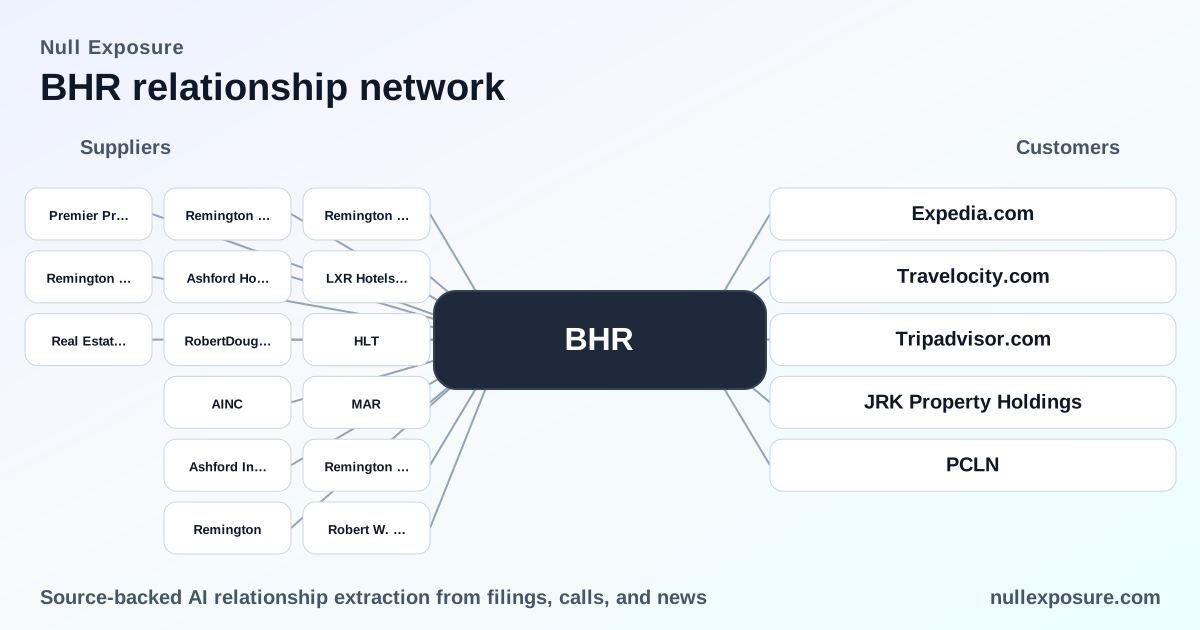
Braemar Hotel & Resorts (BHR): Distribution partners, advisory links, and what customers tell investors
Braemar Hotel & Resorts operates as an owner-operator REIT focused on upscale hotels and resorts in the U.S.; it monetizes through room revenue, ancillary services, and selective asset dispositions, and relies on third-party distribution and advisory relationships to drive occupancy and capital transactions. For investors assessing counterparty exposure and operational durability, the key facts are clear: transient leisure travelers dominate revenue, online travel intermediaries serve as primary distribution channels, and recent advisory and financing amendments with Ashford and Aareal reshape near-term capital and governance dynamics. For more direct intelligence on counterparty relationships and filings, visit https://nullexposure.com/.
Operational model and commercial constraints that matter to investors
Braemar’s operating model is service‑driven: revenue is recognized over guest stays and the company’s contracts with customers are short in duration. The company disclosed that approximately 75% of rooms revenue in 2024 was transient business, 23% group, and 2% contract sales, which signals a customer mix skewed toward individual leisure and transient corporate bookings rather than long‑term contracts. According to the company’s 2024 Form 10‑K, its properties are predominantly located in U.S. urban and resort markets across seven states, DC, Puerto Rico and the U.S. Virgin Islands—this geography concentration concentrates demand and regulatory exposure in North America.
These pieces of disclosure create a set of operating constraints investors should incorporate into valuation and risk workstreams:
- Contracting posture: Short-duration, service contracts for room nights produce high revenue volatility tied to occupancy and ADR cycles; there is limited contractual revenue visibility beyond near-term bookings.
- Customer concentration and criticality: Heavy reliance on transient travelers and online travel intermediaries (OTIs) makes distribution economics and channel fees a material margin lever.
- Maturity and segment behavior: Rooms are recognized as services provided over the stay, consistent with hotel operating norms; this places emphasis on operational execution (revenue per room, cost control) rather than long-term contract renegotiation.
Distribution partners and capital counterparties — each relationship explained
Below I list every relationship extracted from filings and recent coverage, with a concise take and the source for each.
Expedia.com
Braemar sells room inventory through major OTIs, including Expedia.com, which is cited among the Internet travel intermediaries that book the company’s rooms. According to Braemar’s 2024 Form 10‑K, “Some of our hotel rooms are booked through Internet travel intermediaries, including … Expedia.com.” (BHR 2024 10‑K).
Travelocity.com
Travelocity.com is another named online intermediary used to distribute Braemar inventory, reflecting the REIT’s dependence on third‑party channels to reach transient customers. This is stated verbatim in the company’s 2024 Form 10‑K discussion of distribution channels (BHR 2024 10‑K).
Tripadvisor.com
Braemar also lists Tripadvisor.com among the internet travel intermediaries that bring bookings to its properties, underscoring a multi‑channel OTA strategy to capture leisure demand. The mention appears within the same 2024 Form 10‑K disclosure on booking channels (BHR 2024 10‑K).
Priceline.com (PCLN)
Braemar names Priceline.com (symbol PCLN in some industry references) as part of the intermediary set used to book rooms, indicating the use of inventory parity and third‑party rate distribution common across the lodging sector. This is referenced in the company’s 2024 Form 10‑K (BHR 2024 10‑K).
PCLN (duplicate entry)
A second result lists PCLN again from the same 10‑K disclosure; while redundant, it reinforces that Priceline/PCLN is a material channel included in the company’s public description of distribution partners. The citation is the 2024 Form 10‑K (BHR 2024 10‑K).
BHR‑P‑D / Ashford (TradingView report)
A TradingView news item reported that Braemar extended an advisory agreement with Ashford Hospitality Advisors and related Ashford entities for ten years through 2037, indicating a meaningful governance and operating‑services relationship between Braemar and Ashford. TradingView covered this advisory extension in May 2026 (TradingView, May 2, 2026).
BHR‑P‑D / Ashford and Aareal (StockTitan/SEC filings)
Separate coverage of SEC filings noted amendments to advisory arrangements with Ashford Inc. and Ashford Hospitality Advisors LLC, and also referenced a new non‑recourse loan from Aareal Capital Corporation with a $180 million balance and a lower spread of SOFR + 3.00%. These items were reported in March 2026 in coverage republishing SEC disclosures (StockTitan / SEC filings, March 2026).
JRK Property Holdings
Braemar sold the Hilton La Jolla Torrey Pines to JRK Property Holdings, which acquired the asset through its $350 million Hospitality Fund—an example of Braemar monetizing real estate to recycle capital. This transaction was reported by HotelBusiness in March 2026 (HotelBusiness, March 2026).
What these relationships mean for investors
- Distribution risk is intrinsic. The company’s explicit reliance on OTIs like Expedia, Priceline, Travelocity and Tripadvisor means a persistent fee structure and dependence on third‑party traffic to drive occupancy; that amplifies sensitivity to marketing spend and channel mix shifts.
- Transient demand dominance is both an opportunity and a lever. With ~75% of rooms revenue from transient bookings, management can influence revenue through rate management and direct‑to‑site initiatives, but downside from demand shocks is concentrated.
- Advisory and financing links alter capital dynamics. The extended Ashford advisory arrangement and the Aareal non‑recourse loan (reported March 2026) change governance and liquidity profiles: advisory amendments affect operating guidance and alignment, while the Aareal loan reshapes secured financing costs and maturity structure.
- Asset monetization is active. The JRK acquisition shows Braemar is willing to sell assets to redeploy capital or de‑risk markets, a behavior that supports balance‑sheet management but compresses portfolio scale.
Key investment takeaways
- Operational exposure is concentrated in U.S. transient travel and OTA distribution. Investors should underwrite revenue cycles with this concentration in mind.
- Recent advisory and financing moves are material. The Ashford advisory extension and the Aareal loan materially affect near‑term capital strategy and deserve focused diligence in investor models.
- Asset sales are an ongoing portfolio management tool. The JRK transaction is evidence Braemar will use dispositions to manage liquidity and returns.
For a deeper look at counterparty dynamics, filing redlines, and transaction histories related to BHR, see our company relationship hub at https://nullexposure.com/.
Conclusion
Braemar’s business combines typical hotel operating levers—occupancy, ADR and channel mix—with active capital management, including advisory agreements and secured financing that materially affect funding and governance. For portfolio investors, the two dominant exposures are distribution economics through OTIs and the company’s sensitivity to transient leisure cycles, while the Ashford and Aareal items are near‑term corporate developments that change the financing and advisory landscape.