How bioAffinity monetizes CyPath and who pays for it
bioAffinity Technologies develops the CyPath® Lung non‑invasive diagnostic test and commercializes it primarily through laboratory services and fee‑for‑service testing, with a multi‑phase plan to expand from a Texas LDT to CE‑marked and FDA‑authorized markets. Revenue today flows from patient testing fees and lab operations, supplemented by sales to institutional research customers; the company reported $6.162M in trailing twelve‑month revenue and a small market capitalization relative to the opportunity (~$9.8M). Read more about the firm and its commercial footprint at https://nullexposure.com/.
How to read the customer relationships: small scale, service‑heavy commerce
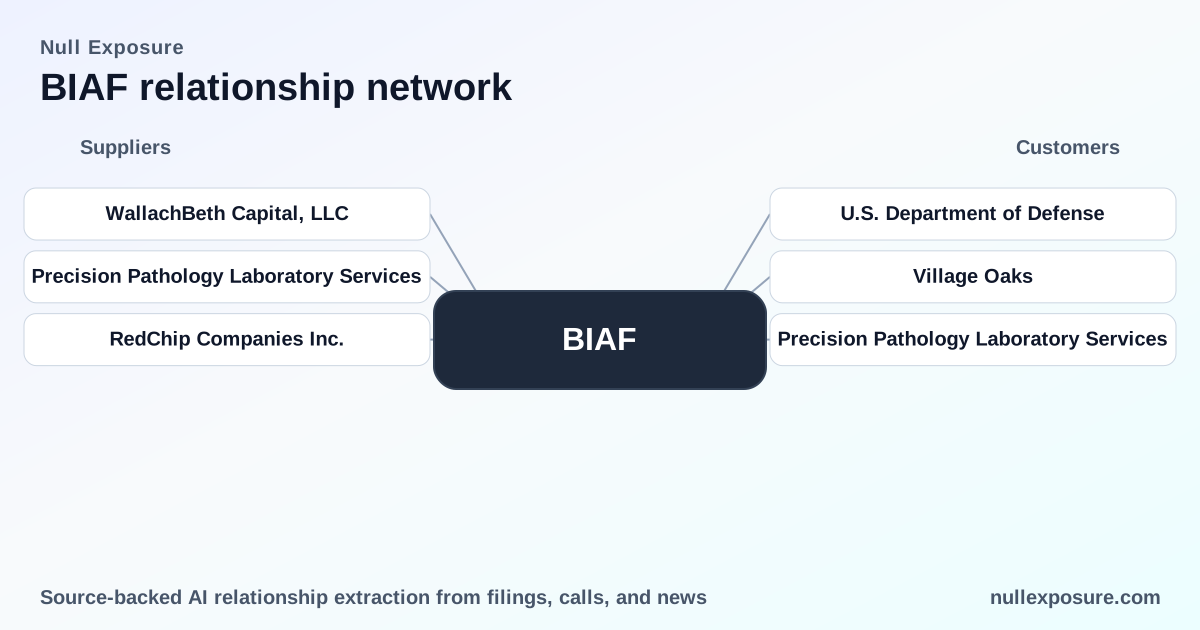
bioAffinity’s commercial model is a service‑first diagnostic play. The company operates internal laboratory capacity (Village Oaks), markets the CyPath test through a subsidiary laboratory (Precision Pathology Laboratory Services, PPLS), and sells directly to patients and institutional customers (including government customers for observational studies). That combination makes revenue both transactional (per‑test fees) and capability‑driven (lab services, clinical support) rather than license or high‑margin software sales.
- Scale and financial posture: The company is early commercial with negative EBITDA (reported -$10.07M) and narrow institutional ownership, which increases sensitivity to execution and partner concentration.
- Regulatory and go‑to‑market staging: Phase 1 was a limited Texas LDT launch completed in 2024, with planned CE‑mark rollout in the Netherlands and staged EU expansion, and a later global scale‑up contingent on FDA authorization.
- Distribution posture: Current selling is done via lab service channels (PPLS and Village Oaks) and direct patient billing; third‑party payors and government contracts are referenced as part of payment flows.
Explore the company overview and customer mapping at https://nullexposure.com/ for an investor‑grade primer.
Named customers and what each relationship means for revenue and validation
U.S. Department of Defense — institutional research buyer
bioAffinity sold CyPath Lung tests to the U.S. Department of Defense for an observational study, providing the DOD with test kits and data for research into lung screening and post‑COVID cardiopulmonary assessment. According to the company’s FY2024 Form 10‑K, these purchases were for the study titled “Detection of Abnormal Respiratory Cell Populations in Lung Cancer Screening Patients Using the CyPath™ Lung Assay.” (Source: bioAffinity FY2024 Form 10‑K)
Village Oaks — in‑house clinical flow cytometry provider
Village Oaks provides clinical flow cytometry services to support CyPath Lung operations, performing laboratory work that feeds into CyPath testing workflows. The FY2024 Form 10‑K explicitly notes Village Oaks’ role in delivering these laboratory services in support of the CyPath Lung test. (Source: bioAffinity FY2024 Form 10‑K)
Precision Pathology Laboratory Services (PPLS) — the commercial lab channel
Precision Pathology Laboratory Services is the subsidiary that markets CyPath Lung as a Laboratory Developed Test (LDT), serving physicians and enabling patient testing in the current limited launch. Multiple press reports in 2026 describe CyPath Lung being marketed as an LDT by PPLS, confirming the subsidiary’s central role in commercial distribution. (Sources: PharmiWeb press release, Feb 2026; StockTitan news, Mar 2026)
Operating constraints and what they signal about business risk
bioAffinity’s public disclosures and segment descriptions provide clear operating signals investors should weigh:
- Counterparty mix: The company sells to individual patients (fee‑for‑service) and to government research customers (DOD purchases are documented in the FY2024 10‑K). This dual counterparty mix creates mixed cash collection and contracting dynamics: patient payments are transactional while government engagements are research‑driven and episodic. (Company signal: FY2024 10‑K)
- Segment structure and concentration: Management reports two operating segments — diagnostic R&D and laboratory services — with laboratory services including Village Oaks and PPLS. That structure concentrates revenue generation in operational lab throughput and sales of CyPath tests rather than diversified product sales. (Company signal: FY2024 10‑K)
- Geographic staging and global ambition: Phase 1 completed with a Texas LDT launch; Phase 2 targets an EU entry via CE marking beginning in the Netherlands; Phase 4 envisions broader U.S. and international expansion contingent on FDA authorization. The staged approach highlights regulatory gating as a determinant of future revenue scale. (Company signal: FY2024 10‑K)
- Contracting posture with payors: The company states it contracts separately with third‑party payors (insurers and governmental payors), which typically are responsible for a majority of fees when applicable — this introduces payor negotiation and reimbursement risk as a central commercial constraint. (Company signal: FY2024 10‑K)
Key operational takeaway: bioAffinity’s revenue is tightly linked to lab throughput and regulated market access; institutional validation (for example, DOD engagement) supports credibility, but the current model remains service‑intensive and geographically limited until CE/FDA milestones are achieved.
What these relationships imply for investors
- Revenue predictability: Heavy reliance on patient testing and lab services creates variability in topline recognition; institutional research contracts (DOD) reduce volatility only if they scale beyond one‑off studies.
- Concentration risk: With laboratory services and a single marketing subsidiary (PPLS) capturing the commercial pathway, operational disruptions at Village Oaks or PPLS would have outsized revenue impact.
- Regulatory upside and gating: CE marking and FDA authorization are value inflection points — success unlocks new geographies and payer reimbursement pathways; failure or delay constrains growth to the limited LDT market.
- Validation and optionality: The DOD study is a strategic validation datapoint that supports clinical utility narratives, which can help with physician adoption and future payor discussions.
Consider these relationship dynamics when modeling scenarios: base cases should assume constrained, service‑driven revenue growth; upside cases require successful regulatory approvals and scalable lab commercialization.
Practical investor checklist
- Confirm lab capacity and throughput trends at Village Oaks and PPLS versus test demand.
- Track CE‑mark filings and FDA regulatory milestones for CyPath Lung.
- Monitor payor engagement and reimbursement announcements; third‑party payor acceptance materially changes economics.
- Watch for additional institutional contracts beyond the DOD that could stabilize revenue.
Bottom line
bioAffinity is an early commercial diagnostic company monetizing CyPath Lung through a lab services engine and a subsidiary sales channel (PPLS), with patient fees and occasional institutional research sales (notably to the DOD) today and regulatory‑driven expansion planned. The immediate investment story is execution and regulatory risk; the upside is a scalable LDT/IVD if CE and FDA milestones are met and payors accept the test. For more in‑depth mapping of customers and counterparties, visit https://nullexposure.com/.