BIAFW: How bioAffinity’s customer relationships frame near‑term revenue and go‑to‑market risk
bioAffinity Technologies sells a non‑invasive diagnostic test, CyPath® Lung, through its pathology subsidiary (PPLS) and monetizes primarily via fees for services billed to patients, physicians and third‑party payors — including government healthcare purchasers. Revenue is concentrated in service fees tied to test volumes, with a recent step‑function increase in CyPath Lung sales to institutional customers (notably the U.S. Department of Defense). Investors should value future cash flow based on volume scalability, contracting posture with government buyers, and PPLS’s traction selling into both individual and institutional payors. For an operational dossier and ongoing monitoring, see the company hub at https://nullexposure.com/.
The single institutional customer that matters: the U.S. Department of Defense
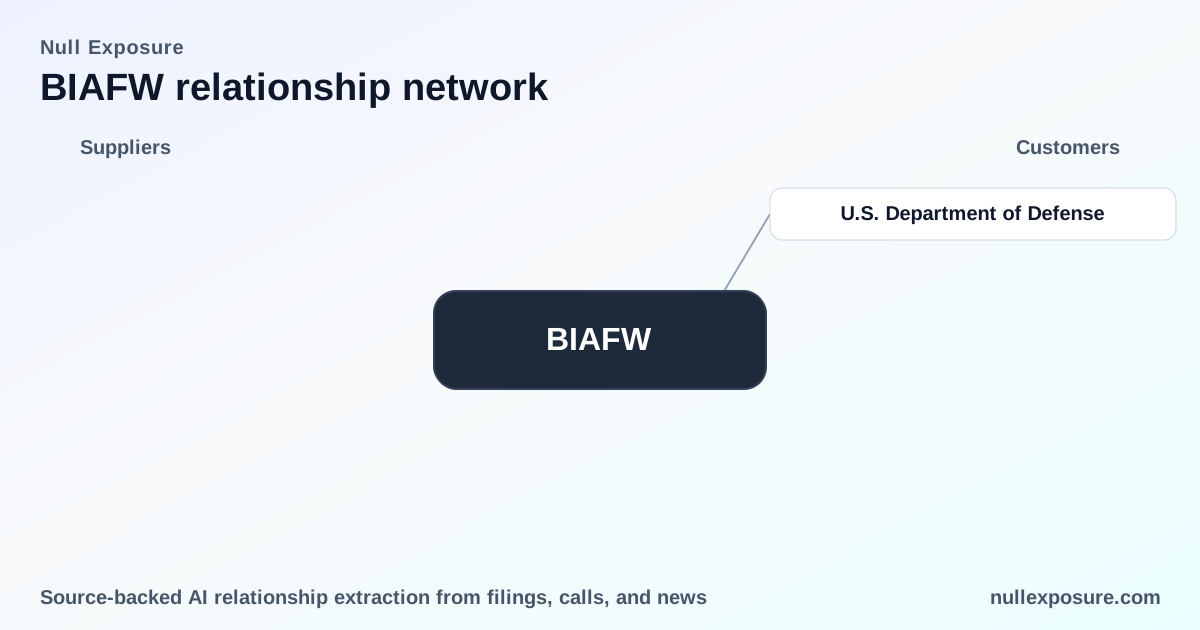
The company’s only explicit institutional customer listed in its FY2024 filing is the U.S. Department of Defense, which purchased CyPath Lung tests for an observational study and for R&D use related to assessing cardiopulmonary function post COVID‑19 infection. This is an active, buyer relationship described directly in bioAffinity’s FY2024 Form 10‑K. According to the filing, these sales began in late 2023 and continued through 2024 as part of a DoD observational protocol. (Source: company FY2024 Form 10‑K, Dec. 31, 2024).
One‑line relationship summary (plain English)
The U.S. Department of Defense purchased CyPath Lung tests from bioAffinity to support an observational lung‑screening study and related research activities — a current, revenue‑producing procurement documented in the company’s 2024 Form 10‑K. (Source: company FY2024 Form 10‑K, Dec. 31, 2024).
What the filing’s operational constraints tell investors about the business model
bioAffinity’s public disclosures provide signals that shape valuation and operational priorities:
-
Government counterparty presence and procurement posture. The company explicitly reports selling CyPath Lung tests to the DoD and notes listing on the U.S. Federal Supply Schedule (FSS) in October 2024, which opens formal channels into federal and veterans’ health systems. That status reduces ad‑hoc procurement friction and increases the probability of repeat institutional purchases, but also locks the company into formal contracting, compliance, and invoicing cycles typical of federal buyers. (Source: company FY2024 Form 10‑K, Oct.–Dec. 2024 excerpts.)
-
Dual customer base: individuals and institutional payors. PPLS invoices patients, physicians and third‑party payors (Medicare, private insurers, governmental payors). The filing positions patients as the end customer for the majority of revenues while acknowledging a role for physician ordering and third‑party billing complexity. This mixed revenue base creates both upside from volume growth and exposure to payer reimbursement complexity. (Source: company FY2024 Form 10‑K.)
-
Revenue concentration by service and nascent commercial maturity. The company discloses that PPLS generates revenue from three service lines — patient service fees, histology services, and medical director fees — and that CyPath Lung revenue increased approximately 1,400% to $0.5 million in 2024 (from $35k in 2023) driven by more than 600 additional test results. This indicates rapid early growth from a small base and places current institutional sales in a low‑to‑mid six‑figure band rather than as a transformative revenue stream. (Source: company FY2024 Form 10‑K, FY2024 results.)
-
Limited commercial scale and sales experience. The filing states the company is still building its sales and marketing organization and has limited experience in marketing and distribution of diagnostics, implying execution risk as the company scales volumes beyond early adopters and institutional pilots. (Source: company FY2024 Form 10‑K.)
How those constraints translate into investor‑relevant risk factors
-
Contracting: FSS listing and DoD purchases lower entry barriers into federal channels but create dependency on procurement cycles, program evaluations, and compliance processes. Payments and contract renewals will follow government timelines.
-
Concentration & criticality: At present, institutional contract revenue is meaningful for validation but immaterial to total revenues, making the company’s financial profile sensitive to test volume outcomes and payer acceptance.
-
Maturity: The business remains in early commercial stages; revenue growth is lumpy and tied to discrete studies and pilot programs rather than broad adoption in clinical workflows.
-
Margin profile: Clinical service revenues have generated gross profit (gross profit TTM reported), but overall operations remain loss-making on an EBITDA basis for the period reported. Convertibility of volume growth into durable margin expansion will depend on payer mix and reimbursement rates.
Practical implications for operators and dealmakers
-
For operator teams, prioritize converting institutional pilots (DoD and FSS) into recurring program contracts and streamline invoicing and compliance processes to match federal expectations. The company’s FSS listing is a strategic asset to be leveraged into repeatable program sales across VA and military health systems.
-
For investors, model conservative ramp scenarios that treat current institutional sales as validation catalysts rather than revenue guarantees; sensitivity to test volume and payer reimbursement should drive downside scenarios.
-
For potential partners or acquirers, PPLS’s three revenue streams and a validated clinical assay represent optionality, but limited commercial execution capability increases the attractiveness of strategic partnerships with established diagnostics distributors or lab networks.
Key takeaways
-
DoD is an active, documented buyer and the most visible institutional customer in FY2024, providing validation and a route into federal healthcare procurement. (Source: company FY2024 Form 10‑K.)
-
Revenue growth is real but small in absolute terms — CyPath Lung testing revenue rose to roughly $0.5M in 2024 after a steep percentage increase, underscoring early‑stage commercial traction more than scale. (Source: company FY2024 Form 10‑K.)
-
Commercial execution is the primary risk and opportunity: FSS listing reduces procurement friction, but PPLS must convert pilots into routine orders and broaden payer acceptance to realize scalable margins. (Source: company FY2024 Form 10‑K.)
For a concise intelligence package and continual updates on customer relationships and procurement signals, visit https://nullexposure.com/.