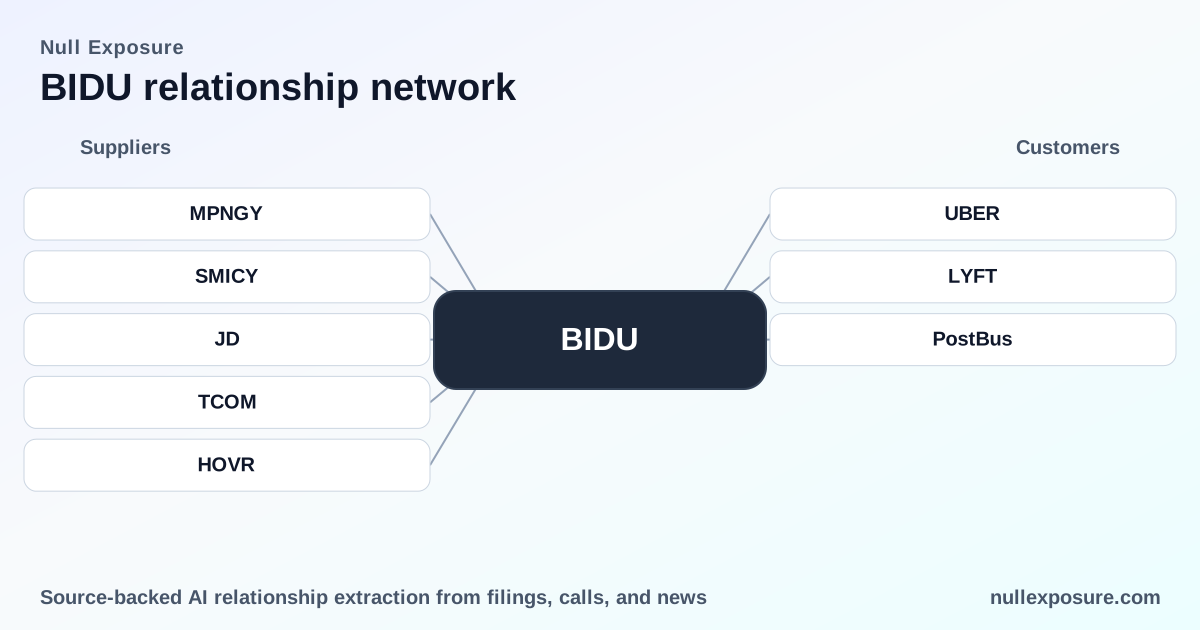
Baidu’s customer map: Apollo Go expands ride-hailing while Ernie spreads into commerce
Baidu operates a two‑pillar monetization model: high-margin search and advertising revenue at scale, plus a fast‑growing set of enterprise AI and mobility businesses that generate platform, licensing and service fees. Apollo Go autonomous services and the Ernie AI integrations are commercializing Baidu’s core machine‑learning IP through strategic partnerships rather than through one‑off hardware sales, creating recurring revenue opportunities for software, cloud inference and operations services. For deeper coverage of partnership flows and customer signals, visit https://nullexposure.com/.
Why partnerships matter for investors
Baidu’s headline metrics still reflect the legacy search business, but partnerships are the conduit that turns R&D into recurring revenue — whether that’s licensing Ernie to e‑commerce platforms or operating Apollo Go services with ride‑hailing and transit operators. These relationships accelerate commercialization, broaden addressable markets outside China, and shift revenue composition toward cloud/AI and mobility services that carry different margin and capital profiles than advertising.
Key takeaway: Baidu is selling platform capabilities (AI models, autonomous stacks, and operations) into other companies’ customer channels, and recent deals show that strategy scaling outside mainland China.
(Read more company signals at https://nullexposure.com/.)
Business model characteristics investors should weigh
Baidu’s partnership-driven model implies a distinct operating posture and risk profile:
- Contracting posture — strategic, platform-level arrangements. Baidu structures long‑term technology and operating agreements rather than simple supplier contracts, because Apollo and Ernie require integration, compliance and continuing support.
- Concentration — diversified across end markets but dependent on a small number of large platform partners for scale. Ads and search remain core, but mobility and enterprise AI growth is concentrated in anchor customers that distribute Baidu’s tech.
- Criticality — high strategic value, variable near-term revenue impact. Partners use Baidu’s models or autonomy stack to deliver customer‑facing services, making Baidu technology critical to those services even if current revenue contribution remains modest versus search.
- Maturity — mixed: mature ad/search economics, early commercial stage for autonomous and some AI partnerships. Apollo and Ernie are moving from pilots to paid deployments and revenue sharing, but these lines are still scaling.
Customer relationships: the current roster and what they mean
Uber — global channel for Apollo Go autonomous rides
Baidu and Uber expand their cooperation by bringing Apollo Go autonomous vehicles to the Uber platform in Dubai, leveraging the Dubai Roads & Transport Authority and the Uber distribution channel to commercialize driverless ride‑hailing beyond China. This builds on a June 2025 arrangement where Uber delivered Apollo Go rides through its platform. (Sources: Just‑Auto, Mar 9, 2026; InsiderMonkey, Mar 9, 2026; StockTitan, Mar 9, 2026.)
Dubai Taxi Company — local operator for fully driverless commercial service
Baidu’s Apollo Go has commenced fully driverless commercial ride‑hailing in Dubai in partnership with Dubai Taxi Company, a deployment that signals direct operator integration into regulated city fleets and incremental recurring revenue from ride operations. (Source: Baidu PR Newswire cited by Finviz, Apr 1, 2026 / reported May 2, 2026.)
PostBus — regional public transit pilot in Switzerland
Baidu tied PostBus to launch the AmiGo autonomous service in Switzerland, demonstrating Apollo’s exportability into European public transit and last‑mile mobility use cases that are distinct from consumer ride‑hail economics. (Source: StockTitan, Mar 9, 2026.)
Lyft — platform operations plus vehicle and tech supply
Under a cooperation agreement, Lyft handles platform operations, customer service and fleet dispatch while Baidu supplies autonomous vehicles and core technology support, indicating Baidu’s role as a systems and software provider while outsourcing go‑to‑market operations to established ride‑hail platforms. (Source: Futunn, Mar 10, 2026.)
JD.com — Ernie AI embedded into e‑commerce experience
JD.com integrated Baidu’s Ernie AI assistant into its platform, extending Baidu’s enterprise AI reach into e‑commerce personalization, search and customer assistance and turning model licensing and API usage into a revenue vector tied to platform engagement. (Source: Simply Wall St, Mar 10, 2026.)
YYAI — third‑party product integrations using Baidu models
YYAI’s AI integrates with large models including Baidu’s Wenxinyiyan to support matchmaking functionality, highlighting Baidu’s displacement from model training into multi‑vendor inference and product integrations. This is an example of downstream software companies embedding Baidu models to support verticalized applications. (Source: MarketScreener, Mar 10, 2026.)
What these relationships imply for revenue and risk
- Revenue composition shift. Partnerships with Uber, Lyft, Dubai Taxi Company and PostBus monetize Apollo through revenue sharing, fleet services and platform access instead of pure software licenses, producing recurring but operationally sensitive cash flows.
- Distribution leverage. Using global partners (Uber, Lyft, JD) accelerates market entry without Baidu building last‑mile customer channels in every geography, but it concentrates commercial exposure into a limited set of large partners that can dictate terms.
- Regulatory and operational risk. Cross‑border autonomous deployments introduce regulatory, insurance and operations risk that can affect near‑term margins and capital intensity.
- Upside from AI monetization. Enterprise Ernie integrations into platforms like JD.com broaden monetization beyond search; that revenue is scalable and higher margin once inference infrastructure scales.
Investment implications and risk checklist
Baidu’s strategy trades short‑term predictability for optionality: its core advertising business funds R&D and gives the company runway to scale Apollo and Ernie into substantial enterprise revenue streams. For investors:
- Evaluate the speed at which partnerships convert pilots into paid contracts and revenue shares.
- Monitor partner concentration, contract length and revenue attribution disclosure in Baidu filings.
- Watch regulatory milestones in markets where fully driverless services are deployed, since regulatory acceptance translates directly into addressable market expansion.
- Track gross margin trends for cloud/AI and mobility services separately from advertising to understand profitability mix.
Bottom line
Baidu is commercializing its AI stack by embedding Ernie into large platforms and exporting its Apollo autonomy stack through strategic operator partnerships. These relationships convert technological leadership into recurring, partnership‑driven revenues, but they introduce operational and concentration risks distinct from the search business. Investors should treat the partnership roster as the lead indicator for the company’s transition from a predominantly advertising business to a diversified AI and mobility platform.
For a concise feed of customer signals and partnership developments, visit https://nullexposure.com/ for ongoing tracking and deal‑level context.