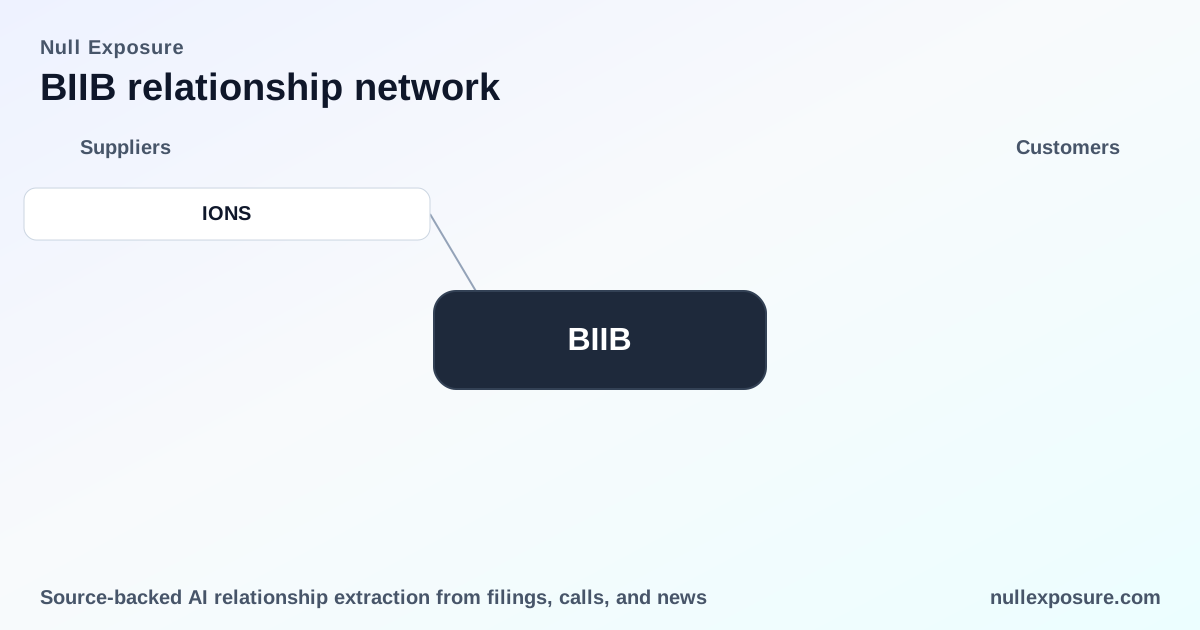
Biogen (BIIB) — Customer Relationships and Operational Constraints that Drive Revenue Visibility
Biogen monetizes by discovering, developing and commercializing specialty therapies for neurological and rare diseases, selling products primarily through wholesale and specialty distributors and specialty pharmacies while also recognizing contract manufacturing revenue from strategic partners. Revenue is concentrated in a small number of distribution channels and subject to U.S. reimbursement mechanics (Medicaid/managed care) and international launch amortization, creating both predictable scale and discrete policy-sensitive risk. For a concise portfolio view and relationship intelligence, visit https://nullexposure.com/.
Business model in one paragraph: how Biogen makes money
Biogen generates revenue from product sales, contract manufacturing agreements, and strategic collaborations that advance and commercialize novel therapies; product sales flow predominantly through wholesale and specialty distributors, with a few wholesalers representing material shares of gross product revenue. The company’s financial profile (approximately $9.94B revenue TTM, $27.6B market cap as of the latest quarter) reflects a mix of mature franchises and pipeline-derived milestone/royalty dynamics, making distribution concentration and reimbursement reserves central to cash flow risk and earnings quality.
What to watch: concentration, reimbursement, and geographic amortization
Biogen’s operating model carries a handful of salient characteristics investors should treat as structural rather than transitory. First, distribution concentration is high — two wholesalers accounted for 28.0% and 15.8% of gross product revenue in 2025 — which pressures negotiating leverage and creates single-counterparty operational dependence. Second, U.S. reimbursement mechanisms are a critical earnings input: Medicaid rebates and managed care reserves require significant judgment and produce large revenue-related accruals (revenue-related reserves of roughly $1.00B at year-end 2025). Third, global product rollouts introduce cross-border accounting and amortization effects — for example, Skyclarys’ E.U. approval in early 2024 initiated amortization of a $2.3 billion IPR&D asset outside the U.S. These are not isolated footnotes; they shape margins, working capital, and near-term free cash flow.
Constraints shaping contracting posture and maturity
The company-level evidence signals a conservative contracting posture with entrenched counterparty complexity and regulatory dependency:
- Counterparty mix includes government payers: Medicaid and related rebates create large, judgment-laden accruals tied to state reimbursement arrangements (evidence cited in recent filings).
- Primary commercial geography is North America: Managed care rebate mechanics in the U.S. are explicitly identified as major obligations, underscoring domestic reimbursement sensitivity to pricing and utilization trends.
- Emerging EMEA commercialization effects: Post-approval activity in Europe triggered significant accounting treatment (amortization of IP-related assets) tied to non-U.S. revenue recognition.
- Contracting roles are mixed and mature: Biogen operates as manufacturer, seller, and distributor counterparty — it both sells through wholesalers and performs contract manufacturing under agreements with strategic customers.
- Materiality and audit focus: Reserves for Medicaid and managed care rebates are classified as a critical audit matter because of substantial measurement uncertainty and high auditor judgment, indicating systemic importance to financial statements.
- Relationship stage signals active commercial engagement: Large reserves and recent revenue recognition flows suggest ongoing transactions and portfolio monetization rather than dormant or one-off arrangements.
These constraints translate into a business that is operationally mature but policy-sensitive, where revenue visibility depends on a handful of counterparties, management judgment in accruals, and successful execution of international launches.
Customers and partners: the relationships you need to know
Below I cover the customer/partner relationships in the provided results. Each entry is a plain-English summary with source attribution.
Stoke Therapeutics — strategic collaborator on zorevunersen
Biogen maintains a strategic collaboration with Stoke Therapeutics to develop and commercialize zorevunersen for Dravet syndrome, and recent clinical results in March 2026 supported progression toward a Phase 3 EMPEROR study. According to a March 10, 2026 QuiverQuant news post summarizing the announcement, the collaboration remains active and clinically material to both parties’ rare-disease programs. (Source: QuiverQuant news, March 10, 2026)
How these relationships affect investor assessment
The Stoke collaboration is a classic biotech strategic alliance: it brings pipeline optionality and potential milestone upside while keeping commercialization risk shared. For Biogen, partnerships like Stoke both diversify future revenue streams and require contingent accounting and development investments that feed into the company’s long-run margin profile.
The broader customer signals — heavy reliance on a few wholesalers, substantial Medicaid/managed-care accruals, and active EMEA commercialization accounting — combine to produce several investor-level implications:
- Revenue concentration risk is real: When two wholesalers represent meaningful shares of gross product revenue, any disruption or pricing pressure from those counterparties can quickly affect top-line growth and gross margin.
- Reimbursement reserves are a key earnings lever: The company’s recognition and estimate of Medicaid and managed-care rebates have been identified as a critical audit matter, demonstrating that small changes in assumptions alter reported results materially.
- International launches carry accounting timing effects: EMEA commercialization and IPR&D amortization (as observed after Skyclarys’ 2024 approval) can shift where and when earnings surface, complicating cross-period comparability.
Risk/return framing for investors and operators
For investors, Biogen is a blend of steady product cash flows and asymmetric pipeline upside through collaborations. Upside is generated by successful clinical progression and commercialization of partnered assets; downside is concentrated around distributor counterparty risk and U.S. reimbursement policy. Operators evaluating relationships should prioritize contract terms that mitigate concentration (broader distributor set), strengthen rebates and accrual governance, and structure collaborations to align milestone timing with cash conversion.
If you want deeper, actionable relationship maps and constraint-driven counterparty scoring for Biogen, explore the full analysis at https://nullexposure.com/.
Bottom line — what matters next quarter
Monitor three metrics in the next earnings cycle: distributor shipment patterns (any deviation from the two large wholesalers), changes in Medicaid/managed-care reserve assumptions, and updates on partnered programs like Stoke’s zorevunersen development. These elements will drive near-term earnings volatility and determine whether Biogen’s revenue mix trends toward greater diversification or remains dependent on a narrow set of commercial and policy factors.