Bilibili (BILI): Open‑loop ad distribution and event tie‑ins underpin monetization
Bilibili is a Shanghai‑headquartered online entertainment platform focused on younger Chinese users that monetizes through a mix of advertising, live‑streaming commerce, games, and membership services. The company deliberately operates an open‑loop advertising posture, integrating external e‑commerce partners and broadcast events to convert attention into commercial flows, while complementary revenue streams provide margin support. For investors, the key question is whether Bilibili’s advertiser and partner relationships deliver durable monetization growth without creating concentration or execution risk. Learn more about customer coverage and mapping at https://nullexposure.com/.
How Bilibili’s partner mix drives revenue and engagement
Bilibili’s commercial model is advertising‑led but multi‑modal. Advertising benefits from native formats (short video, livestream overlays, and bullet chats) that scale with major shopping platforms, while exclusive programming and festival partnerships drive concentrated spikes in engagement and incremental monetization opportunities. Financially, the company shows meaningful revenue scale (approximately $30.35B TTM) and positive operating margins, yet trades at a premium on trailing earnings (trailing P/E ~52.9) with a materially lower forward P/E (~21.3), signaling investors expect continued profit conversion.
- Open‑loop advertising relationships reduce direct platform lock‑in for advertisers but increase the importance of effective ad formats and measurement for continued spend.
- Event partnerships and exclusive integrations enhance retention and allow Bilibili to extract higher CPMs during marquee periods.
Company‑level operating signals and constraints
There are no explicit third‑party contractual constraints supplied with these relationship signals; instead, company‑level characteristics emerge from the relationship set:
- Contracting posture: Bilibili’s open‑loop ad strategy signals a partnership approach rather than exclusive ad network control — the platform is oriented toward broad advertiser access rather than closed monetization rails.
- Concentration: Partnering with multiple large e‑commerce players diversifies advertiser risk across major buyers, reducing single‑sponsor dependency.
- Criticality and maturity: Exclusive broadcast tie‑ins for national events indicate a mature capability to deliver large, time‑sensitive audiences that are critical to advertisers targeting youth cohorts.
- Commercial flexibility: The combination of advertising, live commerce integrations, and event exclusives denotes a pragmatic revenue mix that can tilt toward higher margin formats as the product suite matures.
These company‑level signals frame how investors should evaluate revenue sustainability: strength in platform engagement plus diversified e‑commerce partners supports stability, while reliance on advertising growth rates and event sequencing creates episodic revenue variance.
Financial context that matters to partnership value
Bilibili’s latest reported metrics show robust top‑line scale (Revenue TTM ~30.35B), gross profit of ~11.11B, and positive operating margin (~6.05%). Quarterly revenue growth is modestly positive year‑over‑year and analysts assign a consensus target price near $31 with a majority of Buy/Strong Buy ratings. These figures imply that advertiser monetization and partner integrations are already contributing meaningful cashflows, but the stock price embeds expectations for improved margin conversion and consistent ad growth. For due diligence into customer relationships and commercial exposure, see https://nullexposure.com/.
Relationship coverage — what every partner in the record contributes
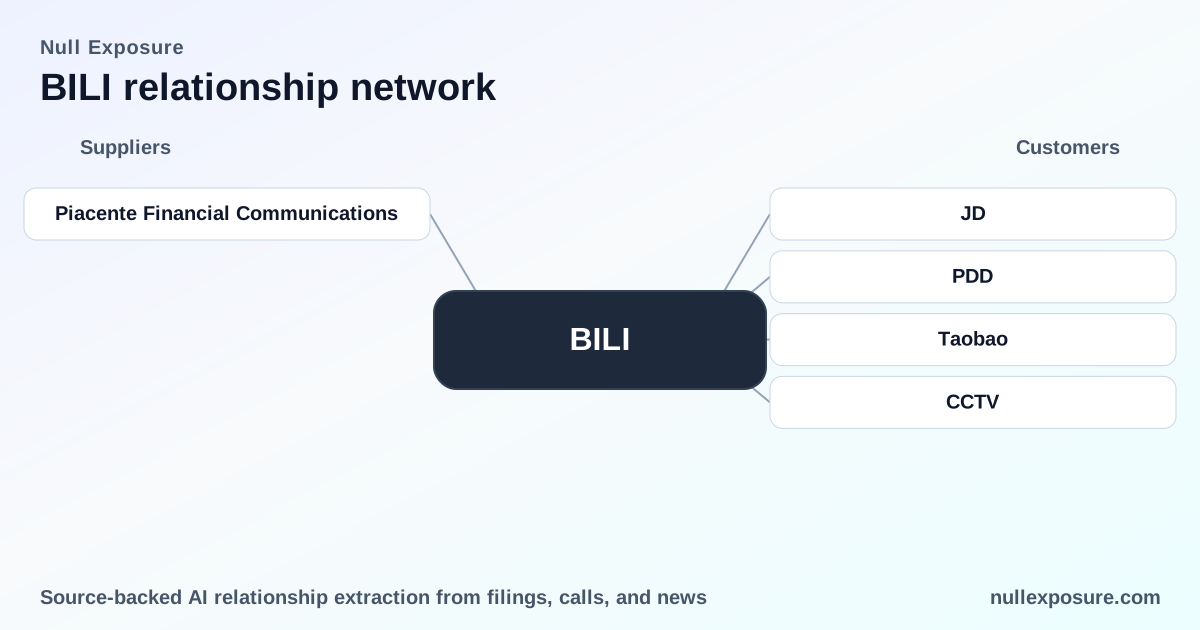
The dataset lists five partner mentions. Each relationship below is summarized plainly with sourcing.
-
JD
Bilibili maintains advertising partnerships with JD, participating in open‑loop ad distribution that connects platform audiences to JD’s commerce ecosystem and ad inventory. According to KR‑Asia coverage dated March 9, 2026, JD is named among the e‑commerce platforms Bilibili integrates for advertising. (KR‑Asia, March 9, 2026) -
JD.com
KR‑Asia’s March 9, 2026 report repeats JD.com as a commercial partner that benefits from Bilibili’s open advertisement channels linking entertainment content to shopping behaviors. This duplicate listing reinforces JD’s role as a core e‑commerce advertiser on the platform. (KR‑Asia, March 9, 2026) -
Pinduoduo
Pinduoduo is identified alongside other major e‑commerce players as part of Bilibili’s open‑loop advertising partnerships, enabling merchants on Pinduoduo to reach Bilibili’s youth demographic through integrated ad units. This relationship is cited in the KR‑Asia article discussing Bilibili’s monetization push. (KR‑Asia, March 9, 2026) -
Taobao
Taobao is listed as an advertising partner in Bilibili’s open‑loop strategy, giving brands and shops on Taobao direct access to promotional placements within Bilibili’s content and livestream ecosystem. The KR‑Asia piece highlights Taobao as part of this multi‑platform advertising approach. (KR‑Asia, March 9, 2026) -
CCTV
Bilibili partnered with CCTV as the exclusive bullet chat platform, leveraging national broadcast events to aggregate youth viewership and monetize engagement during festivals and live programming. The arrangement was discussed during Bilibili’s Q4 2025 earnings commentary, as captured in the company earnings call transcript. (Bilibili Q4 2025 earnings call transcript, reported March 2026)
What investors should extract from these partner signals
- Diversified advertiser base: The presence of Taobao, JD, and Pinduoduo as named advertising partners signals access to China’s largest commerce advertisers, which supports revenue resilience and reduces concentration risk relative to a single ad buyer model.
- Event leverage: The exclusive bullet chat relationship with CCTV demonstrates Bilibili’s capability to convert national broadcast moments into platform engagement and incremental ad monetization; this is a differentiator when pricing premium inventory.
- Open‑loop tradeoffs: Open‑loop advertising increases addressable advertiser demand but also raises the bar on measurement and creative efficacy — Bilibili must continually prove ROI to retain and grow spend from sophisticated e‑commerce partners.
- Valuation vs. execution: Given current margins and forward P/E improvements priced in by the market, execution on ad formats and partner monetization is the primary lever for closing the valuation gap between trailing and forward multiples.
Final read: risk and opportunity synoptics
Bilibili is a platform with scale, proven engagement mechanics, and strategic partnerships that convert youth attention into commerce. The partnership footprint reported—major e‑commerce players plus a national broadcaster—supports a thesis that advertising plus event monetization can sustain revenue growth while margin expansion is realized through higher‑value ad products and subscription traction. Key risks are sector‑level regulation, ad spend cyclicality, and the platform’s ability to maintain creative ad formats that deliver measurable commerce outcomes.
For investors and operators mapping customer exposure, these relationships are high‑value commercial signals worth integrating into revenue scenarios and concentration stress tests. If you want systematic customer mappings and deeper relationship analytics, explore offerings at https://nullexposure.com/.