Bill.com (BILL): Customer Relationships and Strategic Distribution
Bill.com is a cloud-native financial operations platform that monetizes through subscription fees and transaction-based revenue—charging customers fixed monthly or annual rates for access and collecting fees on payments processed through its platform. The company is executing an Embed 2.0 channel strategy that layers tightly integrated partnerships (NetSuite, Acumatica, Paychex and others) to accelerate Total Payment Volume (TPV) and recurring revenue; management has flagged FY2027 as the expected inflection year for partner-driven contribution. For a concise overview of service and partner coverage, visit https://nullexposure.com/.
The investor thesis up front
Bill.com sells software (SaaS) and payment rails to primarily small and mid-sized businesses, earning durable recurring revenue from subscriptions while capturing variable economics from payment flows. Distribution is shifting from direct SMB acquisition toward platform embedding inside ERP/payroll partners, which should materially increase addressable customers and TPV if execution remains on plan.
How BILL contracts, who it serves, and why that matters
Bill.com’s customer relationships are a mixture of subscription-based sales, with evidence of multi-year agreements in the financial institution channel and shorter monthly or annual terms for other customers. This contracting posture creates a hybrid revenue profile: predictable base subscription revenue plus variable payment fees that scale with TPV.
Key business-model signals:
- Contracting posture: Subscription-led monetization with a mix of long-term multi-year deals for financial institution customers and shorter monthly/annual arrangements for many SMB clients.
- Customer mix and concentration: Primary focus on SMBs and mid-market accounting firms; no single external customer exceeded 10% of revenue in the last three fiscal years, indicating low large-customer concentration but greater macro sensitivity due to SMB exposure.
- Geography and reach: Revenue remains U.S.-centric (external revenue outside the U.S. under 3% in recent years), while the product footprint is functionally global through acquired brands—payments, however, are currently limited to specific markets (U.S., U.K., Canada) for some products.
- Role and maturity: Bill.com functions as both service provider and seller—it supplies SaaS, payments rails, and spend products, and its relationships are broadly active (roughly 493,800 businesses used Bill.com solutions and $330 billion in TPV was processed in fiscal 2025).
Collectively, these signals imply a scalable subscription base with embedded upside from payments, but also greater sensitivity to SMB cycles and U.S.-market risk. A focused partner distribution strategy reduces direct sales cost and amplifies TPV growth potential.
Embed 2.0 partners: the named relationships and what they mean
Bill.com’s public commentary and market coverage highlight several channel partners central to the Embed 2.0 play. The following paragraphs cover each named relationship in the provided results.
Paychex
Bill.com has an Embed 2.0 partnership with Paychex that is intended to accelerate TPV and revenue flows through payroll and HR distribution channels; management projects these partnerships will meaningfully contribute to TPV and revenue starting FY2027. This was reported in a May 2, 2026 Tikr post summarizing management guidance and the expected FY27 inflection (https://www.tikr.com/blog/bill-holdings-raises-full-year-guidance-after-strong-q2-earnings-beat).
Acumatica
The Acumatica embed arrangement is a distribution integration aimed at unlocking additional SMB customers for Bill.com’s payments and AP/AR automation; media coverage identifies Acumatica as part of the trio (with NetSuite and Paychex) expected to ramp partner-sourced revenue in FY2027. See the same May 2, 2026 Tikr blog post for management’s timeline (https://www.tikr.com/blog/bill-holdings-raises-full-year-guidance-after-strong-q2-earnings-beat).
NetSuite (Oracle)
Bill.com’s integration with NetSuite is an anchor Embed 2.0 relationship that gives Bill.com reach into large installed bases of ERP customers and is expected to drive material TPV and revenue contribution beginning in FY2027, according to company commentary covered by industry press in early May 2026 (Tikr, May 2, 2026: https://www.tikr.com/blog/bill-holdings-raises-full-year-guidance-after-strong-q2-earnings-beat).
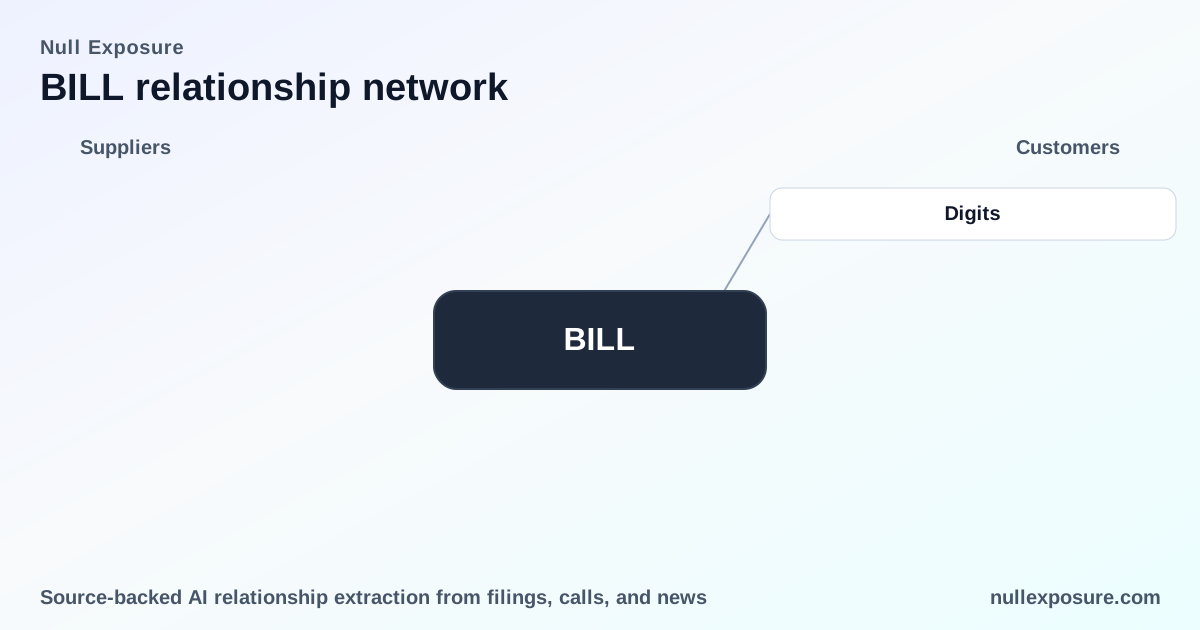
Digits
Digits announced an API partnership with Bill.com enabling real-time syncing of bills, invoices, and payments into Digits’ Agentic General Ledger, designed to streamline financial workflow automation for joint customers; this collaboration was documented in a March 9, 2026 coverage on Simply Wall St (https://simplywall.st/stocks/us/software/nyse-bill/bill-holdings/news/why-bill-holdings-bill-is-down-212-after-activist-pressure-a). The tie-in expands Bill.com’s integration footprint in next-generation ledger automation.
(For a compact partner summary and further context, see https://nullexposure.com/.)
What the partner roster implies for revenue and risk
The Embed 2.0 partners—NetSuite, Acumatica, Paychex and adjacent API integrations like Digits—represent distribution leverage, not an immediate margin engine. Partners will drive incremental customer access (industry commentary suggests access to nearly one million businesses through the combined partnerships), which should accelerate TPV and thus variable payment fees. Bill.com’s reported TPV scale and gross margins provide the structural ability to convert additional flows into profitable revenue, but several constraints determine the pace and quality of that conversion:
- Concentration risk is low at the account level because no customer exceeded 10% of revenue, but SMB exposure raises cyclicality—SMB customers reduce large-customer concentration while increasing sensitivity to economic downturns.
- Contract maturity is mixed: multi-year deals with financial institutions provide runway and predictability, while shorter-term SMB arrangements maintain flexibility and faster churn dynamics.
- Geographic concentration is a corporate-level constraint: U.S.-centric revenue makes the company responsive to domestic economic conditions, while international reach through acquisitions and third-party payments exists but is limited for core payments products.
These forces combine into a clear investment dynamic: successful partner execution scales TPV and lifts variable revenue quickly; failure to convert partner reach into transactions leaves subscription economics as the primary growth engine.
Risk factors that should guide diligence
Investors must weigh operational execution and channel conversion rates against valuation. Bill.com’s fiscal metrics show strong recurring revenue scale (roughly $1.55bn TTM revenue) but negative operating margins and EPS, so the path to durable profitability relies on product-led TPV growth and expense discipline. Partner-led distribution reduces customer acquisition cost but increases dependence on third-party integration execution and time-to-contribution.
Conclusion — where value is created
Bill.com’s value creation thesis is straightforward: convert partner reach into high-TPV flows while retaining subscription revenue durability. If Embed 2.0 delivers the FY2027 inflection management has cited, TPV-driven revenue is the lever to materially expand gross profit and move operating margins toward sustainable profitability. Monitor partner conversion metrics, multi-year contract signings in the financial institution channel, and the company’s U.S./international payments expansion as the primary execution checkpoints.
For a targeted view of customer relationships and partner exposure, visit https://nullexposure.com/ for continuing coverage.