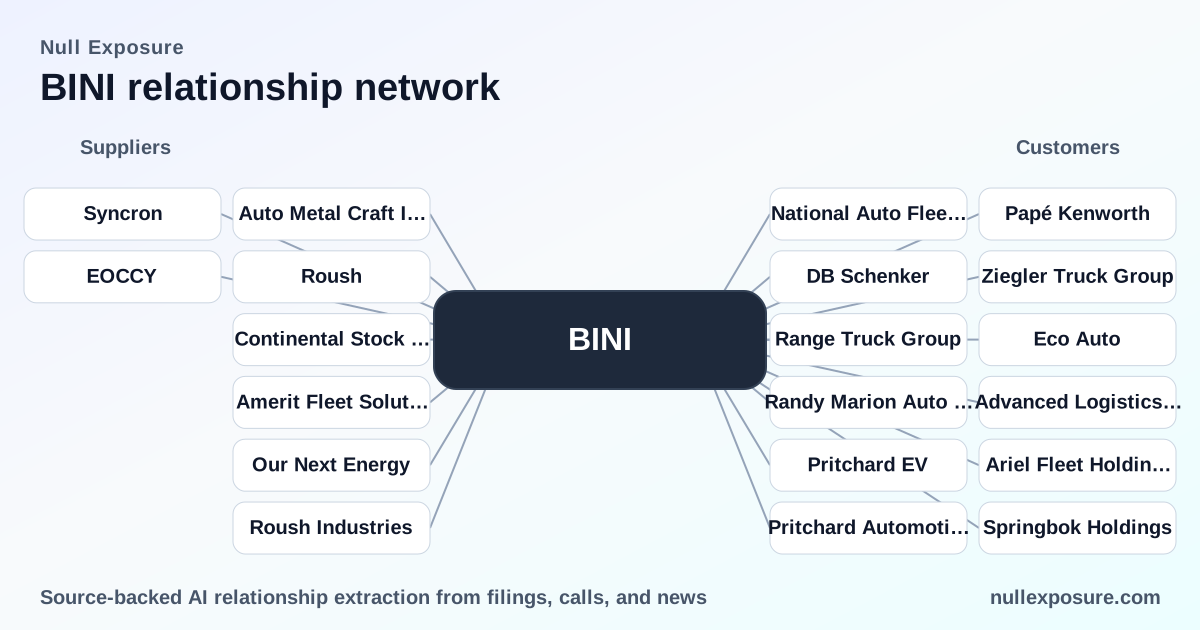
BINI customer map: what dealers, logistics partners and concentration mean for investors
Bollinger Innovations (BINI) monetizes by manufacturing and selling commercial electric vehicles through a compact network of franchised dealers and commercial fleet partners; revenue is driven by wholesale vehicle sales and short-term fleet contracts rather than a broad retail footprint. For investors and operators, the critical lens is dealer concentration, buyer aggregation and the role of logistics partners in early commercial deployments — these factors determine near-term cash flow visibility and execution risk. For a concise provider overview and relationship tracking, visit https://nullexposure.com/.
Dealer network first, scale second: why partner mix matters
BINI’s disclosed customer relationships show a deliberately narrow commercial dealer strategy: a handful of regional dealers and a small set of fleet/last‑mile partners. That structure creates operational leverage when deliveries succeed, and sharp downside if a lead account pauses purchases. Concentration and dealer-dependency are the defining commercial risks for BINI today.
(If you want a single place to monitor these counterparty links and news, see https://nullexposure.com/.)
The on-the-ground relationships — one by one
Below are every counterparty referenced in BINI’s customer reporting and press releases in the provided results, with a one- to two-sentence plain-English summary and the source for each entry.
Papé Kenworth
Papé Kenworth is listed as one of BINI’s commercial dealers providing sales and service coverage on the West Coast and Pacific Northwest; the company is part of the core six-to-seven dealer network BINI publicized in FY2025. According to multiple press releases republished on GlobeNewswire and financial aggregators, Papé Kenworth is a named dealer in BINI’s commercial distribution network (GlobeNewswire / FY2025).
Pritchard EV
Pritchard EV appears as a named dealer and a payer in vehicle sale transactions, indicating an active role in vehicle purchases and distribution within BINI’s dealer network. The relationship is documented in company press releases and news syndication tied to FY2025 announcements (GlobeNewswire / FY2025).
National Auto Fleet Group
National Auto Fleet Group is included in BINI’s dealer list covering Midwest and other US regions, positioning it as a commercial distributor for fleet sales and service. This name recurs in BINI press materials and market news summaries for FY2025 (GlobeNewswire / FY2025).
Ziegler Truck Group
Ziegler Truck Group is a dealer partner and also a purchaser noted in payment records for Class 1, 3 and 4 vehicle sales, implying active fleet acquisition activity. Payment and dealer-network references appear in BINI releases captured in FY2025 reporting (GlobeNewswire / FY2025).
Range Truck Group
Range Truck Group is cited among the dealers that provide regional sales and service coverage; it is part of the limited set of commercial dealers BINI relies on for distribution. The listing appears consistently across BINI press releases in FY2025 (GlobeNewswire / FY2025).
Randy Marion Auto Group
Randy Marion Auto Group is named repeatedly as one of BINI’s dealer partners; internal disclosures also indicate historical dealer agreements with Randy Marion Isuzu, showing a formal distribution relationship. The dealer listing and the explicit dealer agreement reference are available in company filings and associated press releases (GlobeNewswire / FY2025; company filing excerpt referenced in constraints).
Pritchard Automotive
Pritchard Automotive is documented as a payer in transaction notices connected to sales of commercial EVs on specific August/September 2025 settlement dates, supporting evidence of active wholesale purchases. These payment details are reported in press releases and news summaries covering FY2025 sales (GlobeNewswire / FY2025).
DB Schenker
DB Schenker is cited in payment notices as a recipient/payee reference associated with commercial EV sales settlements, suggesting logistics or fleet customer involvement in the flow of sold units. This appearance occurs in the company’s FY2025 transaction disclosures (The Globe and Mail distribution of GlobeNewswire / FY2025).
Eco Auto
Eco Auto is listed among the seven dealers BINI has used to broaden coverage into New England and other U.S. regions, indicating an extension of the dealer footprint beyond the initial six. The inclusion is visible in multiple July–September 2025 press releases (GlobeNewswire / FY2025).
Advanced Logistics Systems
Advanced Logistics Systems is named in a corporate announcement as one of the fleet operators contracted through Ariel Fleet Holdings to receive commercial EVs for last‑mile deliveries, marking it as a logistics customer in pilot/commercial deployments. This arrangement is reported in StockTitan and related press coverage tied to FY2025 transactional announcements (StockTitan / FY2025).
Ariel Fleet Holdings
Ariel Fleet Holdings is the contracting fleet intermediary that signed an agreement to provide vehicles to last‑mile operators (including FedEx ISPs, Advanced Logistics Systems and Springbok Holdings), positioning Ariel as a key commercial buyer/allocator for BINI units. That deal is summarized in recent news coverage of BINI’s FY2025 commercial sales activity (StockTitan / FY2025).
Springbok Holdings
Springbok Holdings is listed as one of the last-mile recipients in the Ariel Fleet / BINI arrangement, showing BINI’s pathway into parcel and delivery fleet use cases. The relationship is disclosed in the same press coverage announcing the 34‑vehicle allocation for last-mile applications (StockTitan / FY2025).
AAL (American Airlines)
American Airlines is referenced once in sector commentary noting onboard selections (coffee/Champagne references) that included a Bollinger product mention; this is an ancillary media mention and not presented as a material sales contract in BINI’s FY2025 filings. The reference originates from sector reporting that mentions Bollinger in a consumer/travel context (Liveandletsfly / FY2026).
What the disclosed constraints say about BINI’s operating model
The extracted constraints paint a consistent picture when interpreted at the company level:
-
Concentrated buyer base and critical revenue dependence. Company disclosures indicate one main customer accounted for 64% of revenue for the year ended September 30, 2024, and management acknowledges reliance on a limited number of contractual commercial dealers for a substantial portion of income (company filings / FY2024–FY2025). That structure creates large revenue sensitivity to individual buyer behavior.
-
Regional focus with U.S. concentration but EMEA outreach. Most revenue and assets are US‑centric (all revenue and long‑lived assets located in the United States), while separate agreements (e.g., an appointment of Newgate Motor Group for Ireland/UK) demonstrate targeted EMEA distribution attempts (company filings / FY2022–FY2025).
-
Role clarity: seller, distributor and buyer relationships coexist. Disclosures show BINI operates mainly as a manufacturer/seller of commercial EVs, with dealers functioning as distributors and a mix of fleet agreements (including a named three‑year purchase commitment by Volt Mobility in the constraints) that create both buyer commitments and channel complexity (company filings / FY2022–FY2025).
-
Early-stage commercial maturity and pilots. Evidence of pilot programs (delivery of a Class One van to Hotwire Communications under a captured‑fleet exemption) and limited dealer counts indicate an operation in commercial rollout rather than large-scale production maturity (company filings / FY2022–FY2025).
-
Contracting posture: concentrated, dealer-mediated and buyer-assigned. The contract examples cited (dealer agreements, fleet purchase agreements, and assignment of large purchase commitments) indicate BINI prefers structured dealer and large-buyer contracts over dispersed retail sales, which accelerates deployment when contracts convert but increases counterparty concentration risk (company filings / FY2022–FY2025).
Investment implications and next steps for operators
-
Key investor takeaway: BINI’s revenue profile is highly levered to a compact set of dealers and a few fleet buyers; positive delivery execution will drive outsized upside, while any buyer pause would immediately compress revenue. Monitor dealer shipment confirmations and payment flows as a leading indicator.
-
Operational focus for management and partners: Prioritize diversification of dealer geography and conversion of pilot fleet arrangements into repeat purchase agreements to reduce the single‑customer concentration highlighted in filings.
For rolling tracking and alerts on these specific counterparties and filings, visit https://nullexposure.com/ for curated relationship monitoring and source consolidation.