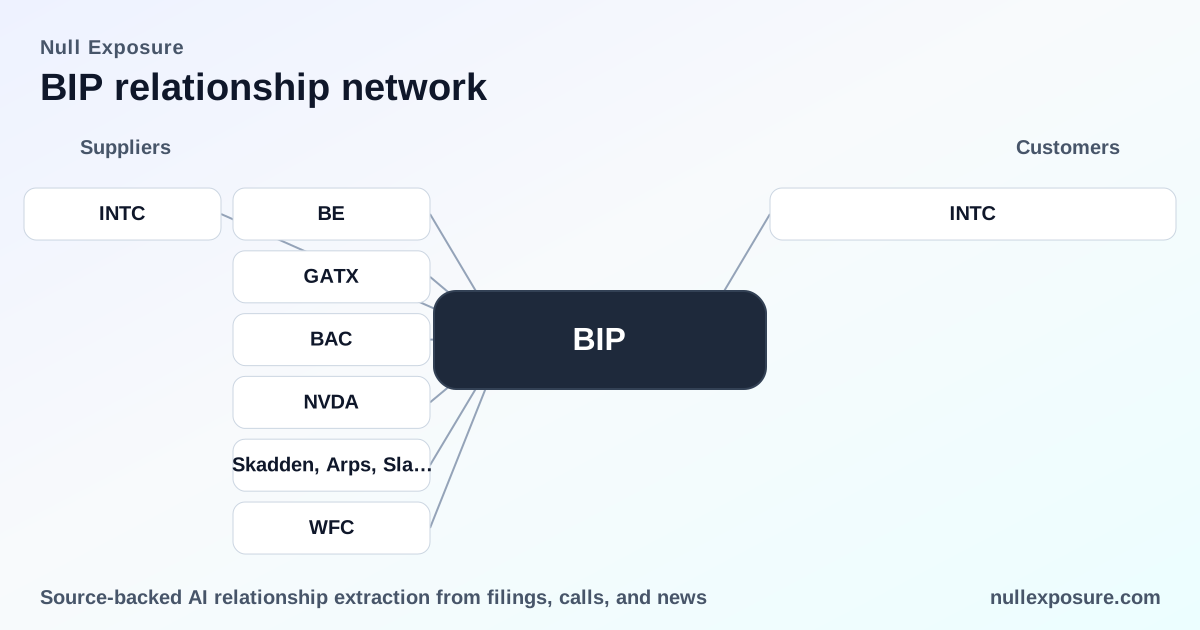
Brookfield Infrastructure Partners (BIP): The Intel Customer Relationship and What It Signals for Investors
Brookfield Infrastructure Partners owns and operates a diversified portfolio of utilities, transportation, midstream and data businesses across the Americas, Europe and Asia Pacific, monetizing through long-lived asset cash flows, user fees and contractual revenue streams. For investors, the firm's business model is driven by large capital projects, joint ventures and backlog that convert into regulated or contracted cash flow over extended periods — and the relationship with Intel is a live example of that model in action. Learn more about the coverage and signals at https://nullexposure.com/.
The thesis in one line
BIP converts large, capital-intensive partnerships into predictable, long-duration cash flows; its work with Intel demonstrates both the growth runway and the project-concentration risks that define the partnership profile.
The relationship evidence — every mention, explained
Below are the discrete items surfaced in the coverage pool; each entry is summarized in plain English with its source.
-
Brookfield previously partnered with Intel to construct $30 billion of semiconductor manufacturing capacity in the U.S., a multi-billion-dollar industrial joint effort that positions BIP as a developer and owner of semiconductor-related infrastructure. A Finviz feature on AI infrastructure referenced that partnership in March 2026.
Source: Finviz news feature, March 9, 2026. -
The same Finviz piece repeated that Brookfield partnered with Intel on the $30 billion semiconductor buildout, underscoring market attention to the scale of the project and its implications for infrastructure providers.
Source: Finviz news feature, March 9, 2026. -
Management disclosed that about $3.9 billion of backlog is attributable to Intel, indicating a material, nearer-term revenue pipeline tied to the partnership and associated projects. This figure was mentioned on Brookfield Infrastructure’s Q4 2025 earnings call and captured in a transcript published May 2, 2026.
Source: Q4 2025 earnings call transcript (reported May 2, 2026). -
On the Q1 2026 call, management noted that Intel made its first small wafer payment in the quarter to the joint venture, indicating the commencement of customer payments and the operational handover of at least some project elements. That discussion was captured in a May 3, 2026 earnings call transcript.
Source: Q1 2026 earnings call transcript (reported May 3, 2026).
How the Intel relationship fits BIP's operating model
The Intel engagements are a textbook example of BIP’s capital-conversion playbook: raise or deploy significant capital into an asset or JV, structure long-term customer or offtake commitments, then convert invested capital into stable, fee-like cash flows.
-
Contracting posture: BIP typically participates through JVs and long-term infrastructure contracts that lock in customer commitments and spread construction and operating risk across partners. The Intel project’s scale and the fact that payments have begun suggest a contractual structure with staged payments and operational milestones.
-
Concentration: The disclosed $3.9 billion backlog tied to Intel implies project-level concentration risk: large customers can represent a meaningful share of near-term earnings and capital recovery, which concentrates execution and cashflow risk in a few large counterparties.
-
Criticality: For Brookfield, strategic relationships with large industrial customers are critical for growth — they underpin major capital deployment and justify long-duration financing. The start of wafer payments signals movement from capital deployment toward revenue capture.
-
Maturity: These are industrial, long-dated projects that exhibit slow ramp and multi-year revenue realization; the Intel partnership sits squarely in the “build-to-operate” maturity profile where early capital outlay transitions to operational cash flow as milestones complete.
(Company-level signal: the research payload did not surface contractual constraints or explicit limit language tied to these relationships, which is a neutral signal on public constraint disclosure.)
Investment implications — upside and risk in plain terms
-
Upside: If Brookfield successfully converts its Intel backlog into stabilized operations, investors should expect enhanced distributable cash flow and a visible earnings contribution from high-quality, large-scale customers. The start of customer payments is a material positive for near-term cash receipts.
-
Risk: Large project exposure to a single customer or sector increases execution and counterparty risk; delays, cost overruns or changes in customer demand for capacity could compress returns and increase near-term capital needs. $3.9 billion of backlog tied to one partner is meaningful for a firm of BIP’s size.
-
Capital intensity and timing: Semiconductor infrastructure is capital intensive and long dated; value realization depends on staged acceptance and payment milestones such as the wafer payment cited on the Q1 2026 call.
What management commentary tells investors
Management’s public comments and call transcripts show a transition point: from construction into customer monetization. The March and May 2026 disclosures together create a narrative of scale (the $30 billion program) and operational progression (backlog attribution and first wafer payment). For analysts, this sequence is the most concrete evidence of near-term revenue crystallization from a previously forward-looking capital program.
Bottom line and action items for analysts and operators
- Key takeaway: The Intel relationship is both a growth vector and a concentration exposure — it demonstrates Brookfield’s ability to secure large industrial partners while also putting a tangible portion of near-term backlog at risk to execution and customer actions.
- For investors building models, explicitly account for the $3.9 billion Intel backlog as a project concentration that phases into revenue over several quarters to years; adjust cash-flow timing for staged payments like the wafer payment disclosed in Q1 2026.
- For operators and counterparty risk teams, monitor milestone schedules, payment cadence and any public updates to JV structure or offtake terms.
If you want a deeper, structured read on BIP’s customer relationships and how we mapped the public evidence, review our methodology and coverage at https://nullexposure.com/.
Bold, large-scale customer relationships like Intel’s are central to Brookfield Infrastructure’s growth thesis — they materially influence near-term backlog realization and longer-term cash-flow stability, and they should be treated as both an upside driver and a concentration risk in any investment analysis.