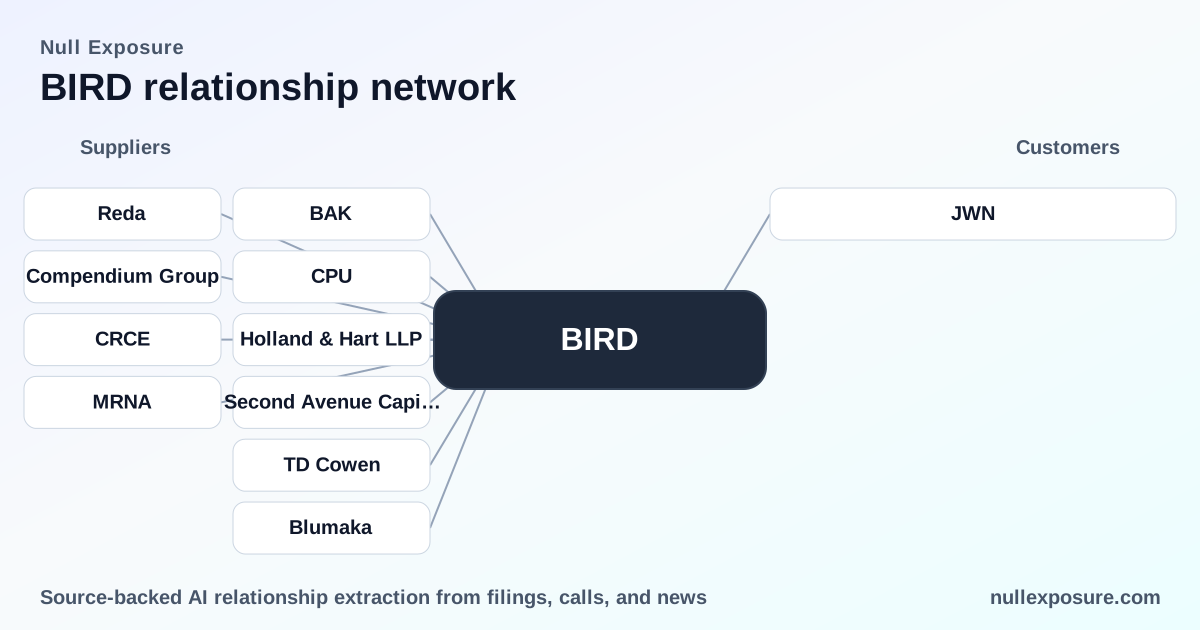
Allbirds (BIRD): From Sustainable Footwear to an AI Pivot — Customer Relationship Map and Investment Implications
Allbirds historically monetizes through direct-to-consumer footwear and apparel sales, supplemented by wholesale accounts; footwear is the company's revenue foundation. In 2026 management executed a strategic overhaul that includes a $39 million asset sale of the Allbirds brand and footwear assets and a concurrent $50 million convertible financing facility, repositioning the public shell toward an AI-related business. Investors should evaluate counterparty arrangements and contract concentration as central drivers of near-term liquidity, residual brand value, and the credibility of the new corporate strategy. For more structured customer analytics and counterparty risk signals, visit https://nullexposure.com/.
Quick read: why these relationships change the investment calculus
Allbirds’ counterparties now determine two things for investors: how much economic value the footwear franchise transfers versus how much runway the public company retains, and whether wholesale and retail customer flows continue to preserve residual brand economics during the transition. The buyer of intellectual property and footwear assets will capture the operating economics that once underpinned Allbirds’ margins and customer lifetime value, while remaining wholesale partners and retail placements determine how much brand visibility and revenue persist post-sale.
The deals and counterparties you need to know
American Exchange Group — the buyer of the core business
Allbirds executed a definitive Asset Purchase Agreement selling “all of the intellectual property and certain other assets and liabilities” to American Exchange Group (AXNY) for an estimated transaction value of $39 million, transferring the brand and footwear business out of the public company and leaving the public vehicle to pursue a new strategy. GlobeNewswire published the definitive agreement details on March 30, 2026 (https://www.globenewswire.com/news-release/2026/03/30/3265093/0/en/Allbirds-Signs-Definitive-Asset-Purchase-Agreement-with-American-Exchange-Group.html).
American Exchange (alternative name in company communications)
Company communications and quarterly filings reference the buyer in variant form as “American Exchange,” reflecting the same asset-sale counterparty referenced earlier; Allbirds’ Q3 2025 results reiterated the pending sale in investor materials and earnings releases ahead of the closing. Allbirds’ Q3 2025 press release highlighted the transaction as a material strategic step in the company’s restructuring (GlobeNewswire, November 6, 2025 — https://www.globenewswire.com/news-release/2025/11/06/3183133/0/en/Allbirds-Reports-Third-Quarter-2025-Financial-Results.html).
Nordstrom (ticker JWN) — wholesale placement and historical retail partner
Nordstrom appears in historical coverage as a wholesale account for Allbirds, illustrating the brand’s pre-sale wholesale distribution channel and third-party retail placements that supported revenue and reach. A February 9, 2026 article chronicling Allbirds’ trajectory cited Nordstrom among key wholesale partners and broader distribution moves, including resale initiatives (The Spinoff, February 9, 2026 — https://thespinoff.co.nz/business/09-02-2026/allbirds-at-10-how-a-6-billion-sustainable-footwear-dream-unravelled).
JWN (alternate listing of Nordstrom)
The dataset includes JWN as an inferred symbol for Nordstrom in multiple mentions; these entries reinforce that Nordstrom was part of Allbirds’ wholesale footprint and relevant to the company’s retail-to-wholesale mix. Coverage referencing Nordstrom under the JWN ticker appears alongside the wholesale and resale commentary from early 2026 (The Spinoff, February 9, 2026).
What these relationships imply for Allbirds’ operating model
- Contracting posture: The asset sale to American Exchange Group is an explicit divestiture of the company’s core operating assets, signaling a tactical shift from operating retail and wholesale channels to a capital-structure and strategy reset. The $50 million convertible facility complements the sale as a financing bridge rather than operating capital for footwear growth.
- Concentration and criticality: Footwear historically represented the majority of revenue, so transferring brand and IP materially reduces the public company’s exposure to its historical top-line engine; wholesale partners such as Nordstrom retain brand continuity only if the buyer maintains distribution agreements. This is a structural concentration event that reallocates economic exposure from public shareholders to the asset buyer.
- Geographic footprint and customer reach: As of December 31, 2024, Allbirds operated 33 retail stores, 30 in the United States and 3 in the United Kingdom, a North American-heavy retail footprint that underpinned direct sales and localized marketing efforts. This indicates that North America is the primary revenue geography, with EMEA as a smaller but present channel.
- Maturity and strategic staging: The company’s decision to sell its defining assets indicates a move from product-market maturity in sustainable footwear toward a speculative, capital-allocation phase for the public entity—investors should treat remaining business lines and any pivot initiatives as early-stage and financing-dependent rather than mature operating businesses.
For deeper counterparty mapping and to monitor post-sale distribution arrangements, see https://nullexposure.com/.
Implications for investors and operators
- Valuation transfer: The $39 million purchase price establishes a baseline market valuation for the Allbirds brand and related footwear economics in the current environment; investors should treat future upside to the public equity as dependent on the success of a new strategy rather than residual footwear cash flow.
- Execution risk: The buyer’s ability to preserve wholesale placements (Nordstrom) and to operate the brand through licensing or direct channels will determine how much brand-related value persists outside the public company. Investors should monitor post-closing commercial terms and any transitional services agreements.
- Liquidity and capital structure: The $50 million convertible financing provides immediate balance sheet relief for the public company but increases debt-like obligations and potential dilution; this financing shapes runway for whatever strategic plan management pursues next.
Closing view: key takeaways for portfolio decisions
- The core business that generated Allbirds’ historical revenues is now an asset sale to American Exchange Group for $39 million. That transaction is the defining event for evaluating future cash flows attributable to the public company.
- North America is the dominant retail market, and wholesale partners such as Nordstrom were important distribution channels that the buyer will need to manage to preserve brand economics.
- Investors must reframe BIRD from an operating footwear franchise to a restructured public entity with financing constraints and execution-dependent upside. Monitor buyer operational plans, transitional agreements, and any retained obligations by the public company.
If you want a focused counterparty risk brief or tracked alerts on post-sale wholesale arrangements, visit https://nullexposure.com/ for tailored coverage and ongoing monitoring.