BNY Mellon (BK) — customer relationships that define scale, service and risk
Thesis: The Bank of New York Mellon monetizes global custody, fund administration, depositary and trustee services by charging recurring fees across large institutional clients, asset managers and issuers; revenue comes from custody/asset servicing, fund administration and corporate trust activities that scale with assets under custody and transaction volume. BNY Mellon’s business model is concentrated on long-duration, fee-for-service relationships with large enterprises, sovereign funds and fund sponsors — a profile that supports high-margin recurring revenue but creates operational and reputational concentration risk. For a concise view of provider/client linkages, visit https://nullexposure.com/.
Overview — what investors need to know up front BNY Mellon operates as a global custodian, depositary bank, trustee and fund administrator. Key monetization vectors are custody and asset servicing fees, depositary services for ADR/ADS programs, trustee/agent roles on debt indentures, and fund administration for sponsored and third‑party funds. The relationships below are drawn from BNY Mellon disclosures and market notices in 2024–2026 and document the firm’s footprint across asset managers, corporates, sovereign investors and issuers.
What the filings and notices collectively reveal about operating constraints
- Counterparty concentration and credit exposure are explicit corporate risks: BNY Mellon identifies major financial institutions and sovereign entities among its significant counterparties, signaling concentration and counterparty risk at the company level (risk disclosure, corporate filings).
- Global footprint is operational reality: The firm discloses sizable offices and operations in APAC, EMEA and the Americas, supporting cross-border custody and ADR processing (corporate filings describing office locations and regional footprints).
- Service-provider posture across segments: Filings classify BNY Mellon as a service provider across Securities Services, Market & Wealth Services and Investment Advisory / Administration — the bank delivers front-to-back operational capabilities rather than principal market‑making (segment disclosures).
- Mature, high‑criticality contracts: Recurring roles as depositary, trustee and fund administrator imply long-lived contracts with operational SLAs and custody responsibilities that are critical to client distribution and payment flows (trust/indenture documents and fund agreements).
Relationships: concise investor summaries Below are the clients, issuers and partners cited in BNY Mellon customer/news disclosures. Each line gives a plain‑English summary and a short source reference.
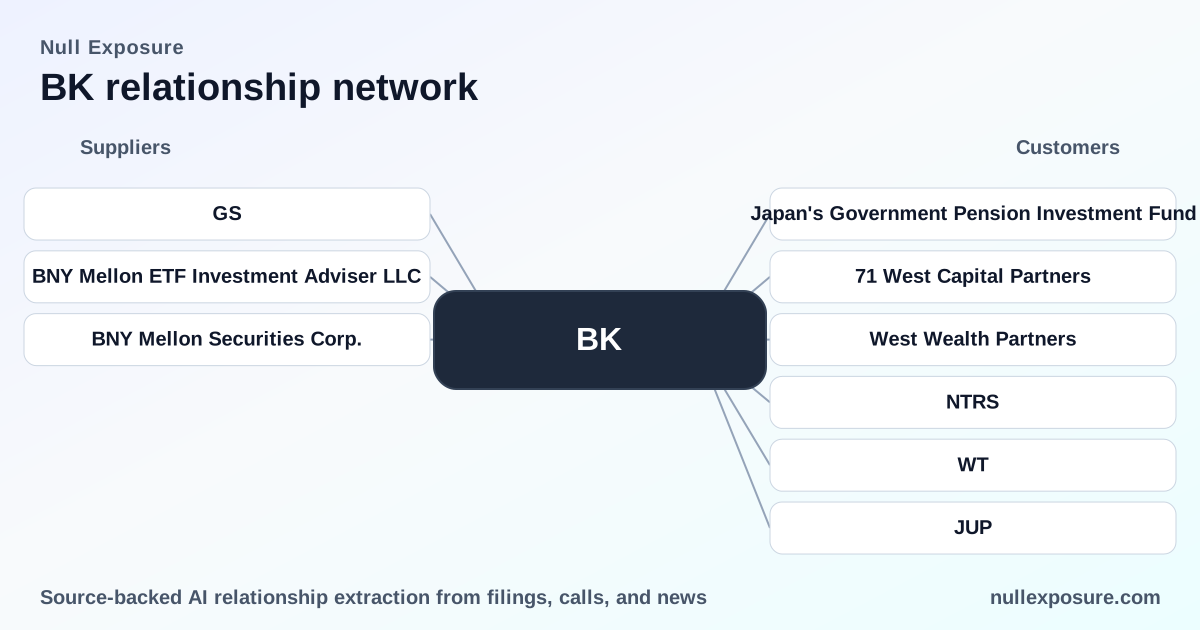
- West Wealth Partners — Selected BNY Pershing for custody and clearing as a new independent RIA; reported on BNY Mellon’s 2025 Q4 earnings call (March 2026).
- 71 West Capital Partners — Chose BNY Pershing for custody and clearing for a new RIA; noted on the 2025 Q4 earnings call (March 2026).
- Japan’s Government Pension Investment Fund — Selected BNY to deliver integrated private markets data and analytics; cited on BNY Mellon’s 2025 Q4 earnings call (March 2026).
- ALLY (Ally Financial) — Uses The Bank of New York Mellon as trustee under multiple indentures for senior and subordinated note issuances; disclosed in FY2026 prospectus filings (May 2026).
- FRSX (Foresight) — BNY Mellon serves as depositary bank and managed an ADS ratio change requiring ADSs to be surrendered and reissued (Feb–Mar 2026 investment notices).
- TRC (Tejon Ranch) — Bank of New York Mellon acted as subscription agent for a rights offering, confirming allocations; reported via market news (March 2010 notice reposted in March 2026).
- VEON — BNY Mellon stopped collecting depositary service fees for VEON ADS holders effective Jan 1, 2026, reducing investor costs; company press releases (April 2026).
- FTHY (First Trust High Yield) — BNY Mellon listed as administrator, fund accountant and custodian under fee arrangements in FY2026 filings (May 2026).
- PayPal (PYPL) — Selected BNY Mellon for institutional-grade digital asset custody to support payments and wallets; reported in FY2026 news coverage of BNY Mellon (May 2026).
- EDN (Edenor) — BNY Mellon acted as fiduciary, trustee and paying/transfer agent under an indenture in Argentina; disclosed in March 2026 legal/transaction notices.
- SCLX (Scilex) — Named in a securities complaint alleging unauthorized transfers through accounts administered at BNY Mellon; covered in legal news reporting (March–May 2026).
- NXDT-P-A — Identified BNY Mellon as custodian in regulatory disclosures (FY2026 filings).
- BRKU — The Direxion BRK/Bull 2x fund lists BNY Mellon as custodian in short‑interest and fund notices (FY2026).
- GS-P-D / GS-P-A (Goldman Sachs preferred notes) — BNY Mellon serves as trustee under senior debt indentures for Goldman Sachs notes; shown in FY2026 offering documents (May 2026).
- Allianz Global Investors (AGI / ALV) — Selected BNY to optimize investment operating model and leverage global capabilities; mentioned in BNY Mellon Q1 2026 coverage (May 2026).
- Northern Trust Asset Management (NTRS) — Launched a tokenized share class initially available on BNY Mellon’s LiquidityDirect platform using Goldman Sachs DAP; covered in March 2026 press (March 2026).
- Jianzhi Education (JZ) — BNY Mellon acts as depositary for ADS voting and ADS exchanges; disclosed in FY2026 SEC filings (May 2026).
- Banco Santander Chile (BSAC) — ADR dividend mechanics and foreign‑tax withholdings processed through BNY Mellon as depositary; noted in FY2026 filings.
- Ameren (AEE) — BNY Mellon Capital Markets listed as joint book‑running manager on a senior notes offering; public offering notices (March 2026).
- VOC Energy Trust (VOC) — BNY Mellon Trust Company, N.A. serves as trustee and administrator under trust documents and distribution notices (FY2026).
- Permianville Royalty Trust (PVL) — BNY Mellon Trust Company, N.A. acts as trustee; disclosed in FY2026 trust filings (May 2026).
- Banco Macro (BMA) — BNY Mellon acted as trustee, co-registrar and paying/transfer agent on international note issuances; legal notices (FY2025–2026).
- YPF — BNY Mellon served as trustee, principal paying agent and transfer agent on an international issuance; disclosed in March 2026 notices.
- Boqii Holding (BQ) — BNY Mellon as depositary issued a termination/ADS exchange notice when the ADS program was terminated and ADSs were surrendered (July 2025 / FY2025 filings).
- Can‑Fite (CANF) — BNY Mellon arranged ADS exchange and handles voting instructions under the depositary agreement (FY2025 filings).
- Purple Biotech (PPBT) — BNY Mellon managed ADS ratio change requiring surrender and reissuance of ADSs; public notice (March 2026).
- Southern California Edison trust securities (SCE‑P‑G / SCE‑P‑K) — BNY Mellon Corporate Trust acted as transfer/redemption agent for trust preference securities; trust redemption notices (FY2024–2026).
- MakeMyTrip (MMYT) — Indenture names BNY Mellon as trustee and describes repurchase rights tied to the notes; issuer notices (FY2026).
- Ascendis Pharma (ASND) — BNY Mellon as depositary oversaw mandatory ADS-for-ordinary-share exchanges during a transition to direct listing (FY2026 press).
- SaverOne / SVRE — BNY Mellon issued new ADSs following a 1-for-3 ADS ratio change; corporate filing (FY2025).
- Guggenheim (GUG) — Entered a new Fund Administration and Accounting Agreement with BNY Mellon to handle administration and pricing (Dec 15, 2025 press).
- Jupiter (JUP) — Selected BNY for front-to-back investment operations, data management and custody services; cited on BNY Mellon 2025 Q4 earnings call (March 2026).
- WisdomTree / WT — Selected BNY as banking-as-a-service provider for the WisdomTree Prime platform; announced on BNY Mellon’s 2025 Q4 call (March 2026).
- Morgan Stanley Investment Management / Morgan Stanley (MS) — BNY Mellon provides custody and fund administration for the Morgan Stanley Bitcoin Trust and other digital asset initiatives; reported April–May 2026 news coverage.
- eToro (ETOR) — BNY Mellon acts as custodian for an expanded stock‑lending programme launched with eToro; press release (FY2025).
- Kaspi (KSPI) — Uses correspondent bank accounts including BNY Mellon for international payments; company investor relations (FY2024 disclosure).
- Tokyo Lifestyle (TKLF) — BNY Mellon acted as depositary for an ADS ratio change requiring surrender of certificated ADSs (FY2024 notice reposted 2026).
- Chemomab (CMMB) — BNY Mellon, as depositary, arranged ADS exchanges during a compliance transition; corporate release (FY2025).
- Starwood Property Trust (STWD) — Notes issued under an indenture with BNY Mellon named as trustee; placement notice (FY2025).
- Coeur Mining (CDE) — BNY Mellon served as trustee/counterparty on note exchanges for New Gold notes; public reporting (May 2026).
- Synchrony Financial (SYF) — Notes governed by base indenture and supplemental indentures with BNY Mellon as trustee; offering announcements (March 2026).
- Babcock & Wilcox (BWNB / BW‑P‑A) — BNY Mellon Trust Company, N.A. served as trustee for senior notes and redemption notifications (FY2025–2026 filings).
- Xchange Tec (XHG) — BNY Mellon as depositary managed an ADS ratio change requiring mandatory surrender and exchange (FY2025 notices).
- MVO / MV Oil Trust — BNY Mellon Trust Company, N.A. named trustee on distributions and annual report contacts (FY2026 filings).
- BK‑branded ETFs (BKFI, BKMS, BMOP, DMB, DHF, DSM, etc.) — BNY Mellon sponsors or manages multiple funds and ETFs and acts as administrator, asset manager or index sponsor as disclosed in fund literature (FY2025–2026 fund notices).
- GGAL, BBAR, BMA (Argentine issuers) — ADR and dividend payments for Argentine banks processed via BNY Mellon for ADR holders; press and regulatory notices (FY2025–2026).
- Irsa (IRS) — BNY Mellon acting as payment agent for interest installments on issued notes; market notices (March 2026).
- First Mid Illinois (FMBH) — Assumed indenture obligations with BNY Mellon Trust Company named in the transaction integration disclosures (FY2026).
- Avis Budget Group (CAR) — Asset‑backed securities issued under a base indenture with Bank of New York Mellon Trust Company as trustee and agent (FY2026).
- Jefferies (JEF) — BNY Mellon Capital Markets served as a senior co‑manager on financings; public offering filings (May 2026).
- ING — Named BNY Mellon, London Branch, under a supplemental indenture for senior notes issued in U.S. markets (FY2026 filings).
- WEX — BNY Mellon Trust Co. acted as trustee on note redemptions tied to corporate actions (FY2026 disclosures).
- Bausch Health (BHC) — Signed supplemental indentures with BNY Mellon in material agreements; news filings (FY2025).
- Hepsiburada (HEPS), Smart Share Global (EM), Ternium (TX), Xylo (XLYO) — BNY Mellon acting as depositary for ADS voting, ADS exchanges or finalization of ADS programs; company press releases and filings (FY2024–2026).
- Scilex (SCLX) — additional legal filing — Lawsuit names BNY Mellon alleging role in administration of accounts used to transfer pledged shares; legal press (March–May 2026).
Investor takeaways and risk framing
- Revenue durability rests on scale and contract stickiness. Custody, depositary and trustee fees are recurring and scale with assets under custody and number of fund clients.
- Concentration is a real governance input. The client roster includes sovereign vehicles, the largest asset managers and frequent trustee roles on bond issuances — this concentrates operational and reputational exposure.
- Operational execution is critical and visible. ADS ratio changes, depositary fee waivers and custody of digital assets expose BNY Mellon to complex operational flows where failures create outsized headlines (see Scilex litigation and ADS program notices).
- Geographic footprint supports growth but raises regulatory scope. Presence across APAC, EMEA and the Americas enables cross‑border services while multiplying regulatory touchpoints.
If you want a clean, investor‑grade map of BNY Mellon’s client exposures and contract roles (custodian vs depositary vs trustee vs fund admin) prepared for portfolio diligence, explore practical summaries and contract‑level signals at https://nullexposure.com/.
Bold final point: BNY Mellon’s customer relationships are its moat — large, recurring service contracts with asset managers, corporates and sovereign funds underpin high-margin, predictable revenues but also concentrate operational and reputational risk that investors must monitor continuously.