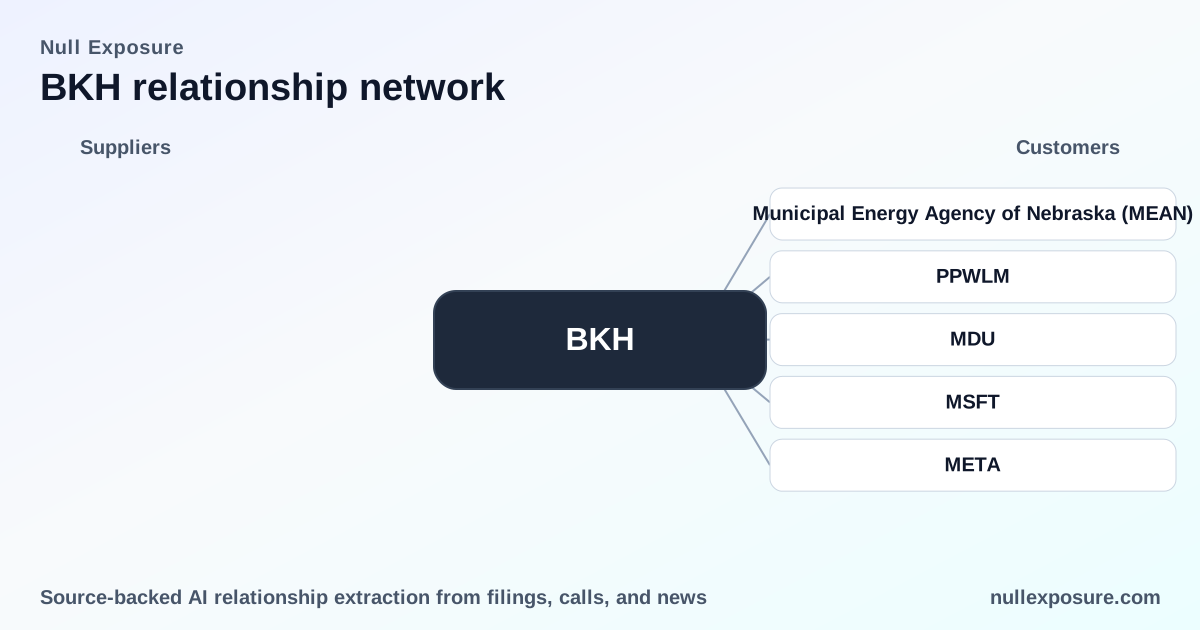
Black Hills Corporation (BKH): Customer Relationships and the Strategic Path to Powering Hyperscale Demand
Black Hills Corporation is a regulated natural gas and electric utility that monetizes through regulated tariffed service, long‑term wholesale power contracts, and merchant sales of excess generation. The company’s core revenue base is stable, rate‑regulated utility cash flows, while recent strategic expansion into data‑center and large‑load power services to hyperscalers creates a higher‑growth incremental revenue stream tied to large enterprise customers.
For a quick look at the coverage and counterparty map of Black Hills, visit https://nullexposure.com/ for the underlying sourcing and document-level tracing.
How Black Hills actually sells power — regulated foundations, plus bespoke large-load deals
Black Hills operates as the principal seller of electricity and natural gas across an eight‑state footprint. Regulated utility tariffs produce the steady, base earnings that underpin dividend coverage and predictable cash flow, while the company supplements that base through long‑term wholesale contracts and opportunistic short‑term sales of excess generation. According to Black Hills’ 2025 Form 10‑K, the Electric Utilities segment sells capacity and energy under long‑term agreements and also sells excess energy on a short‑term basis; the company bills retail customers monthly with typical payment terms and collects regulated returns established by jurisdictional regulators.
Contracting posture, concentration and criticality — company‑level signals investors should weigh
- Long‑term contracting is a structural feature. Black Hills discloses capacity and energy contracts that extend through 2031 and maintains long‑term wholesale sales arrangements with other load‑serving entities, which reduces volatility in generation revenue (per the FY2025 10‑K).
- Short‑term merchant sales coexist with long‑term agreements. Management also sells excess energy on short‑term markets, which provides upside but increases exposure to spot price cycles.
- Large enterprise counterparties are strategic growth drivers. Company disclosures and market reports link Black Hills to major data‑center clients and large industrial loads, creating concentration risk but material upside if Black Hills secures multi‑hundred‑megawatt commitments.
- Geographic concentration is domestic and regulated. All operations are inside the United States across eight states, so regulatory proceedings and state public utility commission decisions materially affect rate base recovery and returns.
- Contract-level materiality is limited. Black Hills states that fixed‑consideration contracts with expected duration of one year or more are immaterial to consolidated revenues, indicating no single non‑regulated contract currently dominates the financials.
- Relationship posture is seller and active. The company reports being the principal in its revenue contracts and serves over 1.37 million customers across gas and electric segments, signaling a diversified retail footprint beneath targeted large‑load deals.
Customer relationships that matter (documented evidence)
Municipal Energy Agency of Nebraska (MEAN)
Black Hills Wyoming owns 76.5% of a facility while MEAN owns the remaining 23.5%, establishing MEAN as an equity co‑owner rather than a pure off‑taker. According to Black Hills’ 2025 10‑K filing, this ownership split reflects a joint investment in generation capacity (FY2025 10‑K).
PacifiCorp (PPWLM) — Wyodak Plant arrangement
The Wyodak Plant is a 402.3 MW mine‑mouth coal‑fired facility at the Gillette Energy Complex that is jointly owned by PacifiCorp (80%) and South Dakota Electric (20%), placing Black Hills’ related South Dakota Electric business within a network of shared ownership and operational coordination (FY2025 10‑K).
MDU
South Dakota Electric’s ownership structure of the relevant Gillette power plant lists MDU as owning 25%, with South Dakota Electric holding 52% and the City of Gillette 23%; this positions MDU as a material equity partner in that generating asset (FY2025 10‑K).
Microsoft
Market reports and analyst coverage in May 2026 tie Microsoft to land purchases for a planned data center that will be served by Black Hills, signaling a customer relationship where Black Hills provides primary grid supply to a hyperscaler installation (InsiderMonkey May 2026; Investing.com May 2026).
Meta (formerly Facebook)
Public commentary and analyst notes describe specific agreements and blueprint installations with Meta, with Black Hills positioning its data‑center play to enable 100+ MW projects and replicate the Meta deployment model across its service territory (Markets FinancialContent May 2026; SahmCapital March 2026).
US Gold Corp (USAU) — CK Gold Project
US Gold Corp’s CK Gold feasibility releases state the project requires up to approximately 30 MW of power to be supplied by Black Hills Energy, delivered via a 115 kV transmission line, new substation, and 13.8 kV distribution network — a direct industrial off‑take commitment described in PR Newswire and technical coverage in May 2026 (PR Newswire May 2026; CruxInvestor May 2026).
(Each relationship summary above is sourced from either Black Hills’ FY2025 Form 10‑K or contemporaneous market and news reports published in 2026.)
What these relationships mean for investors
Black Hills remains a regulated utility first and a targeted large‑load service provider second. The regulated base provides low beta, steady dividends (the company’s dividend yield is reported at roughly 3.58%), while data‑center and industrial contracts offer incremental margin expansion and multi‑year demand visibility when structured as long‑term capacity and energy agreements. Analyst commentary and market reporting in 2026 attributes a re‑rating potential to the company’s expanding data‑center pipeline and customer wins with Microsoft and Meta, which could deliver concentrated earnings upside if Black Hills executes on interconnection and infrastructure projects.
Risks are concrete and measurable: regulatory outcomes across the eight‑state footprint determine allowed returns and cost recovery; concentration risk increases as hyperscaler business grows; and the company’s own disclosure that fixed consideration longer‑term contracts are immaterial suggests current non‑regulated wins are accretive but not transformational to consolidated revenue today. Investors should weigh stable regulated cash flows against the capital intensity and timeline of interconnection work required to deliver hundreds of megawatts to hyperscale clients.
Bottom line and next steps for due diligence
Black Hills is a traditionally conservative utility that is strategically leveraging its regional grid and generation assets to capture higher‑margin enterprise power contracts. That dual nature—stable regulated earnings plus optionality from hyperscaler and industrial supply—creates a clear investment thesis: defend the regulated base while watching for execution on large‑load projects to unlock valuation upside.
For the complete document trail and to track counterparty evidence in source filings and market reports, see https://nullexposure.com/.
Key takeaway: regulated revenues anchor the investment; hyperscaler and industrial customer relationships are the growth vector — monitor contract terms, regulatory approvals, and capital deployment timelines.