Bakkt (BKKT-WS) — Customer relationships that shape value and risk
Bakkt operates a regulated digital-asset platform that monetizes through custody, trading, and payments integrations, supplemented in recent years by divestiture of non-core loyalty assets and capital raises that include equity-plus-warrant deals. Investors should read Bakkt as a payments and infrastructure play that leverages strategic partners (card networks and payments processors) for distribution while using equity transactions and asset sales to manage capital and focus the business. For a concise overview of our broader coverage, visit https://nullexposure.com/.
How Bakkt earns the spread: payments, custody and selective exits
Bakkt’s revenue model combines transaction fees on trading and custody with payments processing and licensing for merchant integrations. The company has historically leaned on high-profile distribution partners—card networks and processors—to scale consumer access, and it has used asset sales (notably of its Loyalty business) and structured equity placements to reallocate capital and sharpen operational focus. The sale of loyalty assets and subsequent litigation over that sale are central to the current counterparty and execution risk profile.
What the relationship map tells investors about concentration and criticality
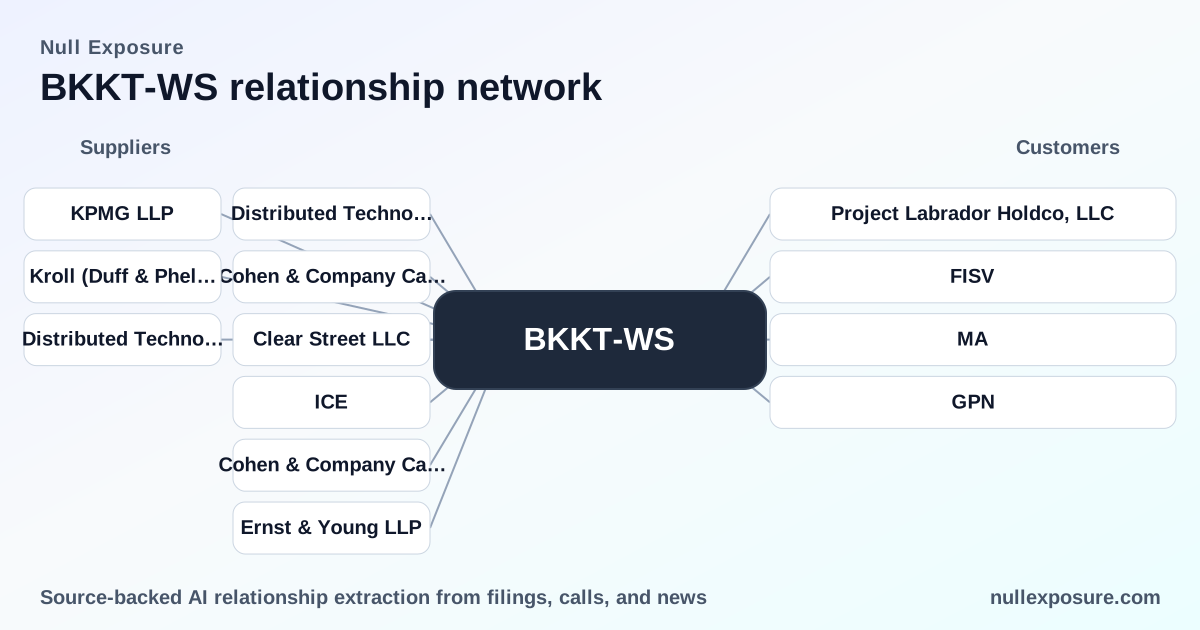
Bakkt’s partner set includes large payments incumbents (Mastercard, Fiserv, Global Payments) and strategic capital counterparts (Intercontinental Exchange). This network indicates commercial dependence on payments rails for scale, while the recent Loyalty sale shows the company willing to de-risk non-core operations through divestiture. The combination of long-standing commercial partnerships and recent transactional activity implies a mid-stage maturity: commercial product-market fit in payments and custody exists, but capital and execution dynamics are driving structural change.
- Contracting posture: The company uses both partnership agreements (distribution/integration) and M&A-style divestitures; litigation around a divestiture indicates counterparty enforcement risk in transactions.
- Concentration: Partnerships with a handful of large payments firms create strategic leverage but also single-point exposure if a partner relationship shifts.
- Criticality: Payments partners are operationally critical for consumer access and monetization; loss or material change to these relationships would have immediate revenue consequences.
- Maturity: Strategic partnerships dating to 2021 combined with 2025–2026 asset sales and capital transactions show a company transitioning from build-and-partner to portfolio optimization.
Relationship-by-relationship breakdown (plain English, source-linked)
Intercontinental Exchange, Inc. (ICE)
Bakkt agreed to sell up to 11,534,025 shares and accompanying warrants to an affiliate of Intercontinental Exchange under the same pricing terms as a broader placement, signaling ICE’s role as a strategic capital provider. According to Investing.com (UK, May 2026), this placement is part of Bakkt’s financing activity in FY2024 that links the firm to a major derivatives and exchange operator.
Project Labrador Holdco, LLC — announced buyer of Loyalty business
Bakkt announced a definitive agreement to sell its Loyalty business to Project Labrador Holdco, LLC, with the transaction expected to close in the third quarter of 2025; this sale represents a deliberate exit from loyalty operations to concentrate on core payments and custody services. The Financing/Company-Announcement was reported on Investing.com (Australia, May 2026) referencing FY2025 activity.
Project Labrador Holdco, LLC — transaction completion
On October 1, 2025, Bakkt Opco Holdings completed the sale of its loyalty and travel redemption business, including Bridge2 Solutions and Aspire Loyalty Travel Solutions, to Project Labrador Holdco, LLC, an affiliate of Roman DBDR Technology Advisors. The Globe and Mail reported this closing in a FY2026 item published in March 2026, confirming the operational transfer of those assets.
Roman DBDR Technology Advisors, Inc. — counterparty in litigation
Bakkt’s subsidiary filed a complaint in Delaware Superior Court alleging breach of contract by Project Labrador Holdco, LLC, a Roman DBDR subsidiary, with respect to the Loyalty Business sale completed on October 1, 2025. The legal filing and company update were summarized in Investing.com’s SEC-filings coverage (May 2026), making Roman DBDR a direct counterparty to litigation risk in FY2026.
Project Labrador Holdco, LLC — defendant in Bakkt complaint
The same Investing.com SEC-filings coverage (May 2026) identifies Project Labrador Holdco as the defendant in Bakkt’s Delaware Superior Court complaint alleging breach of contract tied to the October 2025 sale; this places Project Labrador at the center of a material post-closing dispute for Bakkt.
Fiserv
Market reports dating to October 2021 noted that Bakkt announced commercial deals with Fiserv that contributed to notable share movement, highlighting Fiserv’s role as an early payments-processing partner in Bakkt’s go-to-market. The 247wallstreet note (October 26, 2021) frames Fiserv as an important distribution ally in Bakkt’s earlier commercialization phase.
MA (ticker MA) — market shorthand for Mastercard
A 2021 market note referenced “MA” (Mastercard’s ticker) as a partner whose agreement with Bakkt drove investor enthusiasm, reflecting the importance of card-network relationships to Bakkt’s proposition. The 247wallstreet coverage (October 2021) records that association as a material positive in Bakkt’s narrative.
Mastercard
Bakkt announced deals with Mastercard that received prominent market attention and lifted investor sentiment in 2021; Mastercard’s involvement established credibility for Bakkt’s payments strategy and consumer reach. The same 247wallstreet piece (October 2021) highlights Mastercard as a foundational commercial partner in Bakkt’s payments rollout.
GPN (Global Payments, GPN)
Reports in early 2026 flagged potential contract changes with partners such as Global Payments, indicating that Bakkt’s operating relationships with processors remain active points of market sensitivity. A Meyka blog post (January 5, 2026) cited GPN in a pre-market note about Bakkt, suggesting operational dependency on payments processors during FY2026.
Global Payments
Coverage echoed potential contract changes with Global Payments specifically, underlining that processor-level agreements are part of Bakkt’s day-to-day commercial calculus and a vector for near-term revenue volatility. The same January 2026 Meyka article referenced Global Payments in connection with Bakkt’s partnerships and evolving contract landscape.
What investors should watch next
- Litigation outcome: The Delaware Superior Court action against Project Labrador/Roman DBDR is a binary operational and financial event that could alter expected proceeds or liabilities from the Loyalty sale; monitor filings and hearing schedules closely.
- Partner stability: Continued access to card rails and processors (Mastercard, Fiserv, Global Payments) is critical to distribution; any renegotiation or loss would materially affect transaction flow and revenue.
- Capital strategy: Equity-plus-warrant placements (ICE affiliate) reveal how Bakkt finances growth and operations; watch dilution dynamics and warrant terms for investor impact.
Bottom line
Bakkt’s customer and partner relationships show a company built through strategic alliances with payments incumbents and actively reshaping its asset base through sales and capital transactions. The loyalty divestiture and associated litigation are immediate execution risks, while continued reliance on major payment processors and networks creates concentrated operational exposure. For deeper, ongoing relationship monitoring and deal-level tracking, visit https://nullexposure.com/ for our platform coverage and investor tools.
Key takeaway: Bakkt is a payments-first digital-asset operator whose value trajectory will be decided by the resolution of its Loyalty sale dispute and the stability of its commercial ties to major payment processors and networks.