Booking Holdings (BKNG): Customer Relationships That Drive a Global Travel Marketplace
Booking Holdings operates a worldwide online travel marketplace that monetizes by facilitating travel and dining reservations through a portfolio of consumer-facing brands (Booking.com, Priceline, Agoda, Kayak, OpenTable, Rentalcars and others). The company earns commission and merchant margin revenue at the point of booking, holds material deferred merchant liabilities tied to prepayments, and converts global consumer demand into recurring revenue streams — Revenue TTM $27.7bn, Market Cap ~$128bn. For a concise investor brief on how we extract and surface counterparty signals like these, visit https://nullexposure.com/.
How Booking’s customer relationships translate into cash flow
Booking is a marketplace that sells distribution and payment facilitation to travel suppliers while selling travel to individual consumers. The firm captures value primarily in two ways: commission on agency bookings and merchant margin on transactions where it processes traveler payments. Company disclosures show deferred merchant bookings of $4.0bn at 2024 year-end, with the company expecting to complete performance obligations generally within one year — a structural signal that most commercial relationships are short-term and cash-centric. Merchant revenues are often transacted at the booking moment, a hallmark of a spot-oriented contracting posture.
These operating characteristics create several investor-relevant dynamics:
- Low contractual stickiness: Short-term, spot transactions increase churn risk but keep capital turnover high.
- High dependence on consumer demand: Counterparties are predominantly individual travelers rather than long-duration wholesale contracts.
- Global scale with FX exposure: The business generates the majority of revenue outside the U.S., making currency translation and regional demand critical to performance.
- Platform criticality: Booking’s marketplace is core to its revenue model, so integrations and third-party distribution deals materially affect near-term throughput.
The partner map you need to track now
Below I list every customer relationship flagged in the results and what it means for Booking’s distribution footprint.
SoundHound (SOUN) — OpenTable integrations into vehicle and TV voice commerce
SoundHound’s product announcements reference restaurant reservations powered by OpenTable, indicating that OpenTable is being embedded in in-car and connected-TV experiences to enable voice-activated bookings. This extension broadens OpenTable’s reach beyond traditional apps (Sahm Capital, January 2026; exclusive interview Dec 2025 — https://www.sahmcapital.com/news/content/ces-2026-soundhound-ai-unveils-agentic-voice-commerce-for-vehicles-and-tvs-with-ai-agents-that-order-food-make-dinner-reservations-pay-for-parking-and-book-tickets-on-the-go-2026-01-05 and https://www.sahmcapital.com/news/content/exclusive-soundhound-ai-ceo-on-2026-creating-an-ecosystem-where-innovation-can-scale-quickly-2025-12-31).
Uber (UBER) — In-app dining recommendations and OpenTable bookings
Multiple media reports describe Uber enabling curated dining recommendations with the option to book via OpenTable inside its app, representing an important distribution partnership that places Booking’s dining booking product inside a major mobility ecosystem (The Courant and PhocusWire coverage, April–May 2026 — https://www.courant.com/2026/04/29/uber-hotel-bookings/ and https://www.phocuswire.com/news/technology/uber-hotel-booking-expedia-group). Embedding OpenTable in Uber funnels high-frequency urban consumers directly into Booking’s reservation ecosystem.
WeShop (WSHP) — Consumer transition into online travel providers
WeShop’s SEC registration filing describes a user flow that seamlessly transfers shoppers into online travel providers such as Booking.com and Expedia, which implies Booking’s channels are active targets for third-party commerce platforms looking to add hotel inventory without direct contracting (Form F-1, FY2025 — https://www.sec.gov/Archives/edgar/data/2048271/000149315225018485/formf-1.htm).
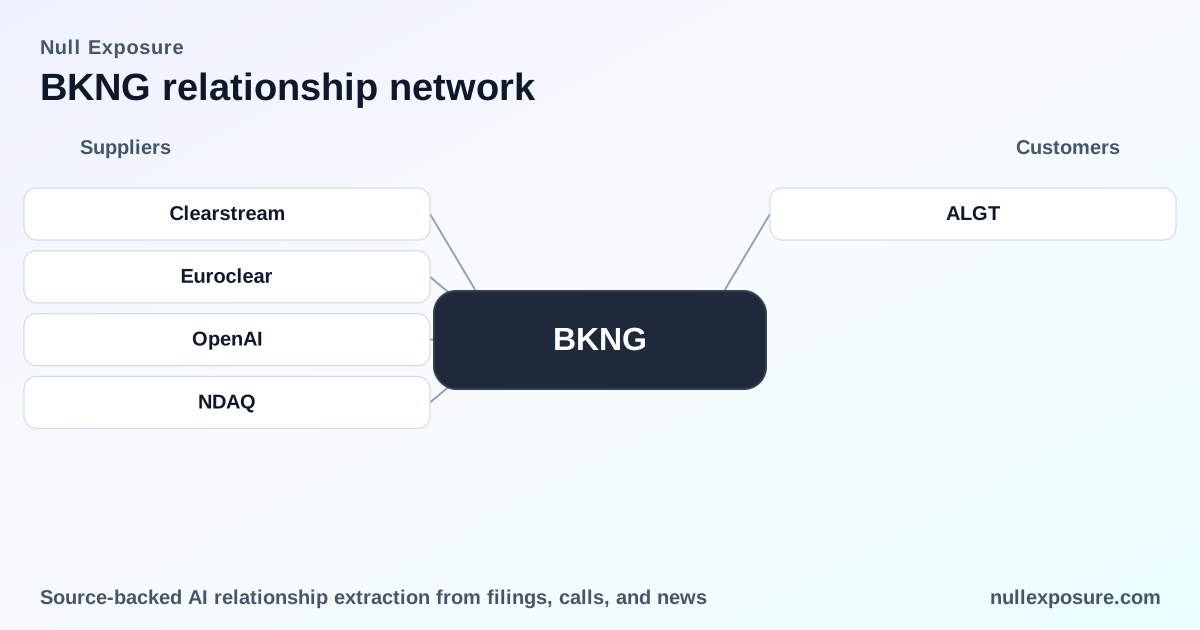
Allegiant Hotels / ALGT — Agoda’s Rocket Travel powering partner hotel platforms
Market reporting notes Rocket Travel by Agoda powers partner hotel platforms including Allegiant Hotels, enabling airline loyalty members to earn and redeem points on hotel stays; this underscores Agoda’s role within Booking’s brand portfolio as a white-label distribution engine for travel partners (StockTitan coverage, March 2026 — https://www.stocktitan.net/news/BKNG/page-26.html).
Why each relationship matters strategically
Each of these connections highlights a distinct route-to-consumer:
- Platform embedding (SoundHound, Uber) increases booking frequency by meeting customers inside other apps and devices, expanding reach without proportional incremental marketing spend.
- White-label distribution (Agoda/Rocket Travel) converts third-party inventories and loyalty programs into Booking revenue without owning underlying hotel assets.
- Commerce-to-travel funnels (WeShop) create cross-category acquisition pathways that feed the core lodging and dining businesses.
All of these flow into Booking’s short-term, high-volume revenue engine and amplify the company’s ability to monetize consumer transactions at the time of booking.
Operational constraints and what they imply for investors
Company-level signals from filings and disclosures provide a clear operating profile:
- Contracting posture: short-term and spot — Deferred merchant bookings and merchant revenue recognition at time of booking indicate most obligations complete within a year and transactions are often spot.
- Counterparty type: individual consumers dominate revenue generation, making demand elasticity and consumer confidence central to performance.
- Geography: global concentration outside the U.S. — A substantial majority of results are generated internationally, introducing currency and regional demand risk.
- Materiality: the marketplace role is critical — Booking derives substantially all revenue from online travel reservation services, so partner integrations and distribution channels materially affect financial throughput.
- Relationship role and segment: principally a seller of services to consumers, while intermittently acting as buyer in merchant arrangements.
These constraints signal high revenue cyclicality linked to travel demand, foreign exchange sensitivity, and operational reliance on integrations to sustain growth.
Key monitoring checklist for investors
- Track expansion of OpenTable integrations into mobility and voice platforms (Uber, SoundHound); these are high-leverage distribution plays.
- Watch deferred merchant bookings and the split between merchant and agency revenue to assess cash timing and margin mix.
- Monitor Agoda’s white-label partnerships and their contribution to revenues outside owned-brand bookings.
- Follow regional demand trends and FX translation impacts given the company’s outside-U.S. revenue majority.
- Assess competitive dynamics as non-travel platforms incorporate hotel and restaurant bookings, increasing distribution competition.
For a structured feed of counterparty intelligence that maps these relationships directly to financial signals, visit https://nullexposure.com/ to learn how these insights are assembled.
Bottom line
Booking’s customer relationships are not passive supplier lists — they are active distribution conduits that scale consumer reach and convert in-the-moment demand into revenue. The company operates a short-term, spot-oriented marketplace with high global exposure and critical dependence on consumer flows and partner integrations; partnerships with Uber, SoundHound, WeShop and Allegiant/Agoda materially augment that distribution engine. For investors, the lens on Booking should focus less on long-term supplier contracts and more on channel expansion, transaction economics at booking, and macro demand drivers.