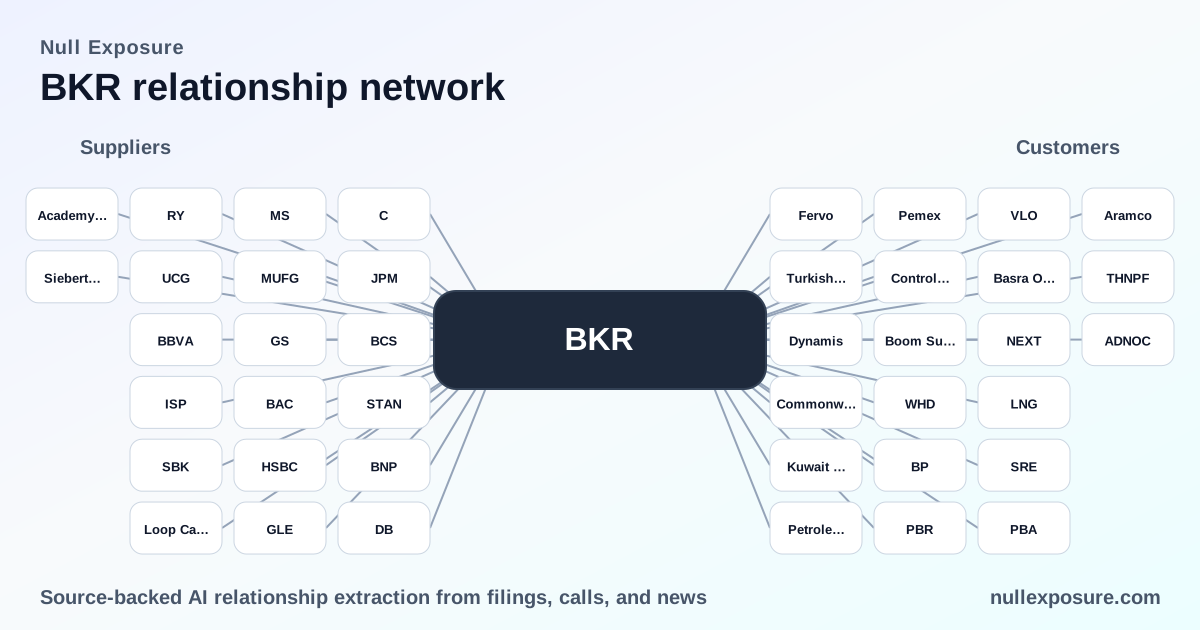
Baker Hughes (BKR): Customer relationships that drive capital intensity and recurring revenue
Baker Hughes is an energy-technology company that monetizes through the sale and long-term service of capital equipment, engineered systems, aftermarket services, and digital licenses to the oil & gas and broader energy sector. Its business model combines large equipment orders and long-duration aftermarket service agreements with recurring digital and field services revenue, creating a high-capex, high-contract-value profile that supports predictable installed-base cash flows and commodity‑linked project bookings. For a concise map of client exposures and contract types, visit https://nullexposure.com/.
What this relationship map tells an investor
Baker Hughes’ customer list in recent filings and press activity shows a dual revenue engine: large, one-off equipment awards that drive near-term bookings and multiyear service and framework agreements that underpin recurring aftermarket margins. The company operates with broad geographic exposure, a high proportion of long‑term and framework contracts, and significant counterparty concentration with national oil companies and global majors — dynamics that both stabilize cash flows and concentrate operational risk.
Key operating signals:
- Contracting posture: Predominantly long-term, framework, and licensing models alongside equipment supply and aftermarket service agreements (company disclosures covering contract types).
- Counterparty mix: Large enterprises and sovereign/state-owned oil companies are prominent customers, indicating high strategic criticality but also political and payment risk.
- Geography and scale: Global coverage with material receivables in North America and the Middle East; bookings and RPO measured in tens of billions point to order-size concentration.
- Segments and spend: Revenue derives from both manufacturing of bespoke equipment and field services; observed order sizes and RPO place many relationships in the >$100M spend band.
- Maturity and materiality: Many customer relationships are mature and contractual; customer payment performance is a recognized material operating risk in filings.
If you want to explore this coverage interactively, see the relationship hub at https://nullexposure.com/.
Customer relationships (concise, complete list)
Below are the companies named in Baker Hughes’ recent results and news, each with a one- to two‑sentence plain‑English description and the source.
Kuwait Oil Company
Baker Hughes reported approximately $1 billion of multiyear contracts that included Kuwait Oil Company in the 2025 Q4 earnings call, reflecting large-scale, multiyear project exposure. Source: Baker Hughes 2025 Q4 earnings call (March 2026).
Turkish Petroleum
Baker Hughes will supply integrated subsea production and intelligent completion systems for the Sakarya gas field third phase under a contracted award disclosed in the 2025 Q3 earnings call. Source: Baker Hughes 2025 Q3 earnings call (March 2026).
Controlled Thermal Resources
Baker Hughes signed a collaboration agreement for the 500 MW Hell’s Kitchen geothermal project in California, advancing its geothermal equipment and services pipeline. Source: Baker Hughes 2025 Q3 earnings call (March 2026).
Dynamis
The company secured a material award from Dynamis to supply mobile power generation for North American oil and gas operations, highlighting Baker Hughes’ portable power capability. Source: Baker Hughes 2025 Q3 earnings call (March 2026).
Fervo
Baker Hughes has multiple contracts to design and deliver equipment for five ORC power plants at Fervo’s Cape Station project, noted in both 2025 Q3 and Q4 commentary. Source: Baker Hughes 2025 Q3 and Q4 earnings calls (March 2026).
Commonwealth LNG
Baker Hughes is providing liquefaction technology for Train 5 at NextDecade’s Rio Grande LNG and Commonwealth LNG’s export terminal as part of large LNG equipment awards. Source: Baker Hughes 2025 Q4 earnings call (March 2026).
Pemex
Baker Hughes reported continued demand for downstream chemical solutions from Pemex to manage crude quality challenges—an aftermarket and solutions sale. Source: Baker Hughes 2025 Q3 earnings call (March 2026).
Petroleum Development Oman
Included in the company’s disclosure of approximately $1 billion of multiyear contracts in Q4 2025 alongside Kuwait Oil Company and ADNOC. Source: Baker Hughes 2025 Q4 earnings call (March 2026).
Petrobras (and PBR / PBR-A)
Baker Hughes signed a 60‑month service agreement supporting turbomachinery across Petrobras’ offshore assets and a major Brazilian refinery, and also announced a frame agreement for up to 50 subsea trees in offshore Brazil. Sources: TradingView / Zacks reporting (May 2026) and Baker Hughes 2025 Q3 earnings call (March 2026).
Boom Supersonic
Baker Hughes agreed to supply BRUSH power generation electric generators to Boom Supersonic for AI data center infrastructure, illustrating diversification of power products into non‑traditional energy customers. Source: Sahm Capital / company news (March 2026).
Crane Company (CR / CR-W)
Baker Hughes completed the sale of its Precision Sensors & Instrumentation (PSI) product line to Crane for roughly $1.06–$1.15 billion, closing January 1, 2026. Source: Baker Hughes press release and Crane earnings commentary (Jan–May 2026).
Venture Global (VG)
Venture Global previously received midscale liquefaction trains and compressor skids from Baker Hughes, shipped from Avenza, Italy, delivered ahead of schedule in reporting cited from 2020. Source: Rigzone (Nov 2020).
Tamboran (TBN)
Baker Hughes deployed anti‑vibration drilling technology and signed a preferred services agreement to deliver oilfield services in Australia’s Beetaloo Basin. Source: Rigzone / Proactive Investors (Oct 2025; 2026 reporting).
Cactus / WHD / Cactus UK Holding Limited / Cactus Companies
Baker Hughes sold 65% of its Surface Pressure Control joint venture to Cactus for $344.5 million (closing Jan 1, 2026), transferring a majority interest in that business. Source: Stocktitan / company filings (Mar 2026).
BP
Baker Hughes secured a long‑term aftermarket services contract with BP for the Tangguh LNG facility in Indonesia, representing recurring service revenue. Source: Baker Hughes 2025 Q3 earnings call (March 2026).
Valero (VLO)
Baker Hughes signed a five‑year extension to provide hydrocarbon and water treatment products and services across Valero’s North American and U.K. refineries. Source: Baker Hughes 2025 Q3 earnings call (March 2026).
NextDecade (NEXT)
Baker Hughes disclosed equipment supply for Train 4 of NextDecade’s Rio Grande LNG and other LNG train awards across prior quarters. Source: Baker Hughes 2025 Q3 and Q4 earnings calls (March 2026).
Sempra / SREA / SRE
Baker Hughes secured equipment orders for Sempra’s Port Arthur Phase 2 (Trains 3 and 4), a multi‑hundred‑million dollar equipment exposure. Source: Baker Hughes 2025 Q3 earnings call and historical reporting (2021–2026).
Aramco
Baker Hughes won a major multi‑year award from Aramco to expand coiled tubing drilling operations in Saudi Arabia, reflecting strategic Middle East exposure. Source: Baker Hughes 2025 Q3 earnings call (March 2026).
Cheniere (LNG)
The company has long‑term service agreements covering Cheniere’s Corpus Christi Trains 8 and 9, demonstrating recurring LNG aftermarket service commitments. Source: Baker Hughes 2025 Q4 earnings call (March 2026).
Pembina Pipeline (PBA)
Baker Hughes extended an agreement to support upgrades on the Alliance Pipeline in North America, adding services revenue in the midstream space. Source: Baker Hughes 2025 Q3 earnings call (March 2026).
Technip Energies (THNPF)
Baker Hughes booked a major order with Technip Energies for the Blue Point #1 ammonia project in Louisiana, reflecting utility/industrial project exposure. Source: Baker Hughes 2025 Q3 earnings call (March 2026).
Basra Oil Company (BOC)
Separately noted industry reporting shows KBR winning a Majnoon contract; included here because it appeared in the relationship results feed, but Baker Hughes’ involvement was not the primary subject of that report. Source: JPT / industry news (March 2026).
Solaris / SEI
An assumption agreement transferred Baker Hughes turbine slots (30 turbine delivery slots for ~500 MW) to Solaris via Colusa Power Infrastructure Partners, indicating secondary market movement of capacity slots. Source: The Globe and Mail / press release (May 2026).
Net Power (NPWR)
Net Power’s strategic partnerships include Baker Hughes as a development partner, providing technical support and capital relationships in decarbonized power projects. Source: MarketBeat / company commentary (2025–2026 reporting).
ANNA
ANNA’s 2024 10‑K referenced Baker Hughes among vendors for drilling, logging, and well services, showing operator procurement ties at the equipment and services level. Source: ANNA 2024 10‑K (filed Dec 2024).
Investment implications and risk checklist
- Revenue mix: Large capital equipment awards drive bookings volatility while long‑term aftermarket and framework agreements provide steady installed‑base cash flows.
- Counterparty concentration: Material exposure to national oil companies and multi‑decade projects increases geopolitical and payment risk; however, these contracts are also high‑margin and strategically sticky.
- Contract types: The firm operates with long‑term, framework, licensing and subscription models across manufacturing and services — a diversified contracting posture that supports annuity revenue.
- Operational leverage: Manufacturing lead times and global project delivery are critical; any execution delays on subsea trees, LNG trains or turbomachinery can meaningfully affect revenue recognition and margins.
- Spend band: Orders and RPO point to many relationships in the >$100M class, implying order concentration and meaningful near‑term revenue impact from a small number of clients.
Bottom line
Baker Hughes’ customer list is a purposeful mix of sovereign majors, global integrated oil companies, independent LNG developers, and industrial power players that together produce large-ticket bookings and durable aftermarket cash flows. Investors should value the stock against the twin realities of high contract concentration and predictable installed‑base service economics. For a navigable view of these relationships, visit https://nullexposure.com/ for further analysis and visual maps.